


09 Apr The Art-driven Home
Architecture | CLB Architects
Construction | OSM Construction
Interior Design | WRJ Design
Landscape Architecture | HDL
The concept of prospect and refuge is a crucial one that is expressed in architecture the world over, from urban homes organized around quiet private courtyards to those perched on the edge of the wilderness. In the pristine wild spaces of the American West — where architecture typically celebrates and immerses in the extraordinary landscapes while also seeking protection from the elements — the principle of prospect and refuge should be the starting point of any significant home of intention.
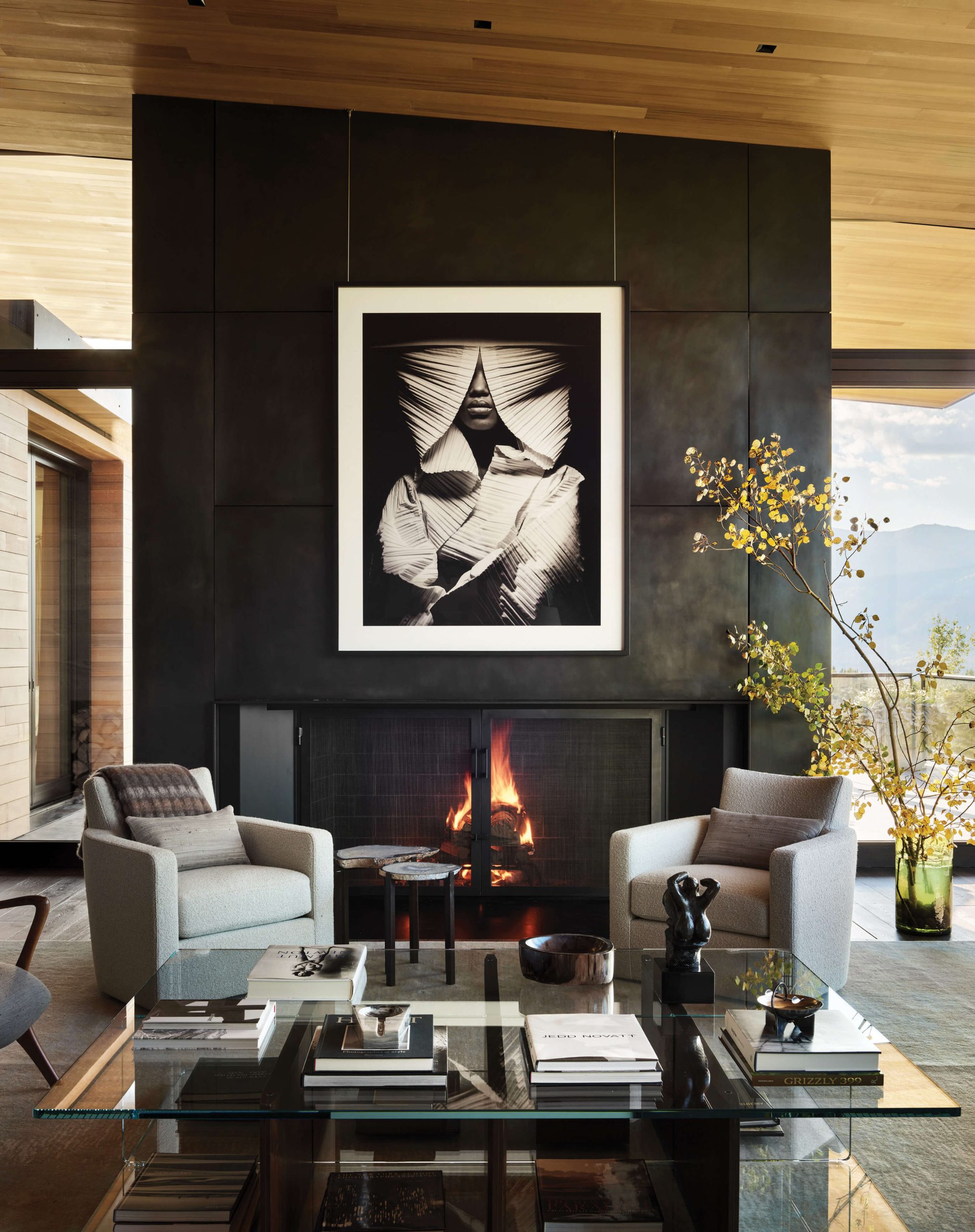
Of equal importance to the views and architecture was the client’s art collection, which includes works by Andy Warhol and Henri Matisse and a stunning collection of photographs, many of which were bequeathed to the wife by her late brother. Says WRJ Design’s founding partner and creative director Rush Jenkins, “An art collection of this scale requires an unusual level of care and expertise. Drawing from my time as director of design for Sotheby’s New York and working closely with the homeowner, we created interiors where furnishings and decor are in clear dialogue with the artworks.”
For a generational home conceived for a family with several decades of lived experience in Jackson, Wyoming, the architects’ prospect-versus-refuge balancing act would be informed by an additional factor: a world-class art collection. And this is how Andy Ankeny of CLB Architects, Rush Jenkins of WRJ Design, and Bonny Hershberger of HDLA (formerly Hershberger Design) found themselves designing a home around two existing collections of paintings, sculptures, and photographs (and even a classic motorcycle), as well as a monumental work-in-progress that would serve as the project’s touchstone. It was OSM Construction’s task to turn vision into reality.
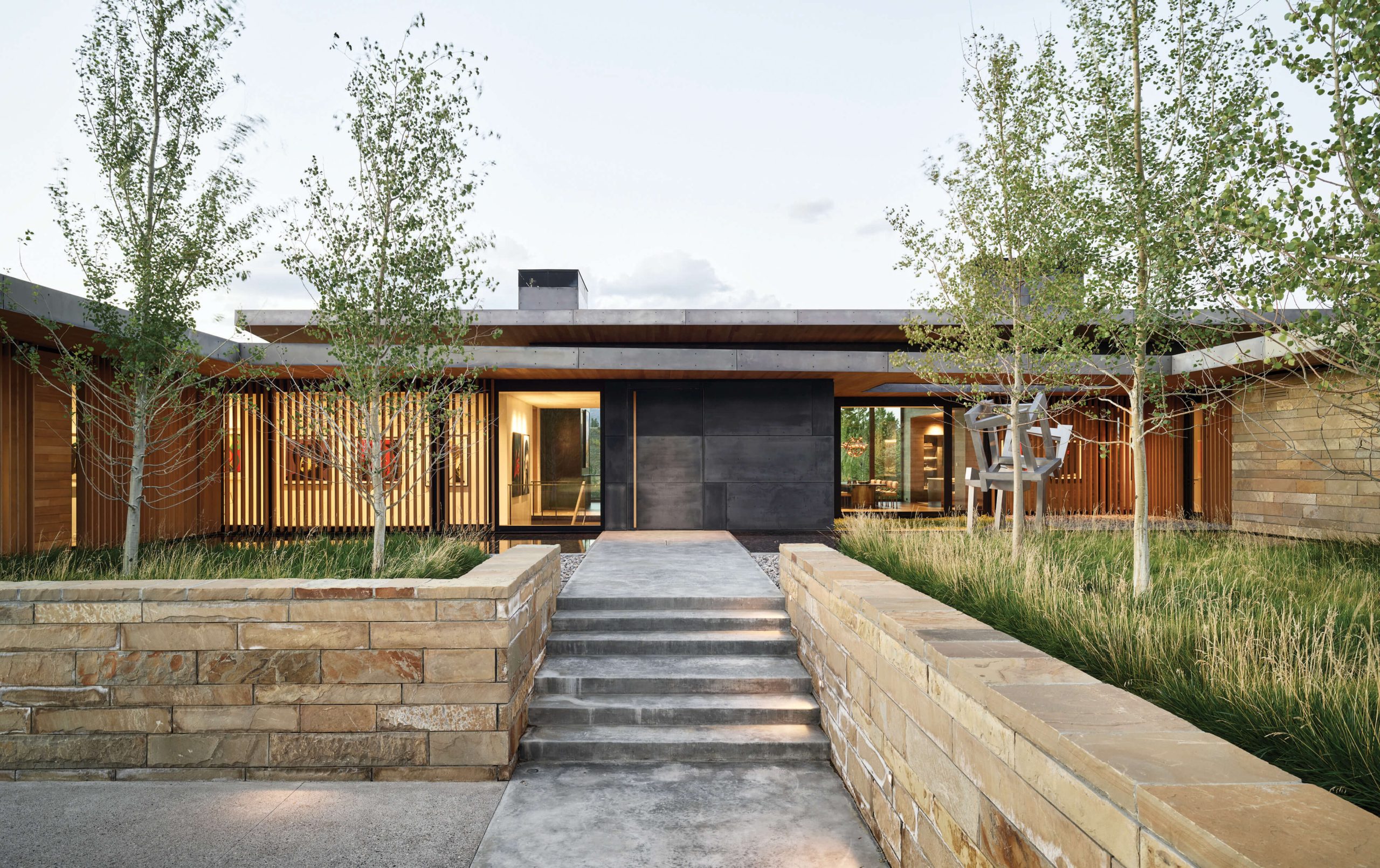
The house has moments of transparency beginning at the approach.
“Projects of this caliber are always highly collaborative,” says Mark Pollard, president and CEO of OSM. “The design team and owners brought forward a very ambitious vision, and our role as the builder was to help translate that vision into something that could be successfully executed in the field. That meant working closely with the architects, interior designers, and owners throughout construction to evaluate how certain ideas could be built, what challenges the site or materials might introduce, and how we could achieve the design intent while respecting the realities of construction in Jackson’s environment. It is a process that requires experience, craftsmanship, and constant dialogue.”
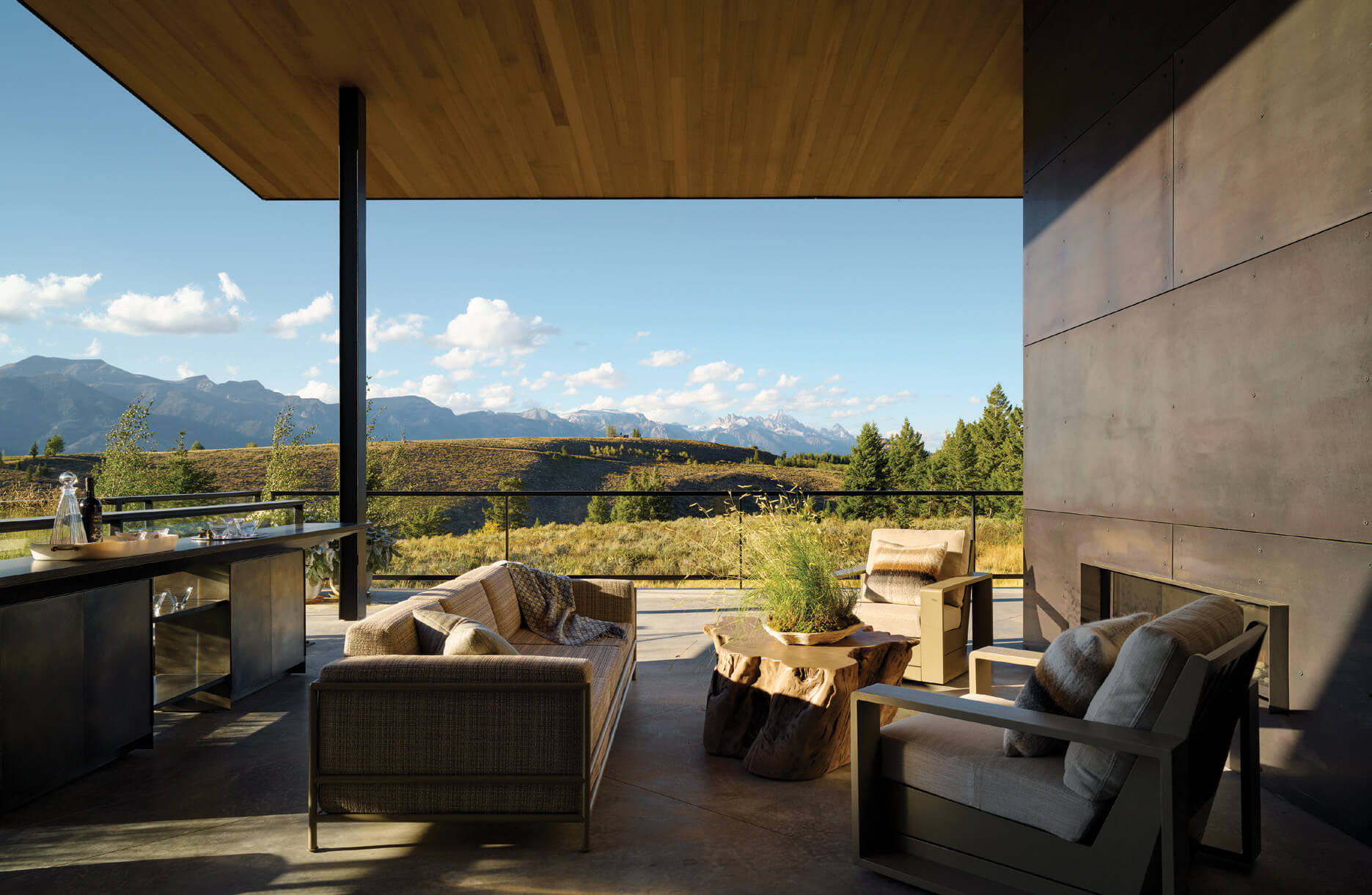
A sheltered outdoor entertaining area further embraces the twin aims of prospect and refuge.
“The home sits at the top of a butte outside Jackson, which meant the site was fully exposed to the elements,” he adds. “Wind, snow, and freeze conditions are part of building in the Tetons, but the geology of the site added another layer of complexity. Portions of the foundation were set directly on rock, while other areas were over wind-deposited silts that required helical piers to properly support the structure. Coordinating those different conditions required close collaboration between engineers, subcontractors, and our field team to ensure the home was anchored appropriately while still respecting the precise siting envisioned by the design team.”
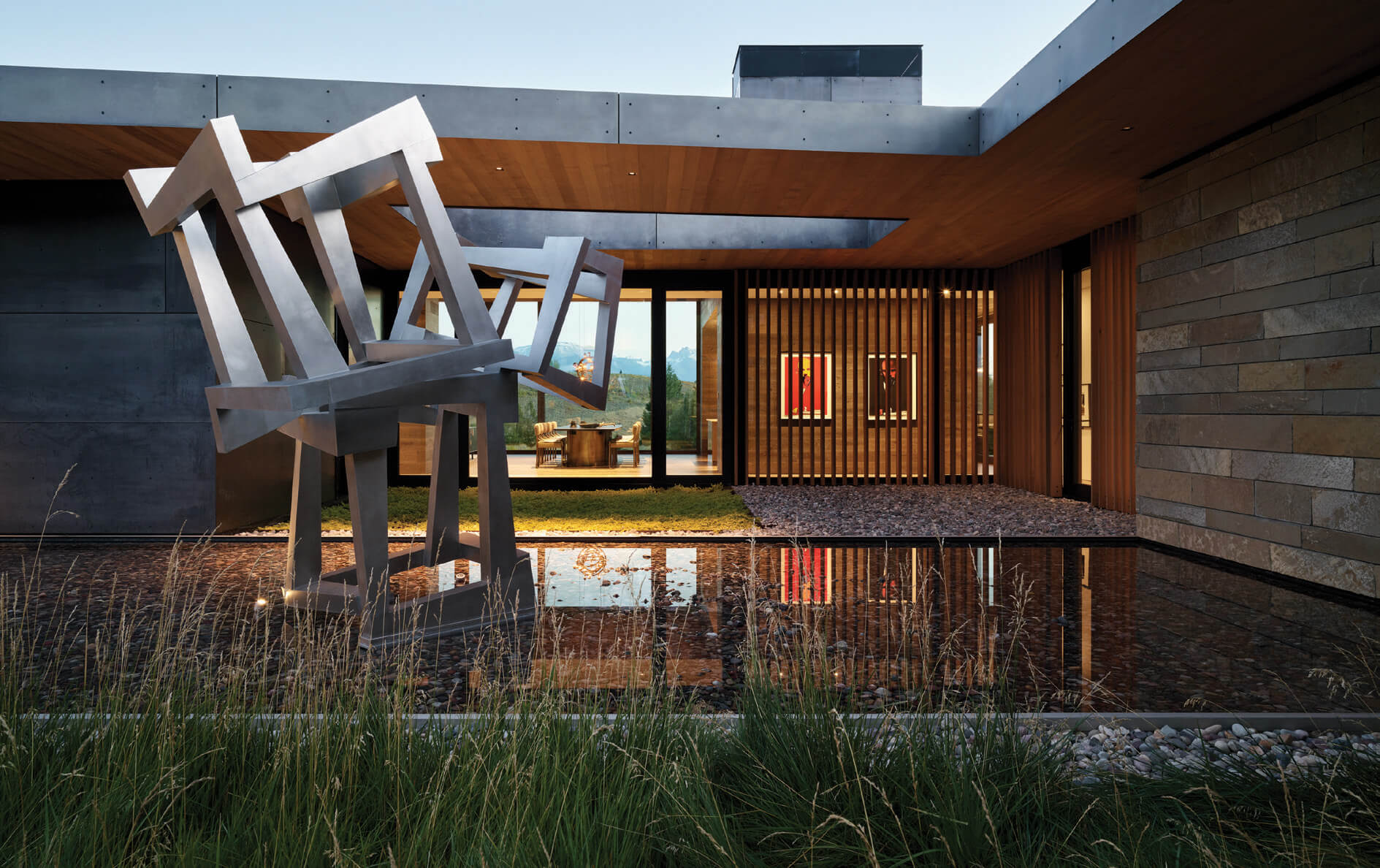
The experience of the home is defined on one side by Teton views and on the other by a striking, site-specific sculpture by internationally recognized artist Jedd Novatt, a friend of the owners. The piece is reflected in a water feature designed by landscape architects HDLA. “The placement had to work on multiple levels, aligning with the approach to the house, the views as you arrive at the front door, and the interior sightlines from within the home itself,” Pollard says. “At the same time, the sculpture needed to sit precisely within the water feature in terms of depth, elevation, and structural support. Achieving that required close coordination with the artist and design team, but much of the final problem-solving happened in the field. Our site superintendent, Kris Kasbaum, worked closely with everyone involved to carefully work through those details and ensure the piece ultimately sat exactly where it needed to.”
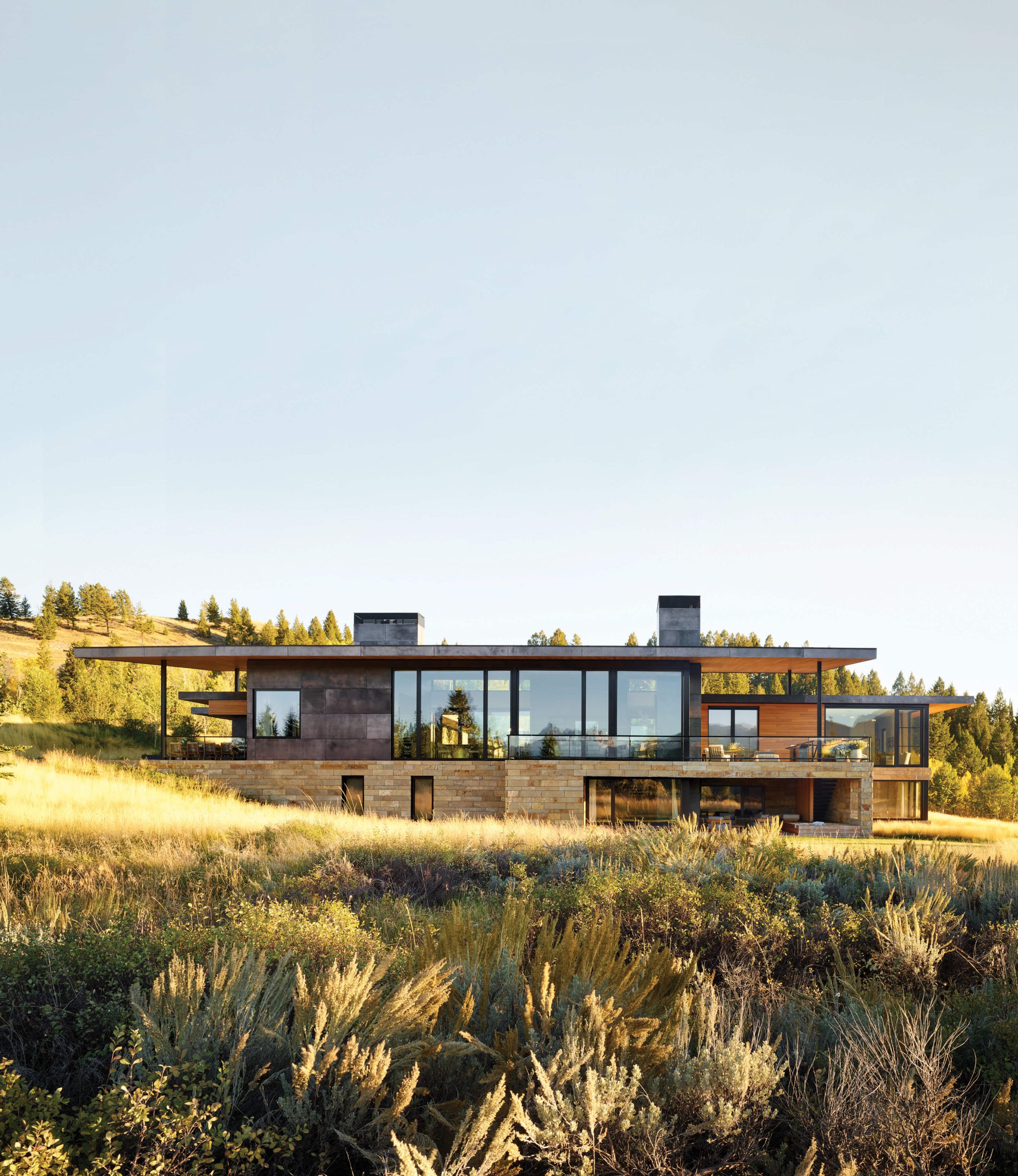
The architects’ plan would rest lightly on the ground from the approach; they would use the land’s natural contours to nestle into the windswept hillside site while opening up to views of the Teton and Gros Ventre mountain ranges to the north and east. Meanwhile, internationally recognized sculptor Jedd Novatt, a friend of the owners, was designing a site-specific work around which the house would be organized. The house, the sculpture, the art collection, and the land would each be given equal weight, each informed by the others, and each speaking to the next. The end result is an eloquent statement of harmony and appropriateness, a natural outcome of a holistic approach from a like-minded group of talented creative professionals rooted in the West.
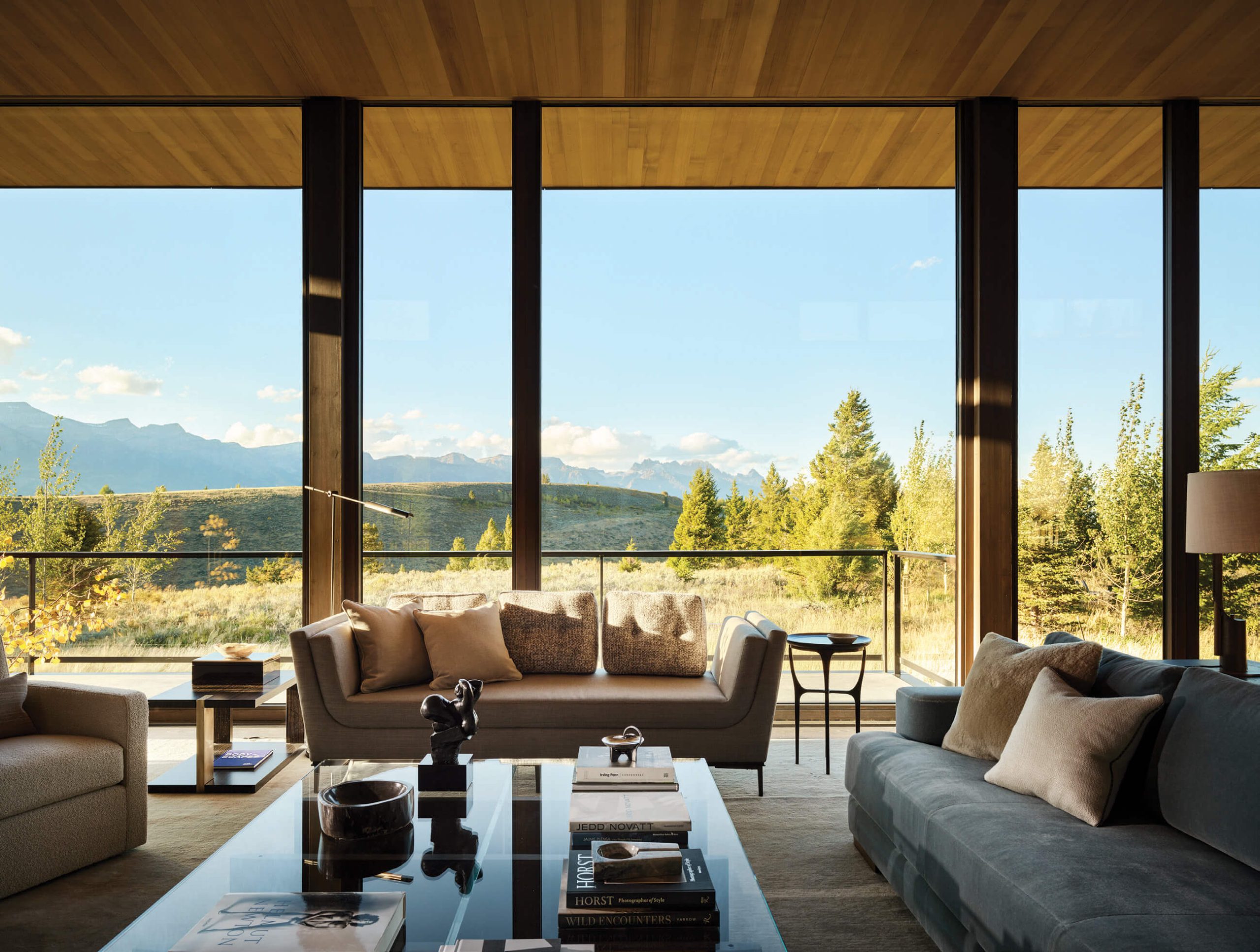
Throughout the home, says Jenkins, “We wanted furnishings that would have great form, craftmanship, and beauty, and stand the test of time.” He combined sofas from Holly Hunt and McEwen with lounge chairs from Holly Hunt and Vladimir Kagan. The cocktail table is Hellman-Chang; the wool area rug is from Fort Street Studio.
The 35-acre site, explains Ankeny, is both dramatic and exposed. “Even though it was a rugged, expansive hilltop site, there was a large flat area and some contours where you could nestle the house. There were mature trees, as well as sagebrush, rock outcroppings, conifers, aspens, and amazing views. It’s on the crest of a hill, both windy and rugged. The outstanding views were the selling point, and they were outstanding, but we could tell it was going to take a dedicated siting effort to make the house feel like it fit gracefully on this ridge.”
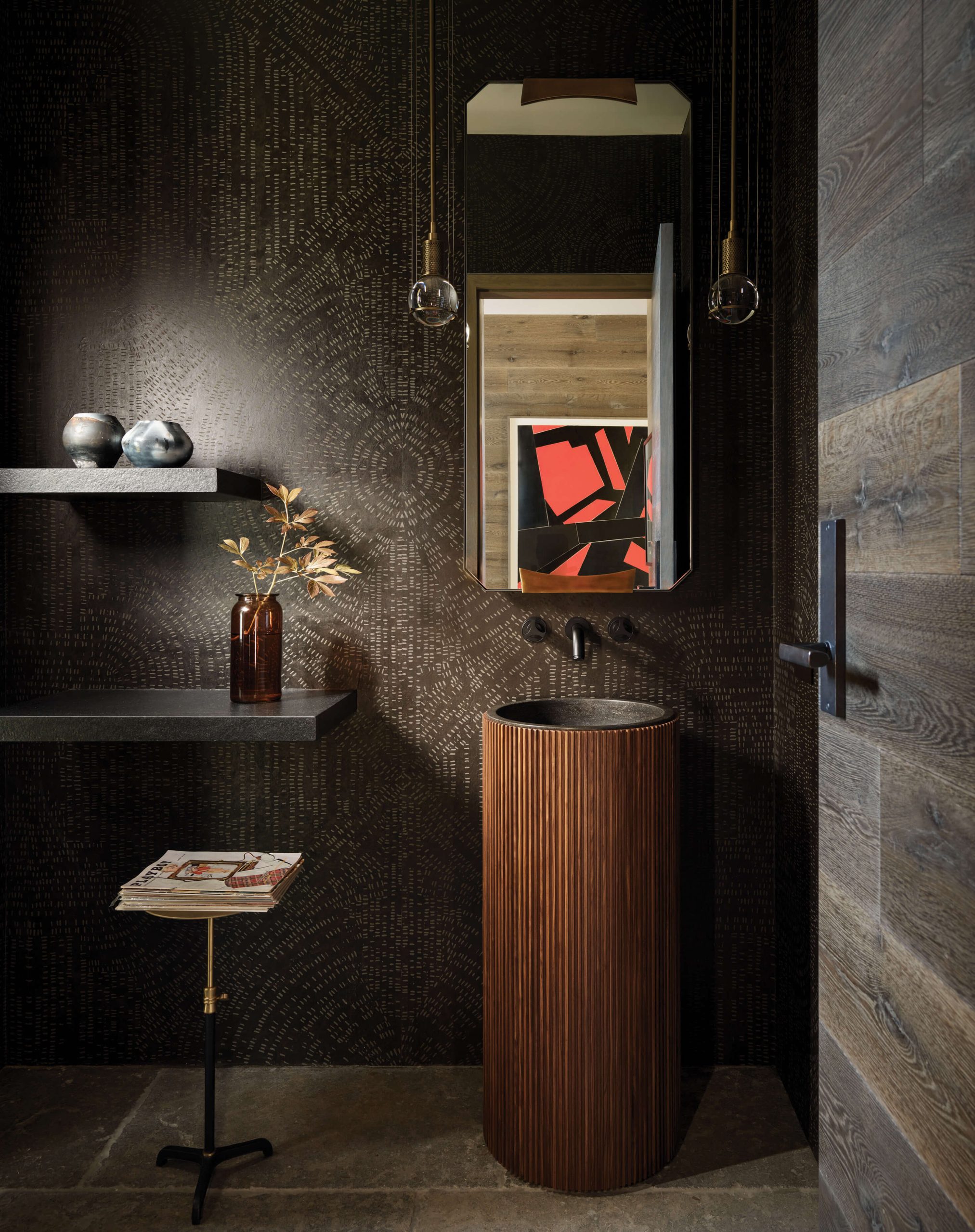
Gregorius Pineo wallpaper sets the tone in the moody powder room.
From the approach, the home’s volume is minimized, tucked into the hillside’s rolling meadows and, on the west side, snugged up near the edge of a mixed forest. Its combination of flat and shed roofs — the shed roof covering the main volume of living room, dining room, and kitchen lifting up to the south, away from the view, to admit as much of the warm southern light as possible — pairs well with its restrained materiality, which further roots the project in its context.
Cedar and blackened stainless steel volumes rise from a base of linear-cut sandstone, echoing the textures and tones of the surrounding landscape. “The house emerges from a rocky crest on this hill, so we wanted the base language to be very robust,” Ankeny says. “Frontier sandstone from Montana was sawn into coursing for a more modern interpretation of rustic stonework. It evokes that unfolding from the landscape, but also provides durability in wind and snow and rain.” The metal-clad chimneys act as vertical elements and visually anchor the home. Inside, warm western red cedar and hemlock complement floors of limestone and white oak. On the view side of the living area, floor-to-ceiling glazing runs the length of the space.
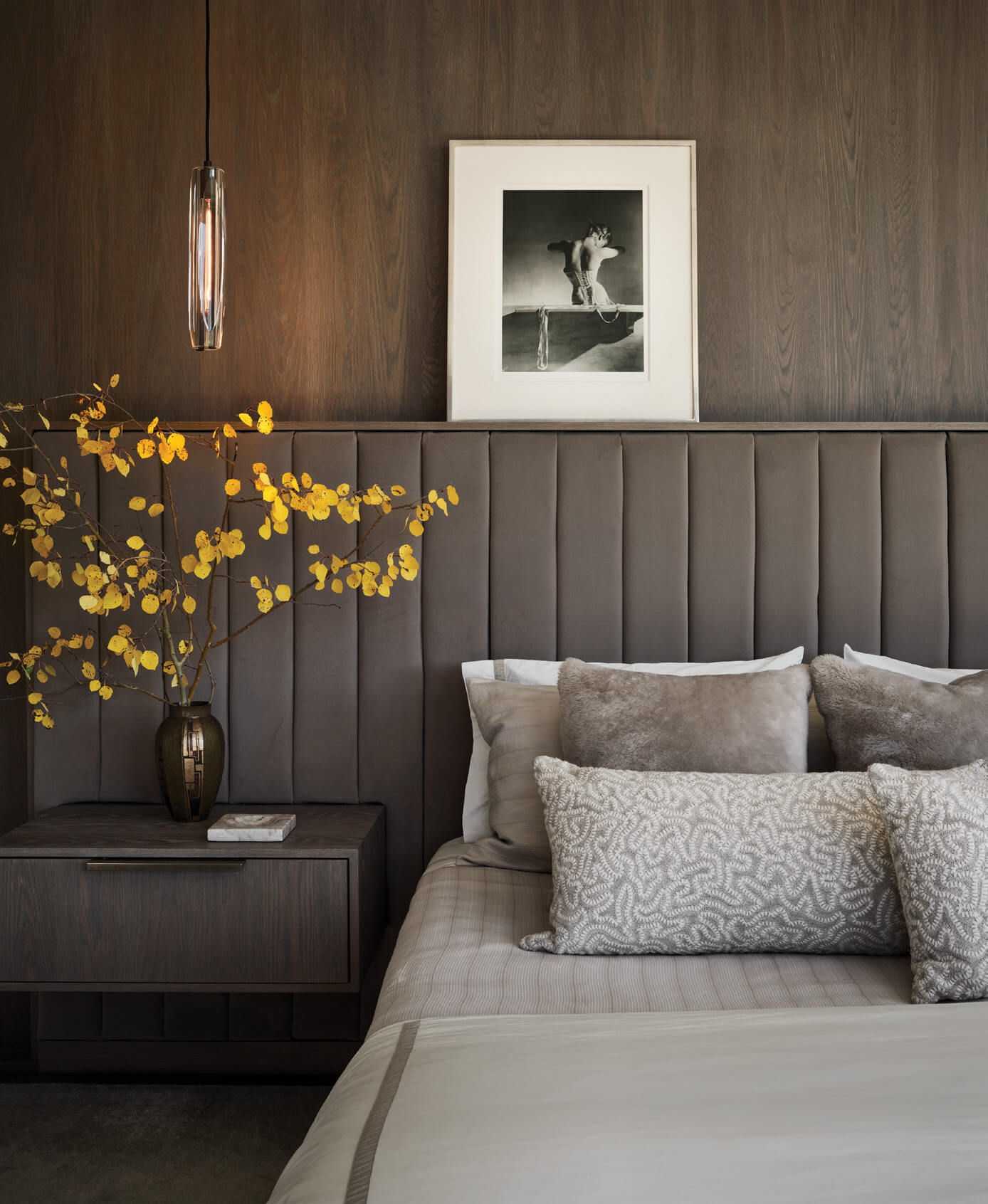
The primary bedroom presents a soothing neutral palette, with an integrated headboard designed by WRJ, a Carlyle Collective side table, and a Jonathan Browning pendant.
The arrival sequence is carefully orchestrated. After following a winding, undulating road to the parking court, a journey designed by Hershberger, guests are drawn to the entry by the Novatt sculpture, a series of stacked, intersecting, and overlapping asymmetrical square shapes rendered in stainless steel. This rests off to one side within a shallow reflecting pool lined with river rocks. Guests then cross a bridge to a front door set beneath deep overhangs with wood soffits, one span of which is punctured by a large cutout that echoes the sculpture’s geometry. A scrim of slatted wood louvers yields glimpses of the art; the significance of the collection only becomes evident once inside the gallery-like foyer, which serves to guide circulation through the main part of the house.
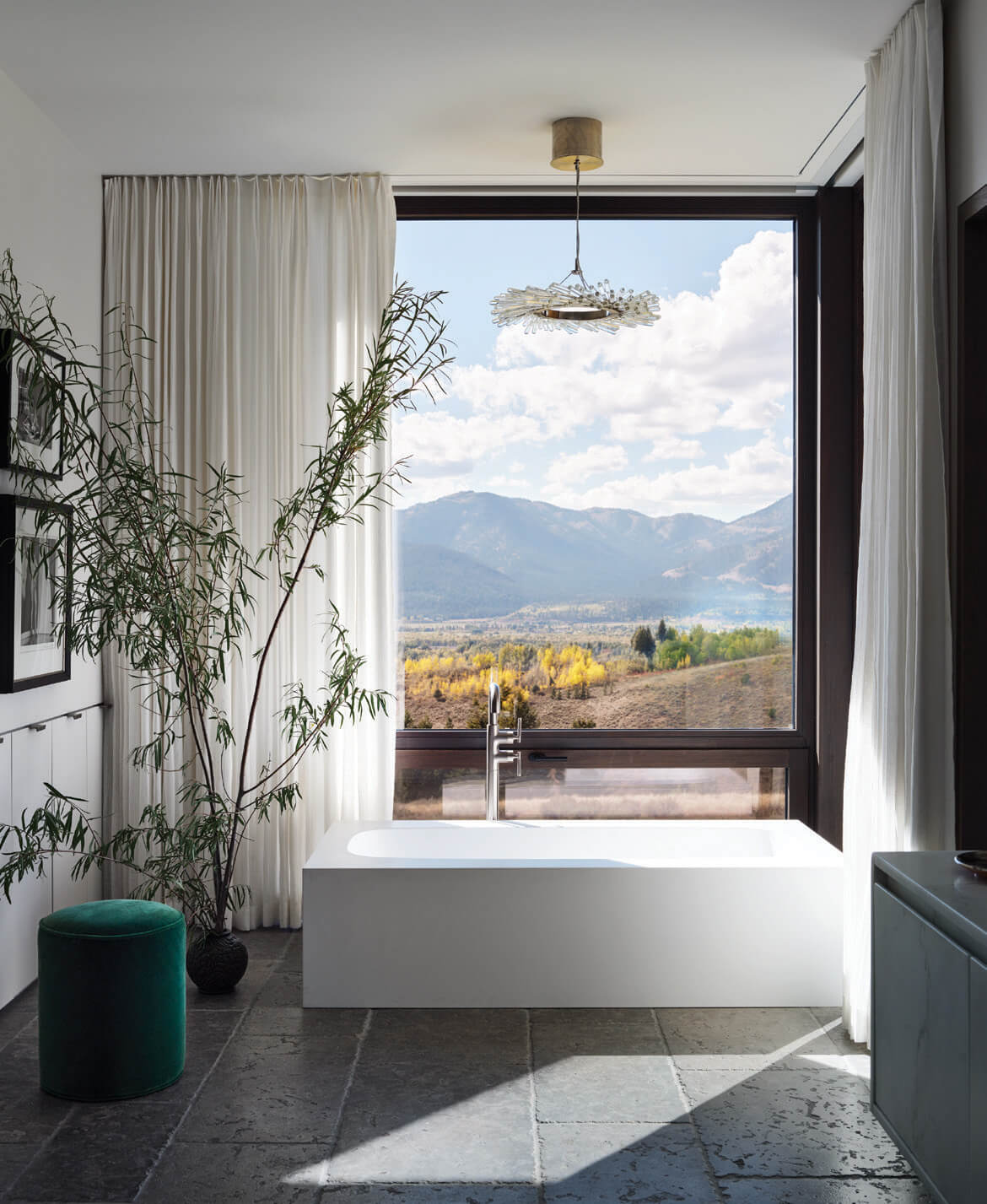
Carefully framed views — accented here by a Hersh Design pendant and Loro Piana linen drapes — are a feature throughout the house.
A guest’s first experience is of the artistry of the home, from architecture and materials to the collections (one of which was bequeathed to the wife by her late brother). These include works by Andy Warhol and Henri Matisse, iconic rock-and-roll and sports photography, sculptures, David Yarrow photos, and a painting by Novatt. It is only once a guest is drawn further into the home that the extraordinary views and wild expansiveness of endless sky are revealed.
It would be difficult to overstate the role that fine art plays in the home; most pieces were placed a year or more in advance. The WRJ Design team had to consider “how they would fit, where they would fit, and how they would speak to each other,” explains Jenkins. This is a practice he honed during his years as design director of Sotheby’s New York.
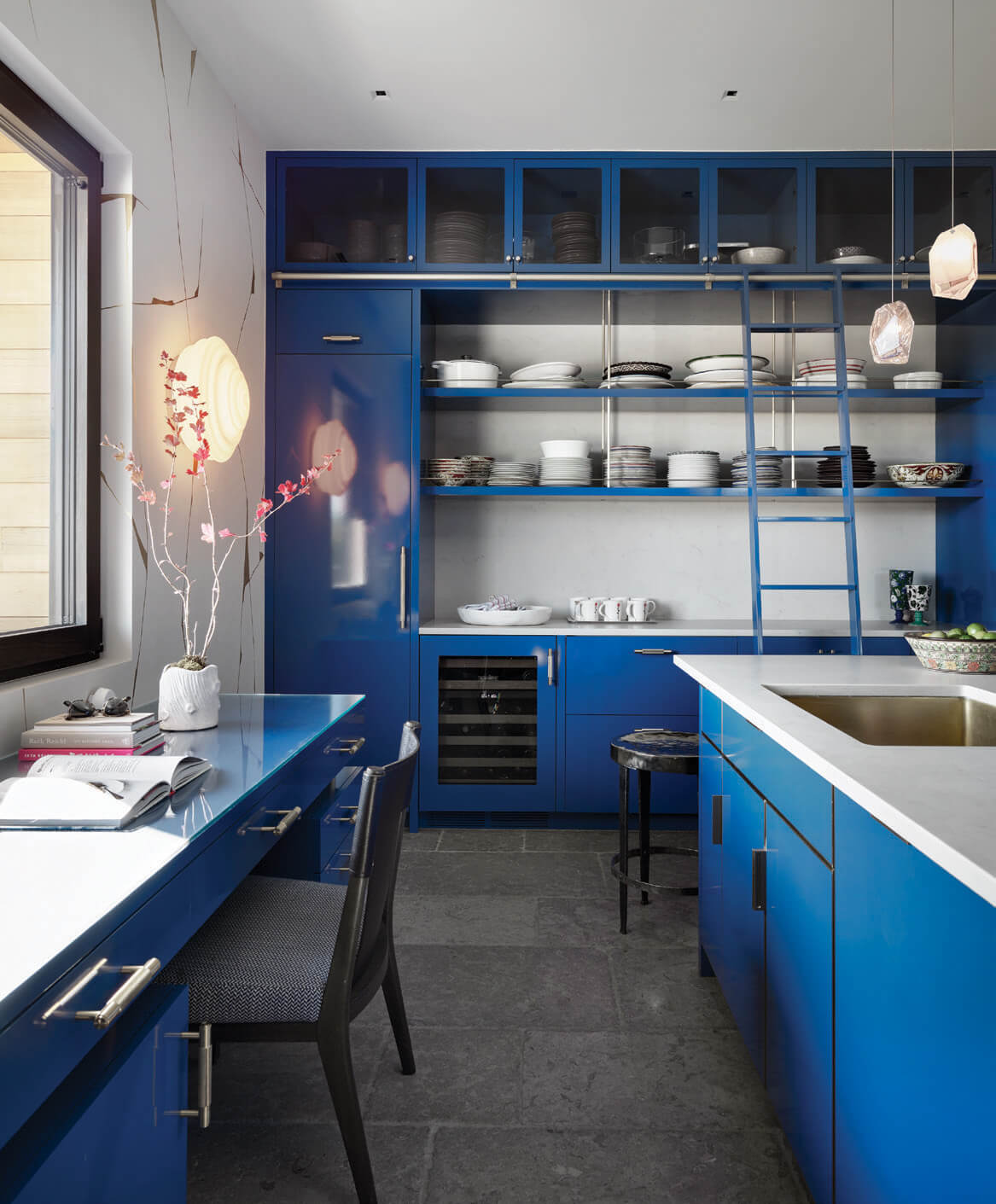
In the wife’s combination pantry/office, the blue of the lacquer cabinetry, accessorized with gold bronze hardware and details, was inspired by a Matisse painting, says Jenkins. “She said, ‘Reach outside your WRJ aesthetic. I want a lot of color.’”
“What I have learned over the years is that art has a way of finding its place,” he says. “You can plan and plan and plan, but when you prepare to hang the art, there are so many nuances that have to be considered, such as scale, color, harmony with other pieces, and finishes — on walls, on ceilings, on floors. I find that part of what we do extremely fulfilling. I love art and objects, and I love architecture; when you’re able to bring it all together and have a piece of art really sing, it’s very meaningful.”
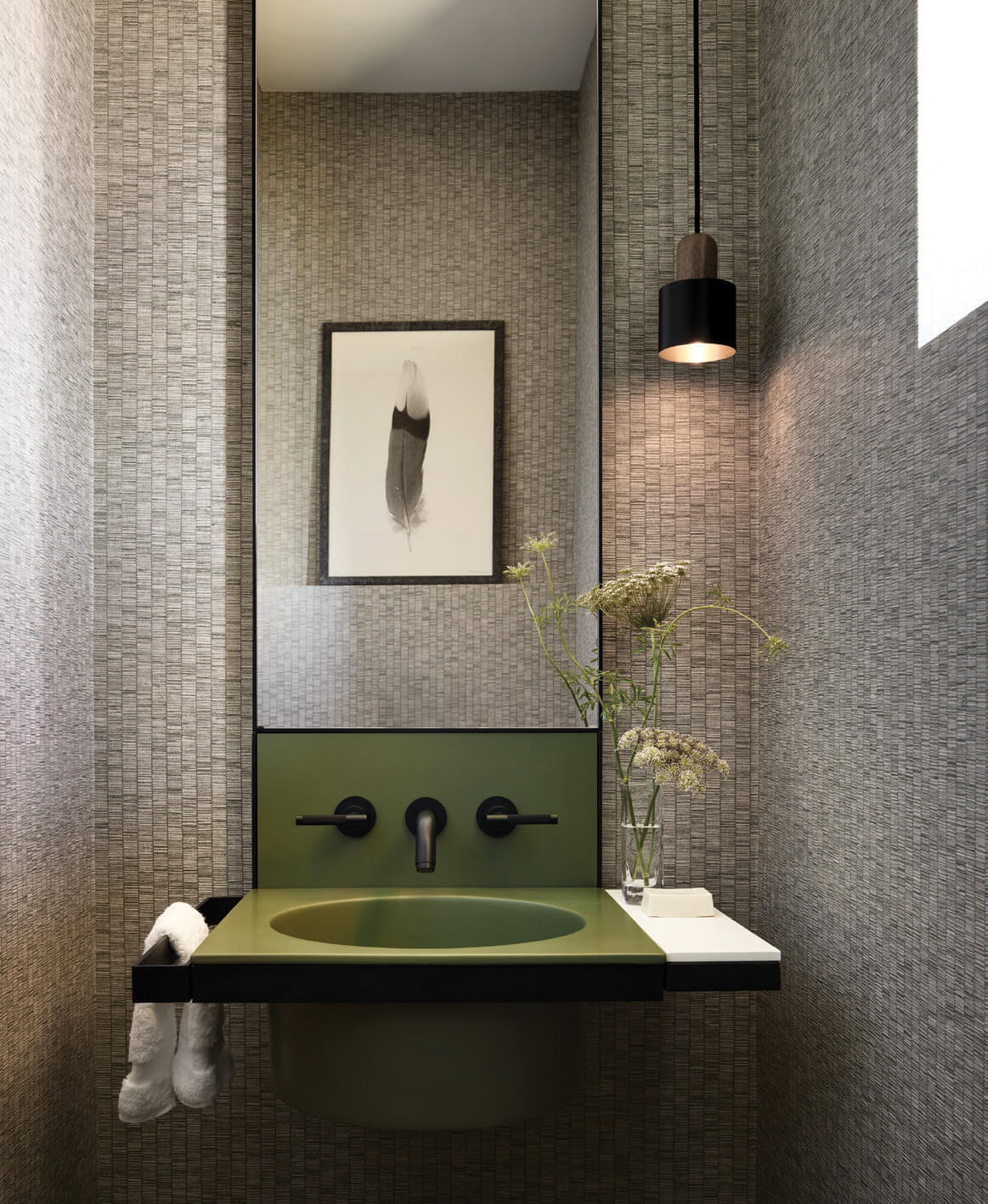
Another unexpected pop of color injects energy into a bathroom.
WRJ worked in close concert with the architects and owners to furnish the house, from helping choose fixed materials to selecting the most beautiful forms in chairs and tables, unique and interesting lighting, and extravagant details (such as bronze droplets inlaid into the dining table). The team layered items with interest and meaning in gathering places where the homeowners can sip a cup of coffee, entertain guests, or simply contemplate the panorama.
In the great room, Vladimir Kagan and Holly Hunt lounge chairs are paired with Holly Hunt and McEwen sofas to encircle a Hellman-Chang cocktail table. In the dining area, a Frederik Molenschot art chandelier offers sculptural intrigue over a custom table. The serene primary suite is all about quiet luxury, with a custom velvet headboard wall designed by WRJ. From the bathroom’s freestanding tub beneath a sparkling Hersh Design pendant, one can gaze at a dramatic view framed by Loro Piana linen drapes.
The palette is primarily neutral, in deference to the art and the views, with the focus on natural fabrics, warm-tone metals, and handcrafted accessories. In the combination pantry and wife’s office space, bright blue lacquered cabinetry inspired by a Matisse artwork is a dramatic surprise. The vibe turns more playful downstairs, where the steel-and-glass stairs lead to the pedestal-mounted classic Indian motorcycle at the landing. The program includes several bedroom suites, a bunk room, a gym, and a rec room, which opens to a sheltered patio featuring a fireplace and spa. There’s also an exquisite glassed-in wine room with woodwork echoing the scrim at the entry.
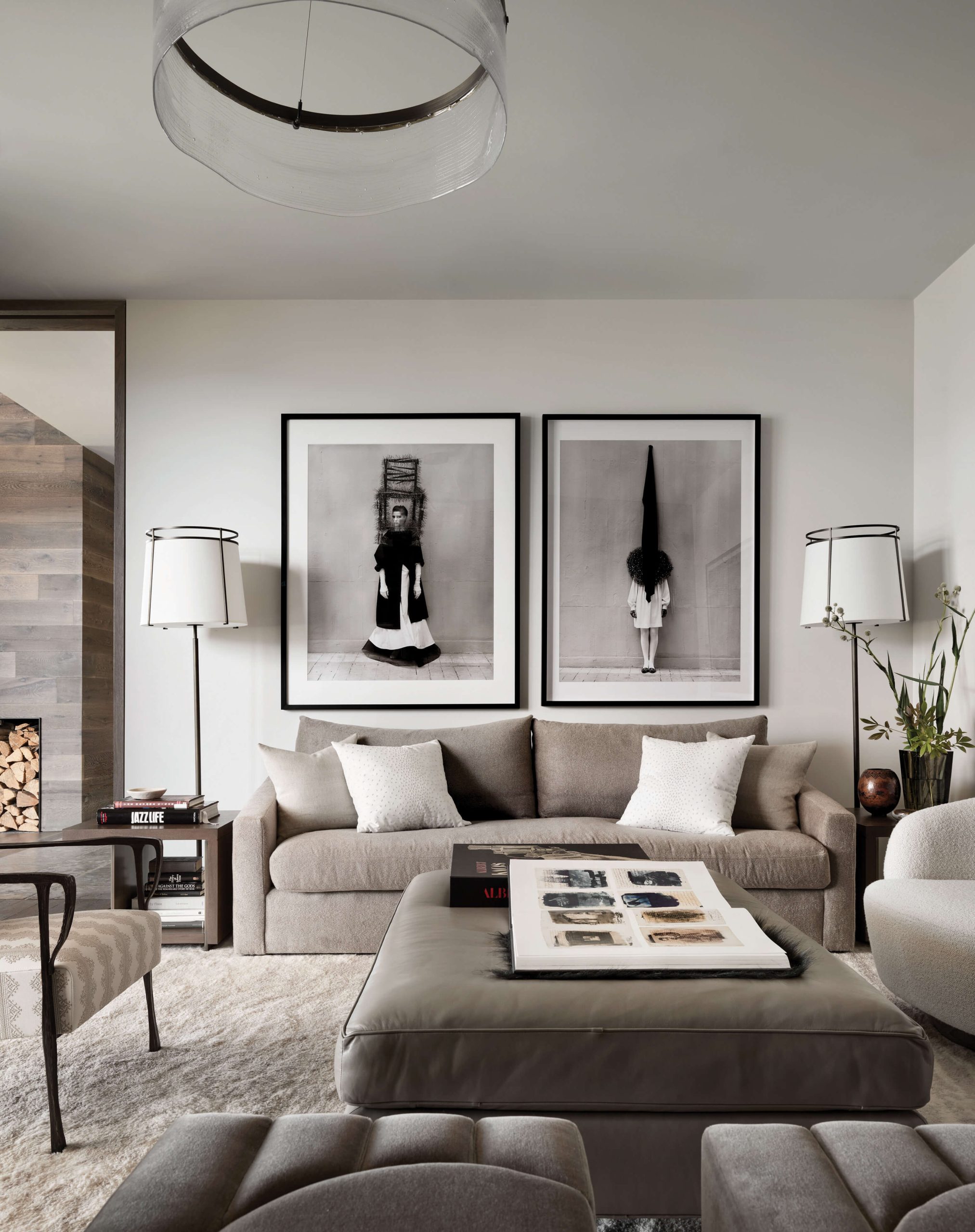
Soft, neutral furniture allows the striking black-and-white photos by Albert Watson to take center stage.
Sustainably minded design features include a high-performing, energy-efficient building envelope and mechanical systems; regionally sourced materials such as stone, western red cedar exterior cladding, and hemlock interior ceilings and soffits; triple-glazed windows; and thoughtful siting to maximize daylight and minimize impact.
“OSM and trade partner teams were challenged with complex architectural details that couldn’t have been achieved without careful strategies and real-time problem solving,” says OSM site superintendent Kris Kasbaum, who oversaw the collaborative process that brought this home to fruition. “From tackling variable soil conditions to accuracy on the detail between wall louvers and reflecting pools, the home is a testament of craftsmanship, adaptability, and coordination.”
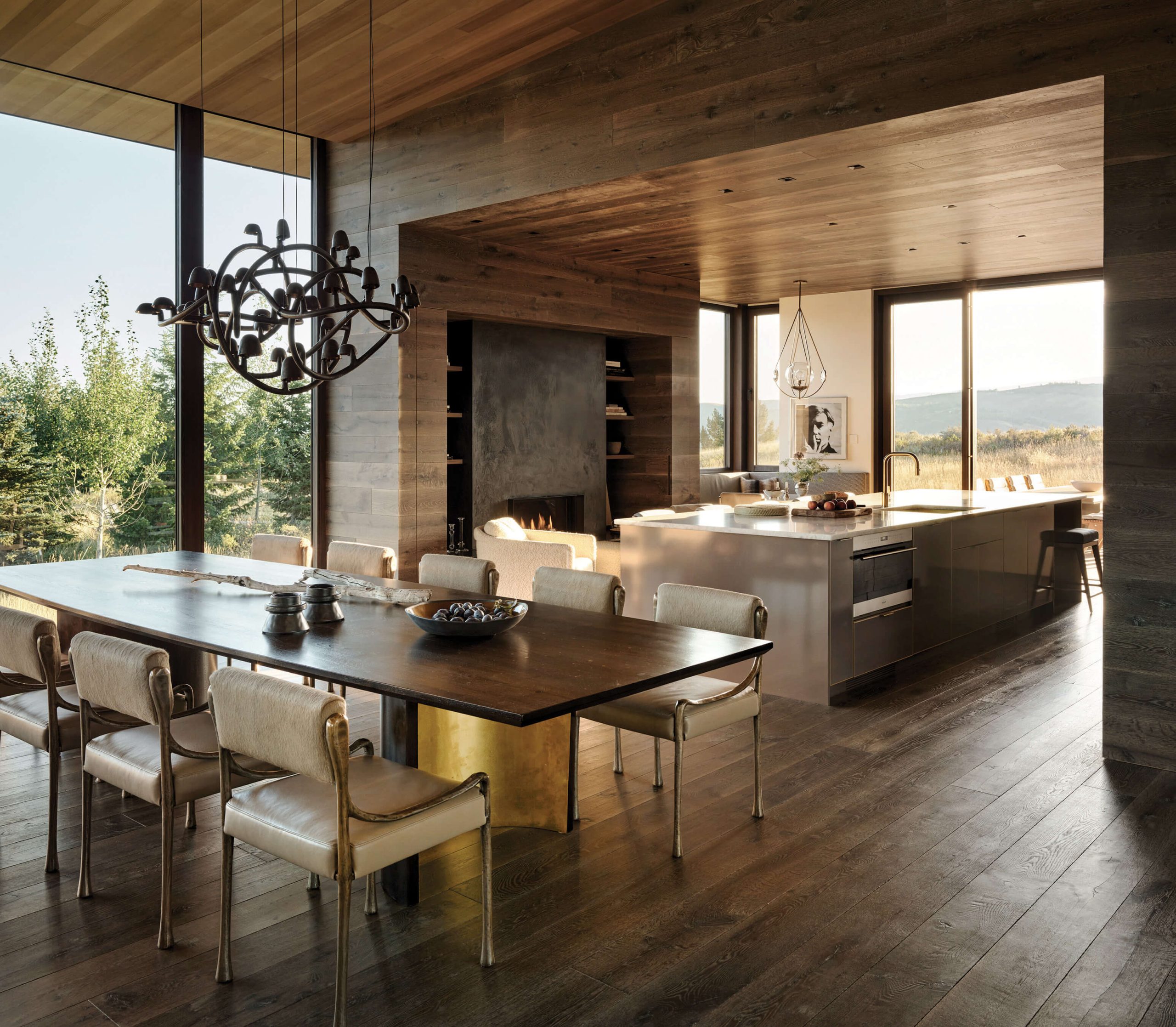
In the dining room, a Frederik Molenschot art chandelier from Carpenters Workshop hangs above a custom table.
“This project is about contrast,” says Ankeny. “We’ve blended this robust Wyoming landscape with the clients’ spectacular art collection and high design goals, echoing both modern art and the Western landscape.” The result, he continues, “is a combination of introspective moments alongside beautiful, long-distance views that embrace the landscape. The experiences within this home are variable, yet the architecture itself is a simple, refined gesture.”
“The setting is breathtaking,” says Jenkins, adding that the landscape, architecture, and art each complement the other. Once inside the dwelling, he continues, “The simplicity and repetition of line throughout the home reinforce the intentionality of the design. Pattern, texture, and natural materials are thoughtfully edited in a way that highlights the incredible level of detail. Handcrafted accessories beautifully reflect the surrounding landscape. Each piece tells a story imbued with meaning for the homeowners.”
Chase Reynolds Ewald has been writing about Western design, food, art, travel, and rustic style for more than 25 years. A consultant, editor, and freelancer, her books include American Rustic; Cabin Style; At Home in the Wine Country; and, with photographer Audrey Hall, the multi-award-winning Bison: Portrait of an Icon. Her latest book, Modern West, was released in 2025; chasereynoldsewald.com.
Matthew Millman has been photographing architecture and interior design for over 20 years. His work has appeared in a wide range of publications — including The New York Times, Dwell, Architectural Digest, Interior Design, Elle Decor, Luxe, and Architectural Record — and books, such as Art House, West Coast Modern, Collected Cool, and Inner Spaces. Millman’s personal work focuses on various subjects, from architectural abstractions to a 10-year project of portraiture and reportage in Haiti.
No Comments