


09 Apr Something Old, Something New
Architecture and Interior Design | Pearson Design Group
Construction | Highline Partners
Specialty Wood Products | Montana Reclaimed Lumber Co.
When skiing first became popular in Montana over a century ago, the typical ski cabin was a relatively small, one-room, rough-hewn log structure, simply furnished and lacking in all but the most basic creature comforts — a far cry from the large, luxurious lodges of today. With that humble throwback approach in mind, however, the clients who originally commissioned Bozeman-based Pearson Design Group in the mid-2010s to create a Big Sky ski cabin wanted something similarly simple, at least by modern terms: “a minimalistic 1,800-square-foot structure with a primary bedroom, a bunk room, and a great room, something that speaks to the elemental timelessness of such retreats,” says Justin Tollefson, a principal with Pearson Design Group.

The gathering room of the recently restyled ski cabin gains comfort through such furnishings as a Verellen sectional and swivel chairs and an alpaca boucle rug by Rosemary Hallgarten.
Those original clients furnished the cabin — built by Highline Partners based in both Bozeman and Big Sky — with comfortable but streamlined furnishings that echoed its straightforward lines and the colors and textures of its rustic, utilitarian materials: fieldstone and reclaimed-wood walls, black-stained concrete floors, and kitchen counters of wood and patinated steel.

Above the kitchen island, pendants in alabaster and bronze by J. Adams & Co. Lighting elegantly highlight meal prep on one side and casual dining, on stools from Croft House, on the other.
When new owners recently acquired the property, they sought the support of Pearson Design Group to help them reimagine how they might live their lives there. “Understandably, they wanted to bring their own personal touch,” says Dani Flax, the Pearson interior designer who spearheaded a new vision for the cabin. “And they shared with us guiding words for what their goals were, like ‘warmer’ and ‘more polished,’ asking us to include layers of texture and color to help them achieve that look and feel.”
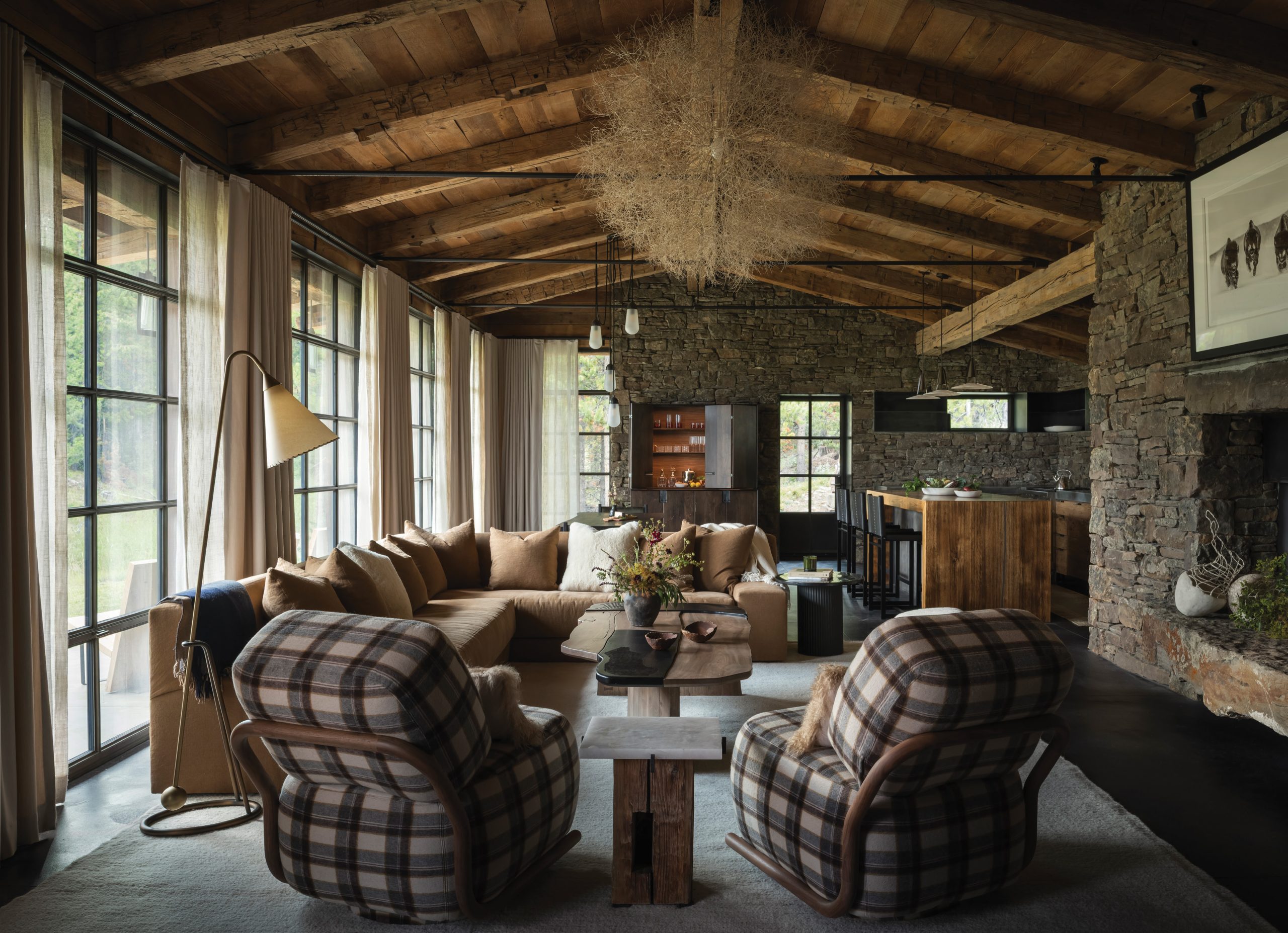
A chandelier fashioned from an actual tumbleweed by Owen Mortensen artfully diffuses light above the center of the gathering room. Still more illumination comes from the fireplace, above which hangs The Bills III by David Yarrow; a Beatrice floor lamp by Soho Home; Apparatus pendants above the dining table; and the sparkle of glassware in the bar hutch custom designed and built by Jack Metcalf.
With her well-disciplined eye, Flax brought together elements large and small to fulfill that goal, sourced from international and national suppliers and local artisans alike. “Dani led an interior renovation that really wasn’t about changing the finishes but more about refreshing the interior vibe to the tastes of the new clients,” Tollefson explains. In the process, Flax and her associates also availed themselves of Highline Partners, the contractors who originally built the house, to help fulfill specific construction needs in achieving that goal.
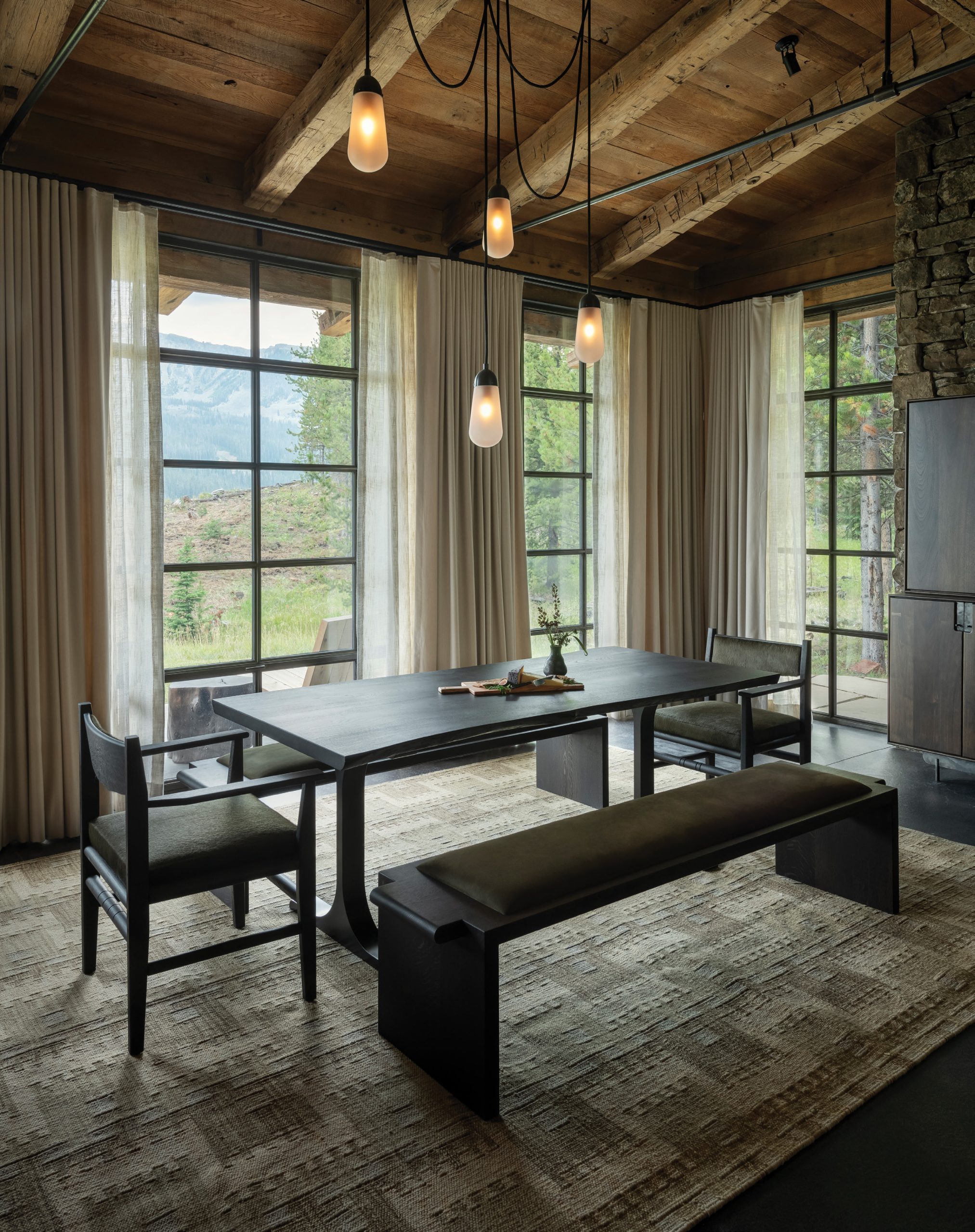
Gathered around the dining table are chairs from Fern, upholstered with hair-on hide from Edelman Leather, and Fern benches topped with leather from Jerry Pair. A subtly patterned rug from Kush Rugs helps define the space.
That approach becomes evident upon entering the cabin’s front door, which leads directly into its great room — or, as the designers and owners alike have come to call it, the “gathering room.” Indeed, the space’s new look encourages people to enjoy the firelit space, which combines living, cooking, and dining areas, all beholding the ski slopes through a south-facing steel-framed window wall that is the original architecture’s most dramatic concession to modern times.
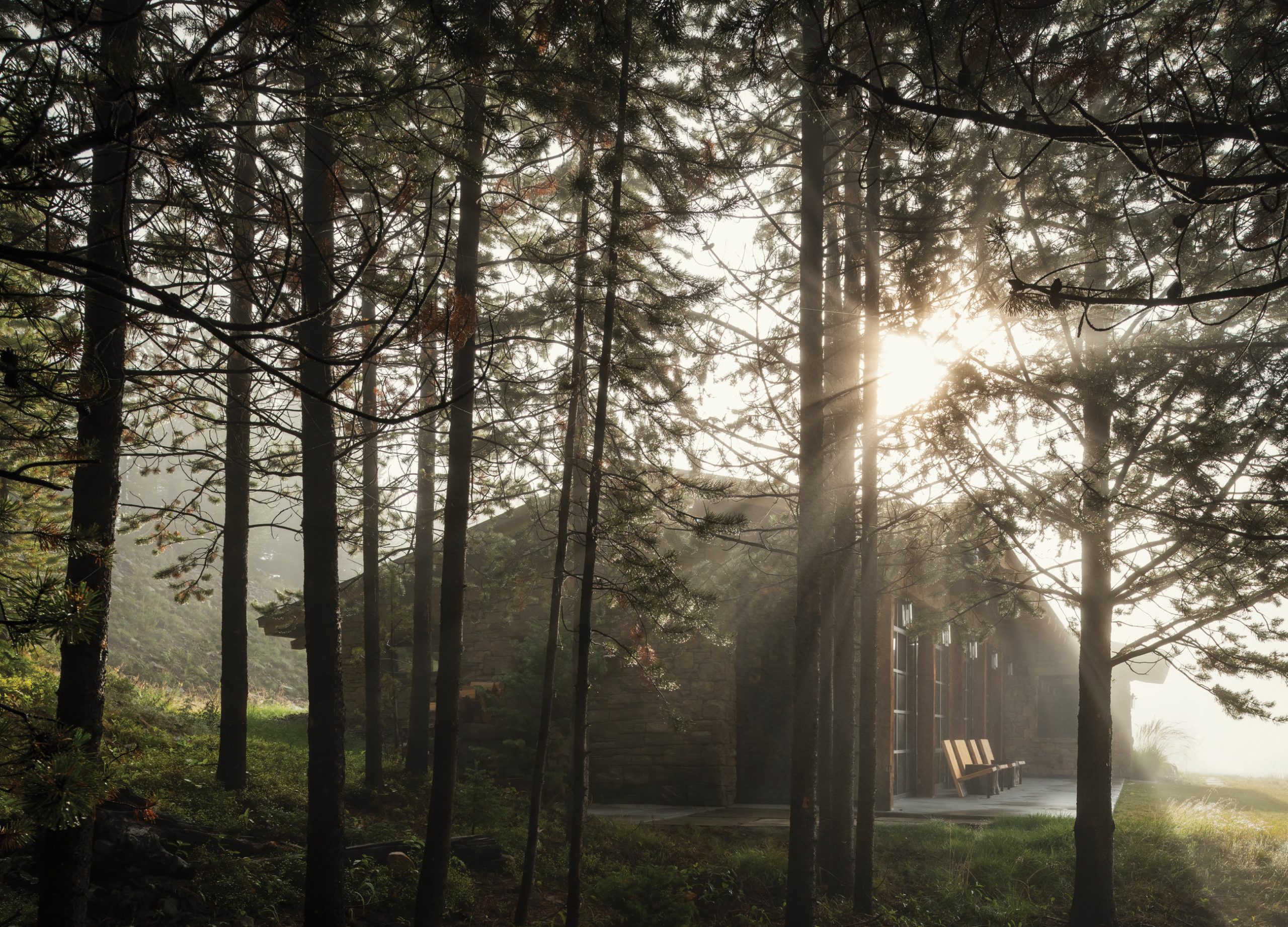
Viewed with the bright morning sun’s rays streaming through the trees, the decade-old dwelling appears to be, in form and materials alike, not far removed from Montana ski cabins of the early 20th century. Yet such details as the south-facing window wall of its great room and the comfortable, well-crafted furnishings within feel very much defined by today’s sensibilities.
To maximize the views — which Flax softly framed in wool drapes with linen sheers — but also the pleasures offered by the massive fieldstone fireplace on the opposite wall, Flax designed a seating area made up of a large, comfortable sectional sofa covered in oversized cushions, a pair of plush swivel chairs, and two oversized shearling-covered stools that seem almost biomorphic in their design. “We chose such interesting shapes,” she says, as counterpoint to the architecture’s simpler rectilinear forms. That approach is also evident in the walnut coffee table. One of several new pieces in the house created by local furniture and cabinetmaker Jack Metcalf, the near-sculptural centerpiece highlights natural edges and fissures in the wood, along with some decorative carving, staining, and polishing.
While the fireplace itself is essentially unchanged in its style, one major but unanticipated alteration was required from Highline’s construction crew. The new owners had specifically purchased a large bison image by famed fine art photographer David Yarrow with the intention of hanging it above the forged-iron mantel. However, when the framed work arrived, recalls site supervisor Cooper Behr, it didn’t fit. So, Behr and his team were able to remove a sizable chunk of the stone and lower the mantel by about a foot to perfectly accommodate the photo.
In the adjacent dining area, a live-edge table from SOBU furniture makers, based in Oakland, California, continues that well-crafted approach. Enhancing the casual entertaining ethos, both long sides of the table feature benches topped with hair-on-hide cushions, enabling the hosts “to squeeze more people in,” Flax notes. That spirit is further bolstered by another custom creation from Jack Metcalf, a bar cabinet made of walnut and steel, to which Flax and Pearson Design Group added integrated lighting to enhance the glassware’s sparkle. Before it could claim its spot, however, still more expert work was required of Highline. That particular stretch of wall had previously featured an almost life-sized scrap-metal sculpture of a moose, embedded into the stone. “We basically tore down that wall to remove the art piece, which we returned to the cabin’s original owner,” Behr says. “And then we patched the stone back together.”

The primary bedroom achieves an air of welcoming warmth with its bed from Verellen, luxuriously made with a duvet, sheets, and pillowcases by Matouk; shams by Saum & Viebahn; and an alpaca throw from Auskin. Local artisan Jack Metcalf made the onyx-topped bedside tables.
No changes were requested to the design and function of the cabin’s kitchen, which still features its original waterfall-edge wood island, steel wall counters, and cabinetry and appliances faced in reclaimed barnwood. But that didn’t preclude enhancing the comforts it offers. Here, Flax introduced a trio of welcoming bar stools with leather backs and cushions — which help guests feel at home — and patinated steel frames that harmonize with the counters.
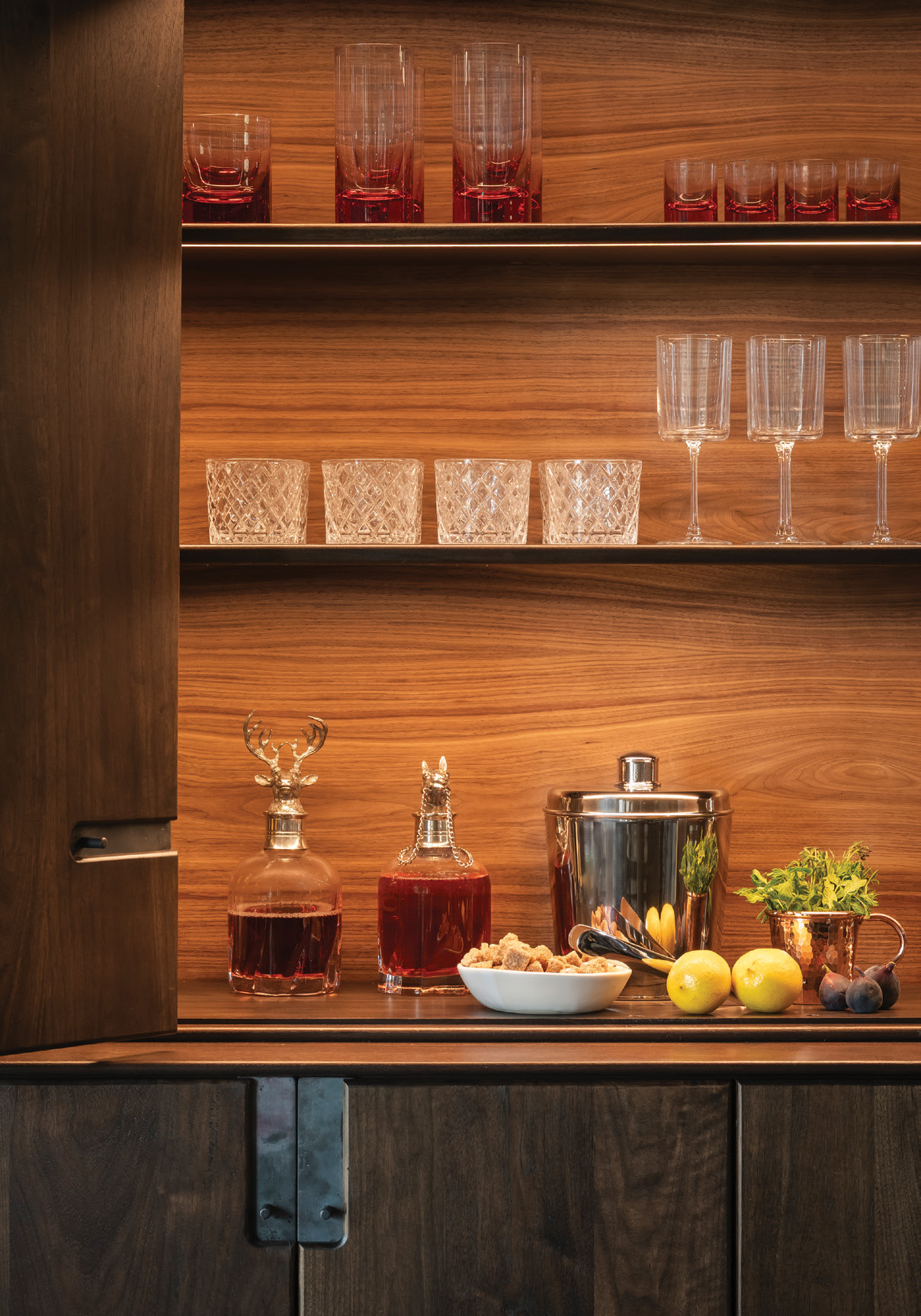
Moser Gold Ruby Bohemian crystal sparkles in the bar hutch.
To further define the three distinct areas in the open-plan gathering room, Flax also enhanced the lighting. Over the kitchen island, three pendant fixtures made of alabaster and bronze cast an inviting glow. The dining area gains distinction from four glass pendant lights suspended at varying heights. And most dramatic of all, a chandelier made from an actual tumbleweed hangs above the living area’s coffee table. “It’s one of my personal favorite fixtures,” says Flax. “It has great volume but still feels light and airy, it casts interesting shadows, and the tumbleweed’s primitive nature interests and attracts people.”
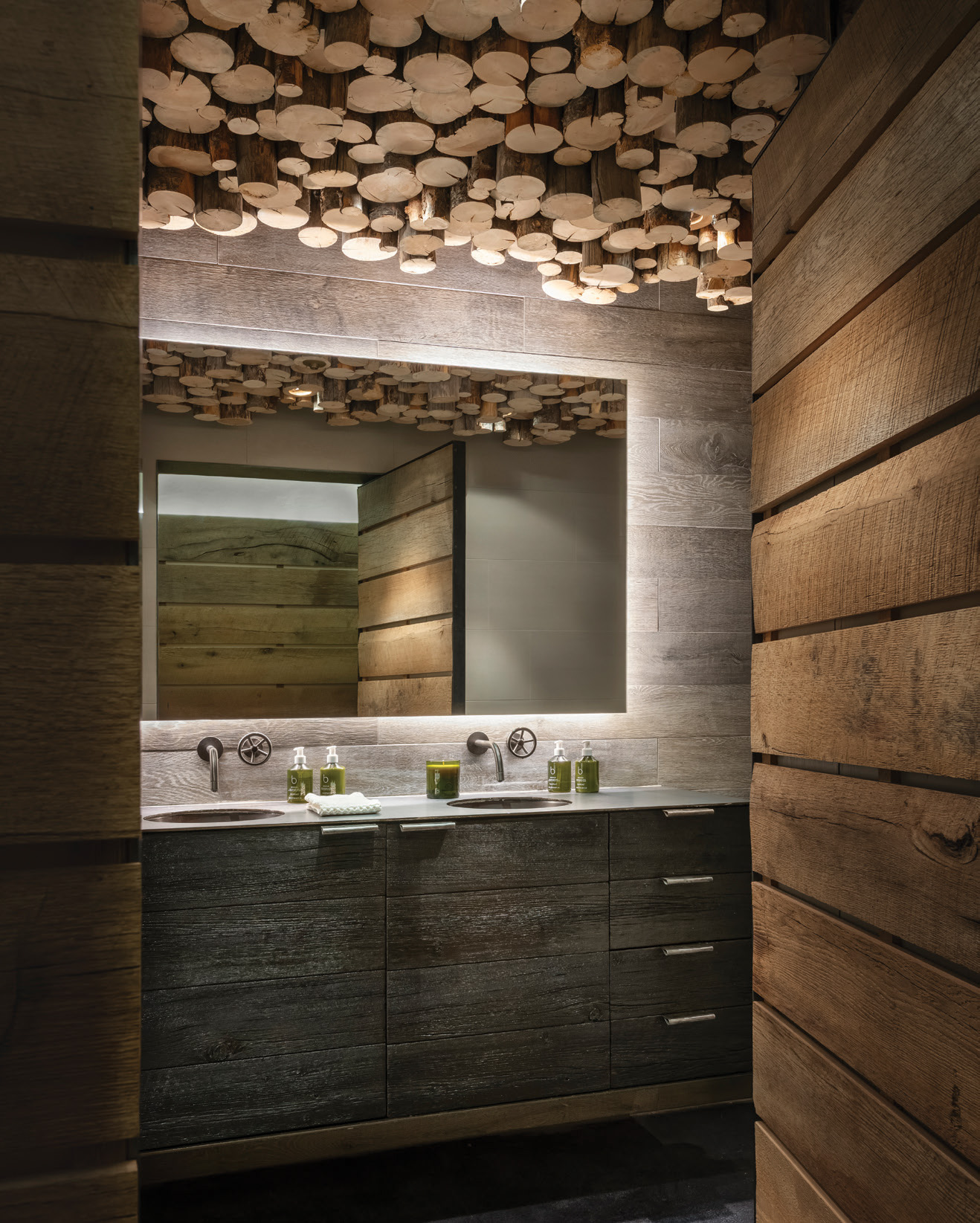
For the guest bath ceiling, site supervisor Cooper Behr of Highline Partners created a “log cloud,” complete with concealed lighting, using sections cut from dead-standing lodgepole pine on the property.
Beyond this communal room, the two sleeping spaces offered more opportunities to bring new warmth and polish to the existing cabin. The primary bedroom, although not large, feels both comfortably welcoming and spacious thanks to a Croft House steel-and-leather dresser beneath the window faced by the bed. On either side of the dresser, custom closets created by Rusty Nail Design in Bozeman and installed by Highline expand what had been scant storage. Enhancing the feelings of warm comfort amid the rustic architectural materials are a plaid-upholstered custom headboard, a new sheepskin rug, an alpaca throw, and wool Roman shades. Lighting, too, plays a key role in making the space feel more like a haven, with a linen pendant fixture from Pinch, based in London, adding a soft glow. “In a way, it reminds me of the gathering room’s tumbleweed chandelier, because it feels sculptural and casts a soft, interesting glow,” Flax says.
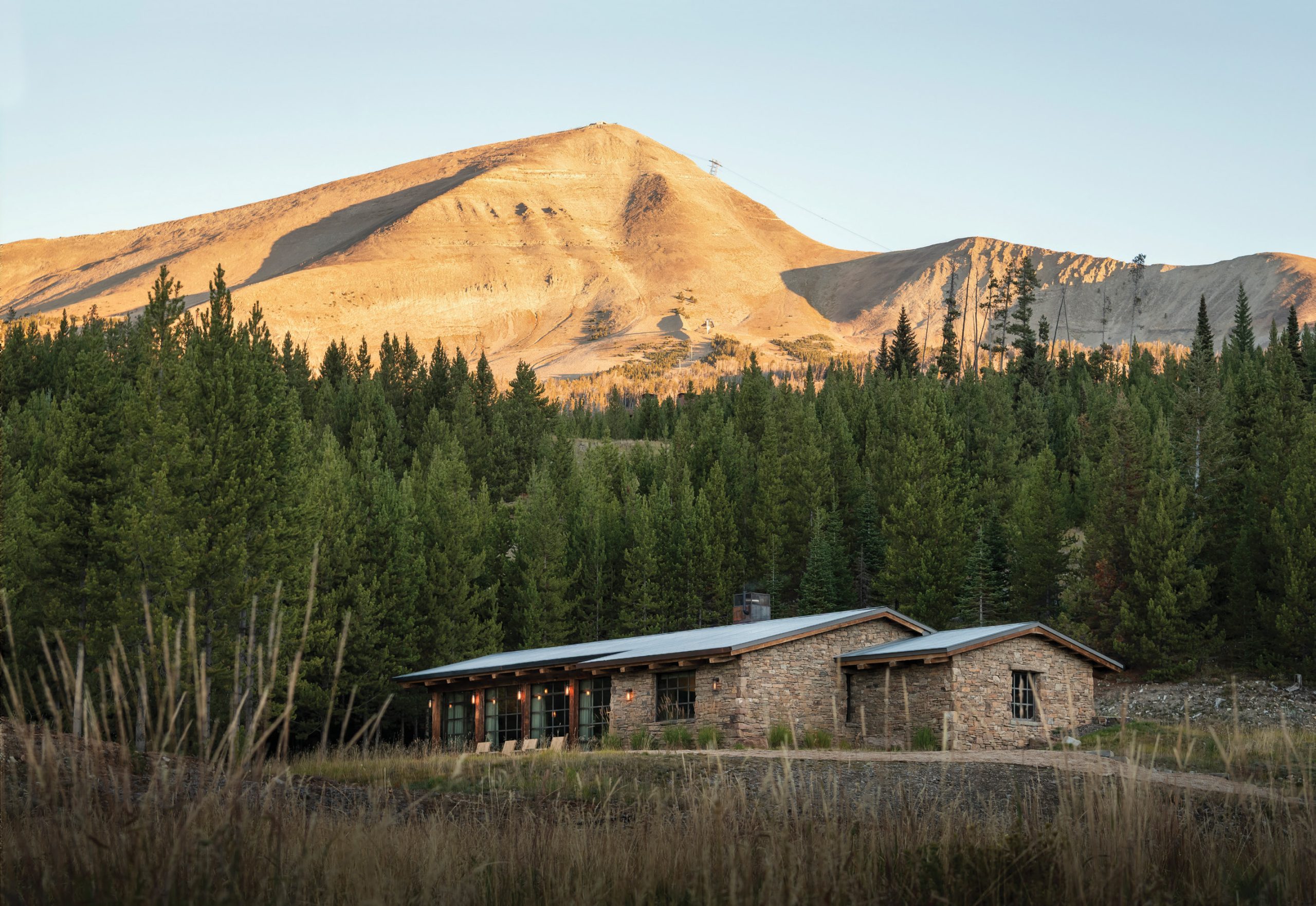
Popular Big Sky skiing is just moments away from the home, which is equally picturesque in the summer months.
The adjoining primary bathroom also benefited from a few new furnishings to enhance its ease and functionality. Beneath each sink in the existing dual vanity, Flax tucked a hair-on hide ottoman from Jamie Young Co. that easily pulls out for comfortable, impromptu seating. And along the wall to the left of the vanity, a new cabinet with reeded-glass doors from Copenhagen-based Ferm Living enhances linen storage capacity.

The guest bedroom’s custom bunks feature headboards made locally by Studio Schoen and upholstered in a 100-percentwool plaid fabric from Holland & Sherry, with sconces by Avantgarden.
One of the most dramatic transformations of all is in the second bedroom, dedicated to visiting family and friends. Here, following Flax’s vision, Rusty Nail Design built reclaimed-wood bunk beds that are a far cry from the regimented arrangements common to the ski cabins of a century ago. A long queen-sized bed on the bottom and a long twin bed above provide ample, flexible sleeping options within the compact space, and wall-mounted individual sconces on flexible arms wrapped in cobalt-blue leather provide personalized reading light. “We meant it all to feel like a different, fun space,” Flax says.

Occupying a private corner of the cabin, the compact primary bedroom gains extra privacy from wool Roman shades by Nobilis and luxurious comfort from such details as an Auskin alpaca throw and a leather-bordered sheepskin rug by Forsyth.
That sense of fun also carries through the cabin’s interior redesign in another subtle way: touches of red introduce notes of warmth that both enliven and soothe the senses amid a snowy climate and a structure fashioned from rustic, earth-toned materials. A discerning eye will be drawn to the hue on the top shelf of the gathering room’s built-in bar cabinet, for example, where pride of place belongs to an array of Gold Ruby Bohemian crystal glasses by the Czech company Moser, a shimmering counterpoint to the glow of the nearby fireplace. The color finds expression yet again in the primary bedroom, where the dresser’s leather drawer fronts are burgundy-hued, echoed by the bed’s plush throw pillows and the trim of its pillowcases — which themselves rest against the headboard’s 100-percent wool upholstery, a plaid from the venerable British textile company Abraham Moon & Sons, in which hints of red interweave with the pattern’s predominant browns, tans, blacks, and grays.
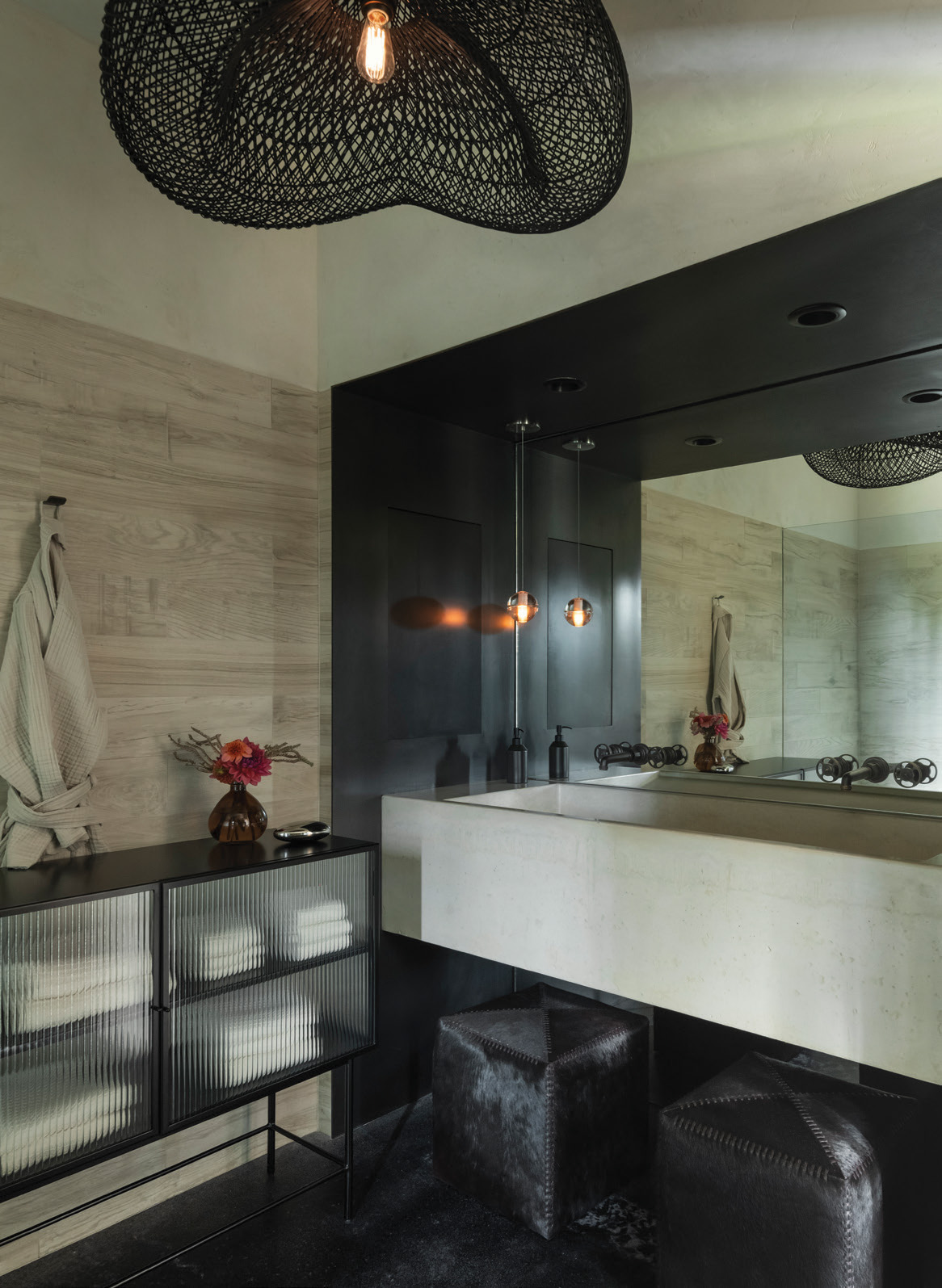
Near the primary bath vanity, glass light fixtures from Bocci contribute a warm glow. The vanity fixtures are by Watermark.
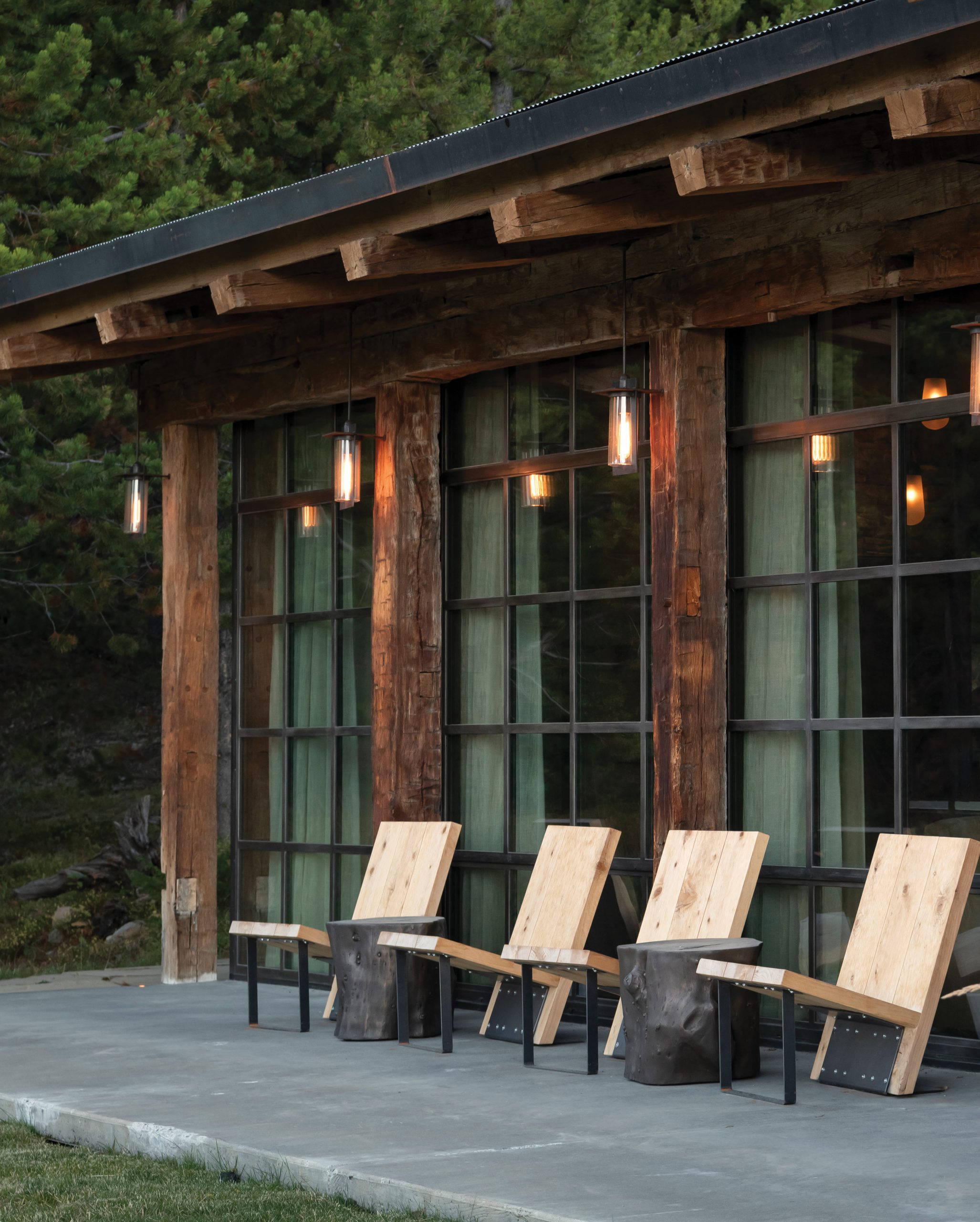
Even on the deck beyond the gathering room’s south-facing window wall, such russet tones will manifest themselves in time. Flax and the Pearson Design Group furnished it with a contemporary industrial take on Adirondack chairs, simply designed by ORCA Studio in Los Angeles, fashioned from cedar boards and steel fittings. “They’re raw materials, with no wax, no stain, or other finishes,” explains Flax. “So, the wood will gradually weather to a grayish-brown color, and the steel will turn rusty” — thus providing, in the most natural of ways, yet another subtle connection to the refurnished interiors and, come fall, to the natural world all around a contemporary cabin that remains modest and warmly welcoming in the best, old-fashioned way.
From his base in Marin County, California, Norman Kolpas writes about art, architecture, travel, dining, and other lifestyle topics for magazines, including Western Art & Architecture and Southwest Art. He’s a graduate of Yale University and the author of more than 40 books, the latest of which being Foie Gras: A Global History. Kolpas teaches in The Writers’ Program at UCLA Extension, which named him Outstanding Instructor in Creative Writing.
Based in Aspen, Brandon Huttenlocher is an architectural and design photographer whose work has appeared in outlets around the country. He loves blending his passion for the outdoors with his architectural photography. When he’s not working, he can be found spending time in the mountains, whether snowboarding and splitboarding or biking and backpacking.
No Comments