


09 Apr Sense of Place
Architecture and Interior Design | Pearson Design Group
Construction | North Fork Builders
Specialty Wood Products | Montana Reclaimed Lumber Co.
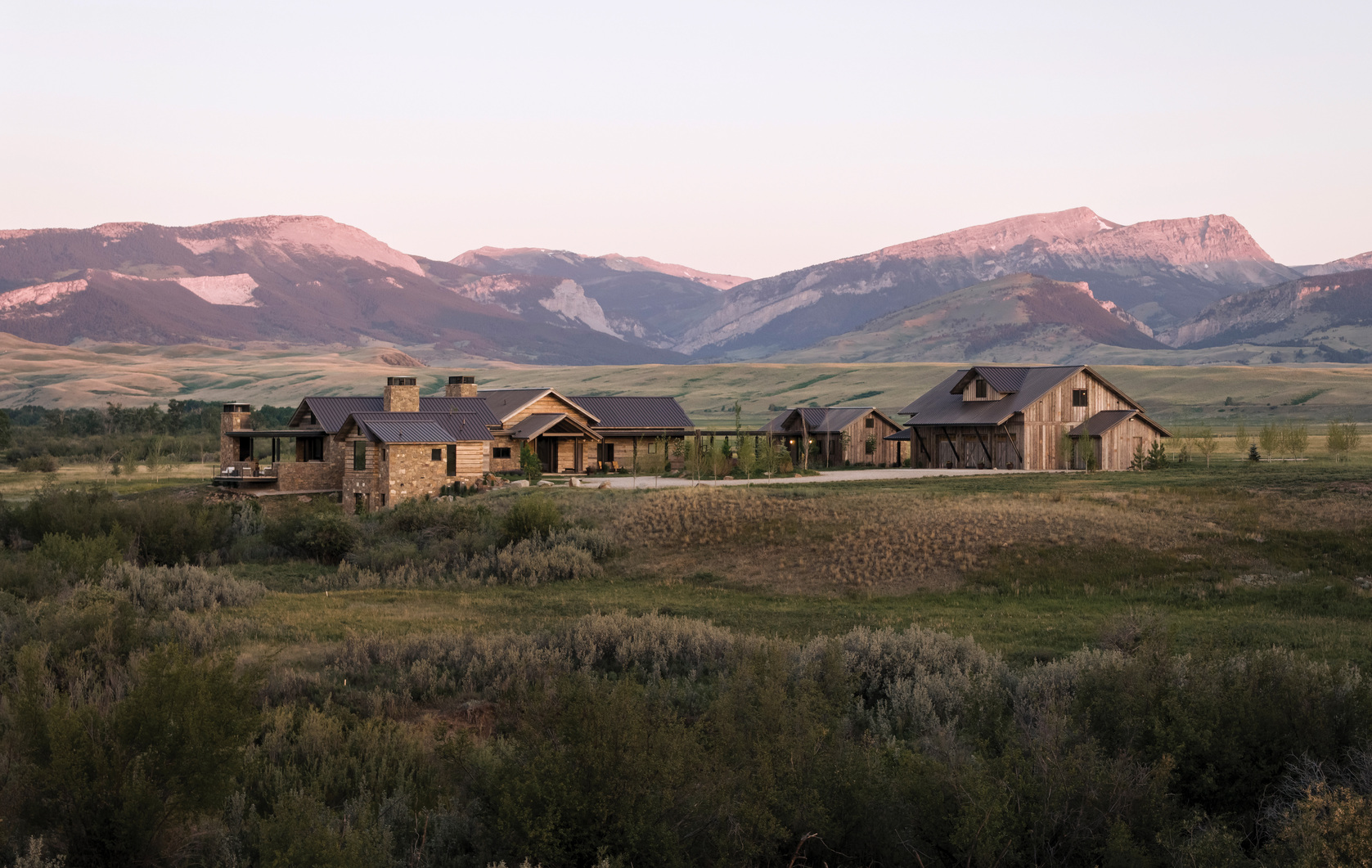
Set amid the rolling grasslands of central Montana, a new family retreat looks completely at ease in the environs, perfectly positioned to embrace the drama of the surrounding landscape. The product of a well-choreographed vision, the home nods to homesteads built by American settlers who expanded westward in the 19th century, while embracing the cutting-edge use of steel, glazing, and well-appointed finishes meant to support a home built for living.
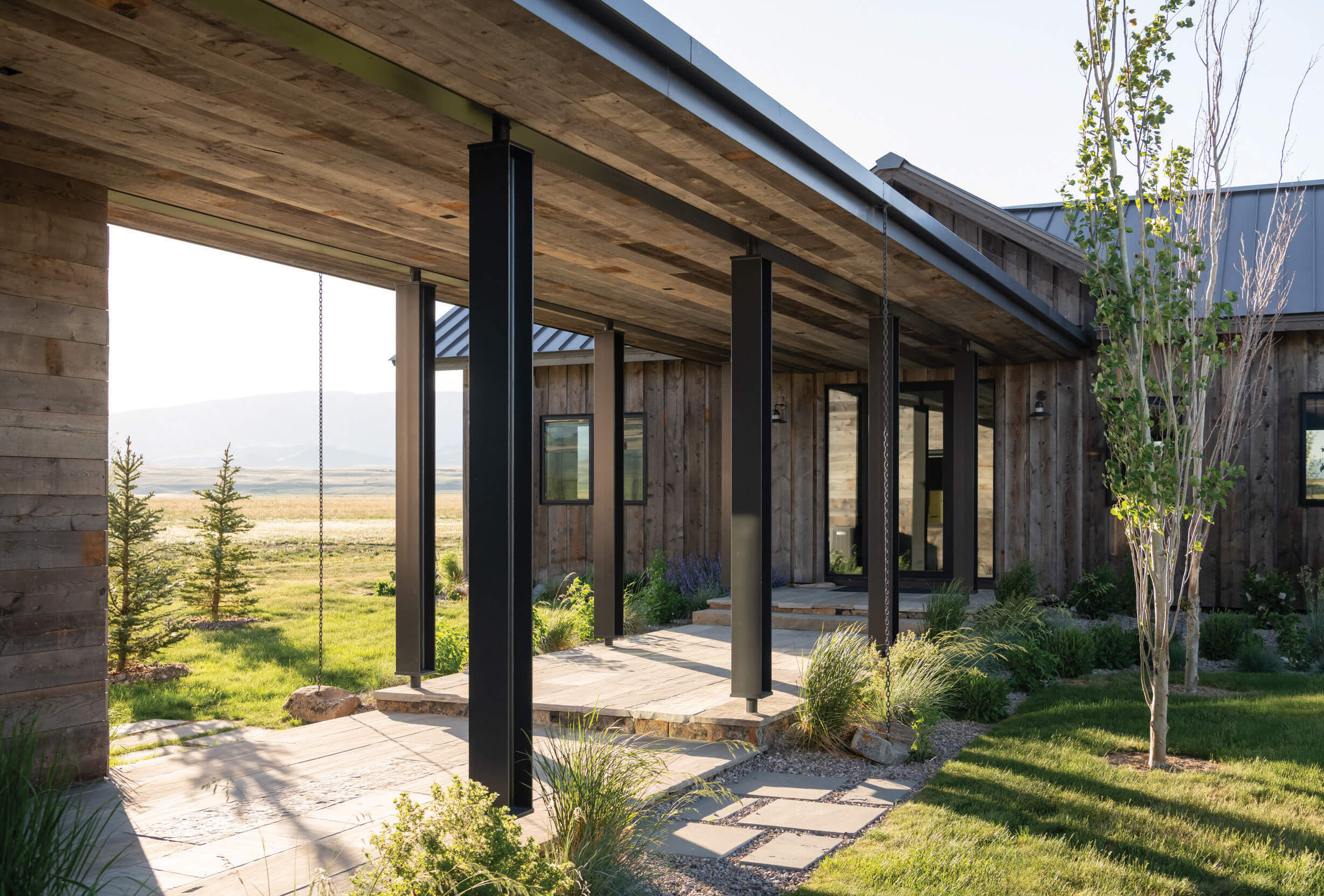
The covered walkway between the lodge and guest cabin creates a quiet moment of transition, with framed views of the surrounding landscape.
“The property is a working cattle ranch, and our clients hired us to develop it as a recreational retreat for family and friends,” says Justin Tollefson, the project architect and a principal of Pearson Design Group, whose team designed the two-bedroom dwelling and nearby accessory structures. “Even though the home and outbuildings are thoroughly modern, they were designed to look like a collection of agrarian forms to complement an old barn and other structures on the property and feel grounded like the humbler, historic structures of Montana.”
The resulting compound is comprised of the main house and a nearby lodge, guest cabin, and separate bunkhouse designed to accommodate guests. Created as a private sanctuary where the natural landscape can be appreciated to its fullest, the single-story main home spans roughly 4,000 square feet and supports the daily routines of the owners, who live here seasonally. It features two bedrooms, three baths, an office, and an attached garage.
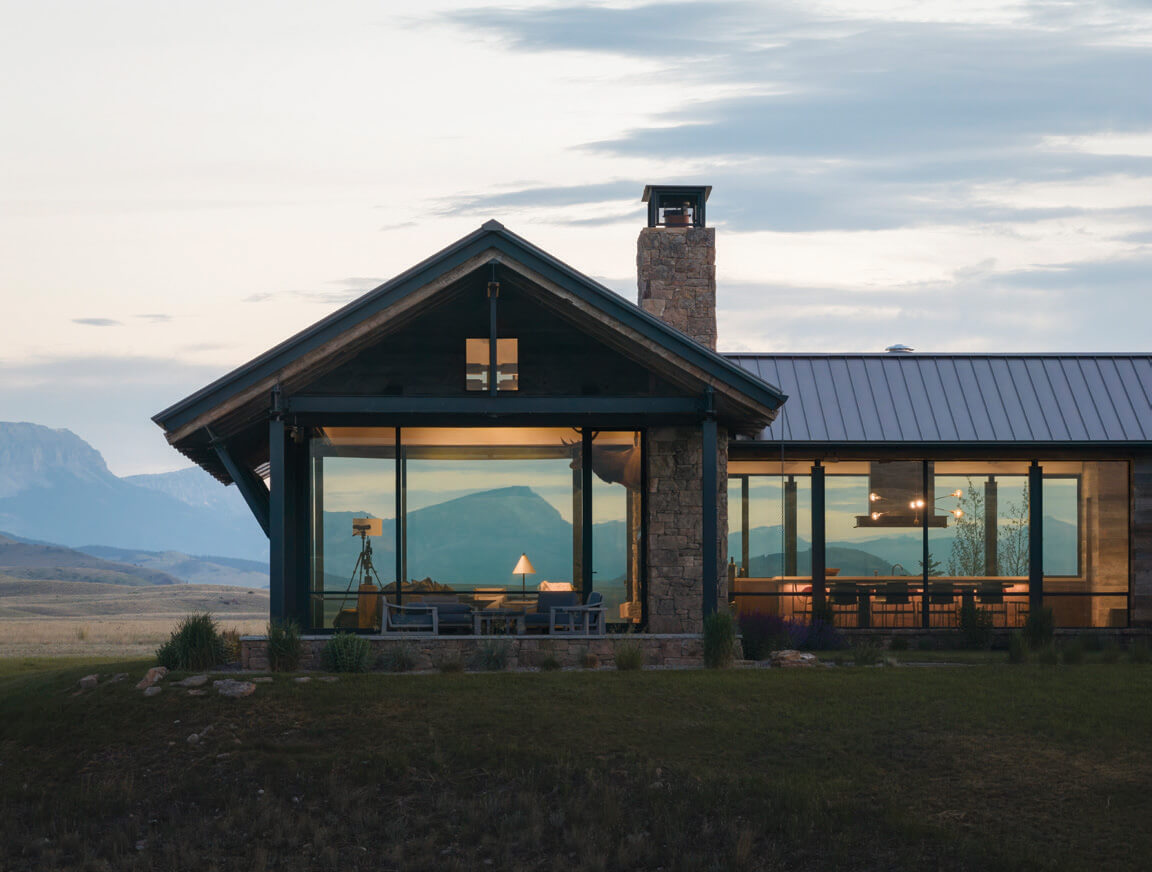
Expansive glass walls create a sense of transparency in the main house, dissolving the boundary between the interiors and the surrounding landscape.
Positioned across a small draw from the main home, the guest quarters are in close relation and overlook a stream and picturesque pond where livestock graze. The lodge includes spacious room for living and entertaining, with two bedrooms, a bunk room that sleeps four, five baths, a relaxed seating area in the great room, a rec room with pool and shuffleboard tables, a large kitchen, and a spacious dining room — all with views to the outdoors. A guest cabin that sleeps six is connected to the lodge by a covered porch that offers views to the historic barn and accessory ranch structures nestled among the cottonwood trees. Beside the cabin, a bunkhouse that sleeps 18 includes a full gear room and large garage.
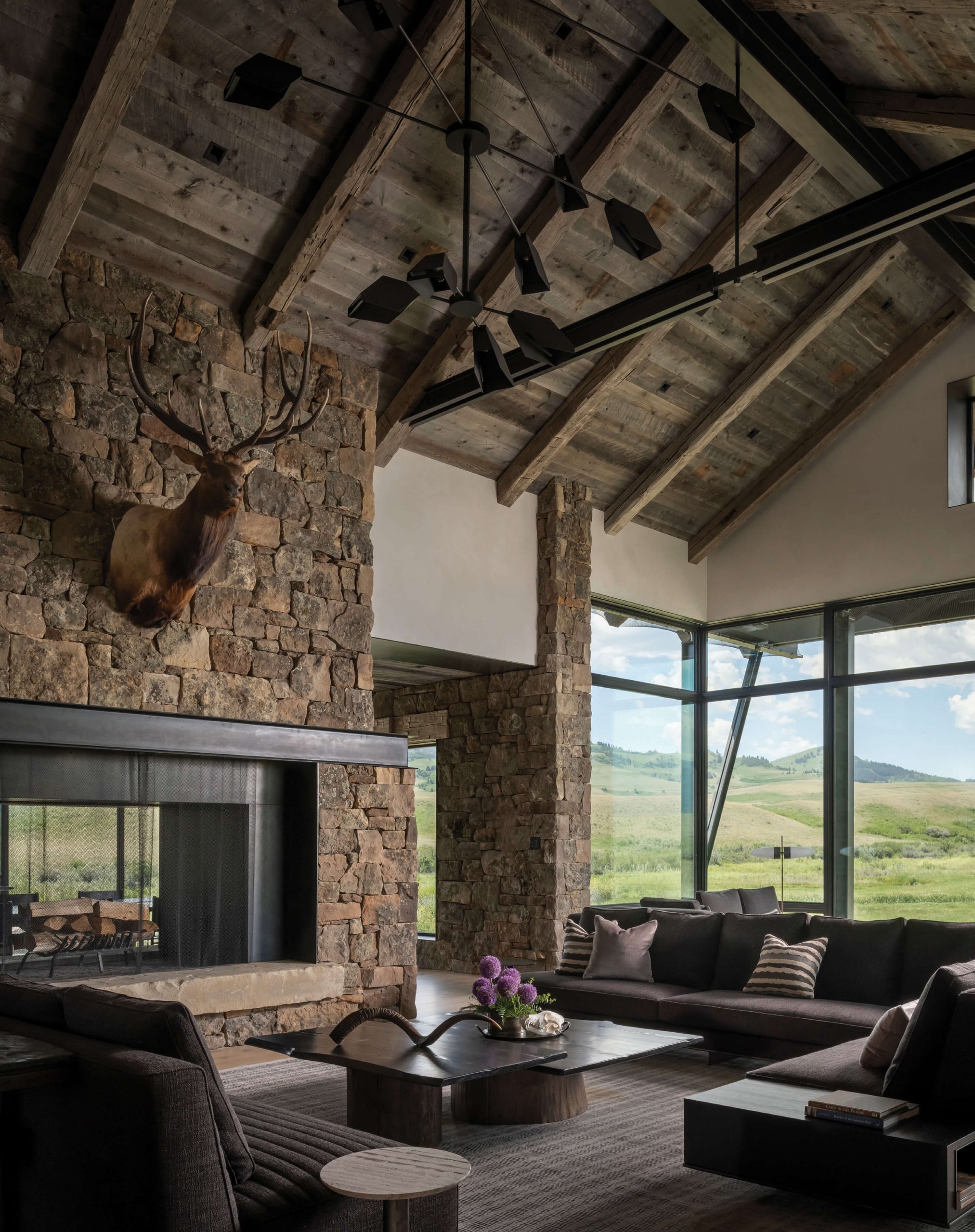
Oversized upholstered seating from Minotti in deep-plum wool surrounds custom coffee tables, creating a cozy gathering place in front of the fireplace in the lodge, where reclaimed timber and local moss rock define the spaces to look historic yet feel modern.
“The husband enjoys fishing, elk hunting, and pheasant hunting, and he wanted to preserve some historic parts of the property as a working ranch,” says Tollefson. “He had a loose vision of something fresh and modern that cued us up, but he’s also oriented toward conservation, and he trusted us to weave together a materials palette that felt organic in the landscape.”
Built by a team led by Jon Evans, president and founding partner of North Fork Builders, the new structures — despite their old-world appearance — are reinforced with contemporary building materials, making use of steel beams and columns that support vaulted ceilings in the main house and lodge, as well as extensive triple-pane glazing that provides transparency and light.
“This is the windiest part of Montana,” says Evans, who collaborated with the architects to create structures that perform to the highest levels of contemporary energy standards and weather resistance to cope with the high winds, heavy rain, and snowstorms that often pass through the area. “The winds were extreme to work in — we almost had a job trailer blown over at one point — and the house had to be designed and built to withstand these winds and provide shelter. The Rocky Mountain Front is a beautiful but rugged landscape.”
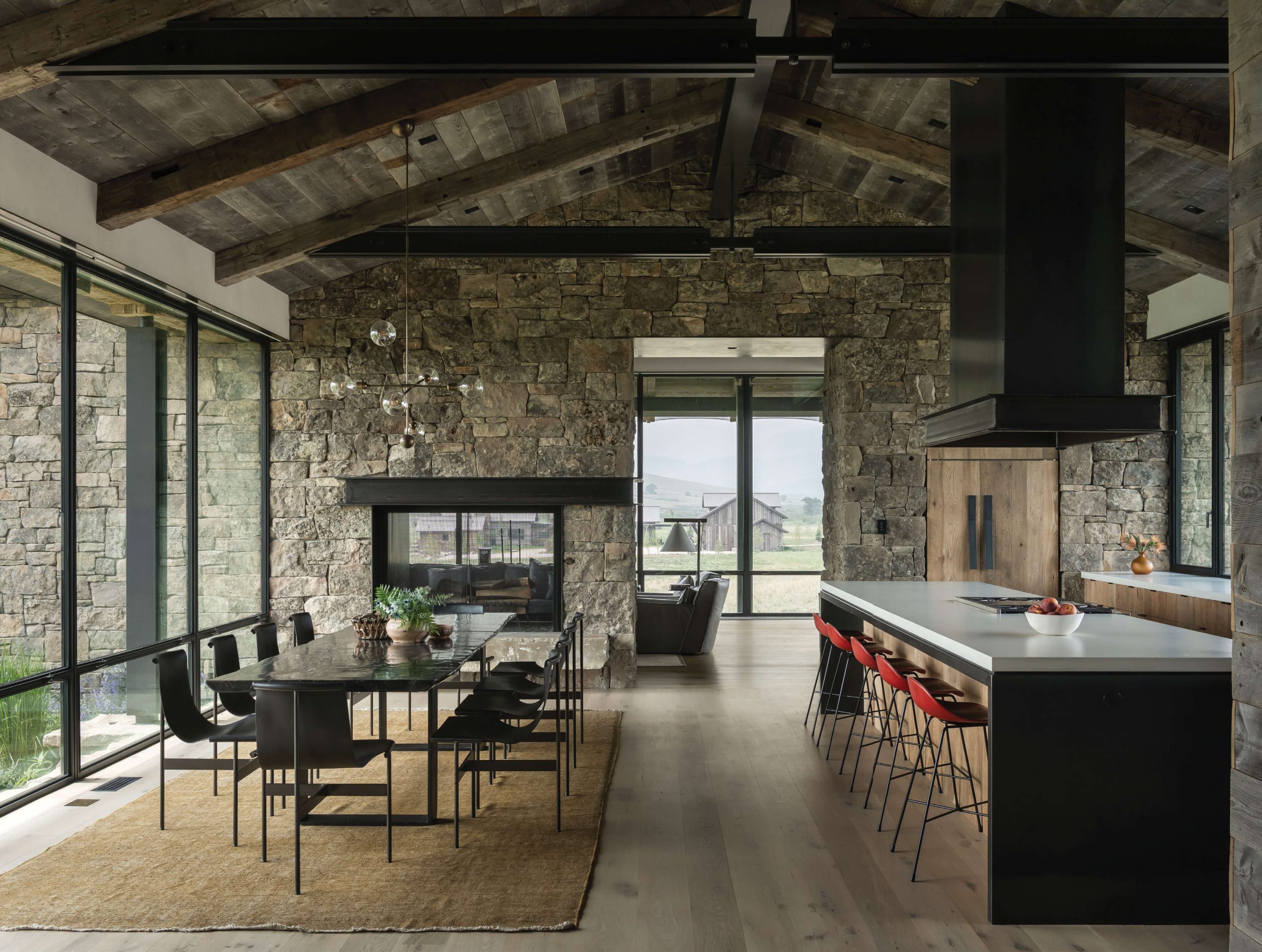
Barstools covered with dark-red leather add shots of color to the otherwise neutral palette in the open kitchen and dining area in the main house. Sling chairs surround a custom dining table with a top made from a slab of petrified wood.
Throughout the project, the design-build team sought to connect the stunning landscape with the living routines of the homeowners. This began with orienting rooms and window walls to maximize vistas of the surrounding mountains and frame the mosaic of silvery-blue western wheatgrass, golden big bluestem, fescue, and wildflowers. “In some areas, the exposed steel beams and columns are separated from window walls to allow them to be continuous, like a curtain-wall system, and frame the landscape views like large-format artworks,” Evans says. “The fieldstone masonry beautifully meets the clean-lined steel-plate trim framing many of the windows.”
Careful detailing by the architect enabled the artful union of old and new building techniques, while the natural materials palette further engages the structures with the outdoors. The architects chose elements that would gently reference the surrounding landscape while adding timelessness to the compound. They integrated fieldstone sourced from regional quarries and reclaimed timbers and siding, some more than 150 years old. The reclaimed wood clads the exteriors as well as some of the structures’ interior walls, and lichen-flecked stones add character to the fireplace surround, chimneys, and walls. “The ranch vocabulary and native materials create a tactile vibe and make it hard to date the new structures,” says Tollefson.
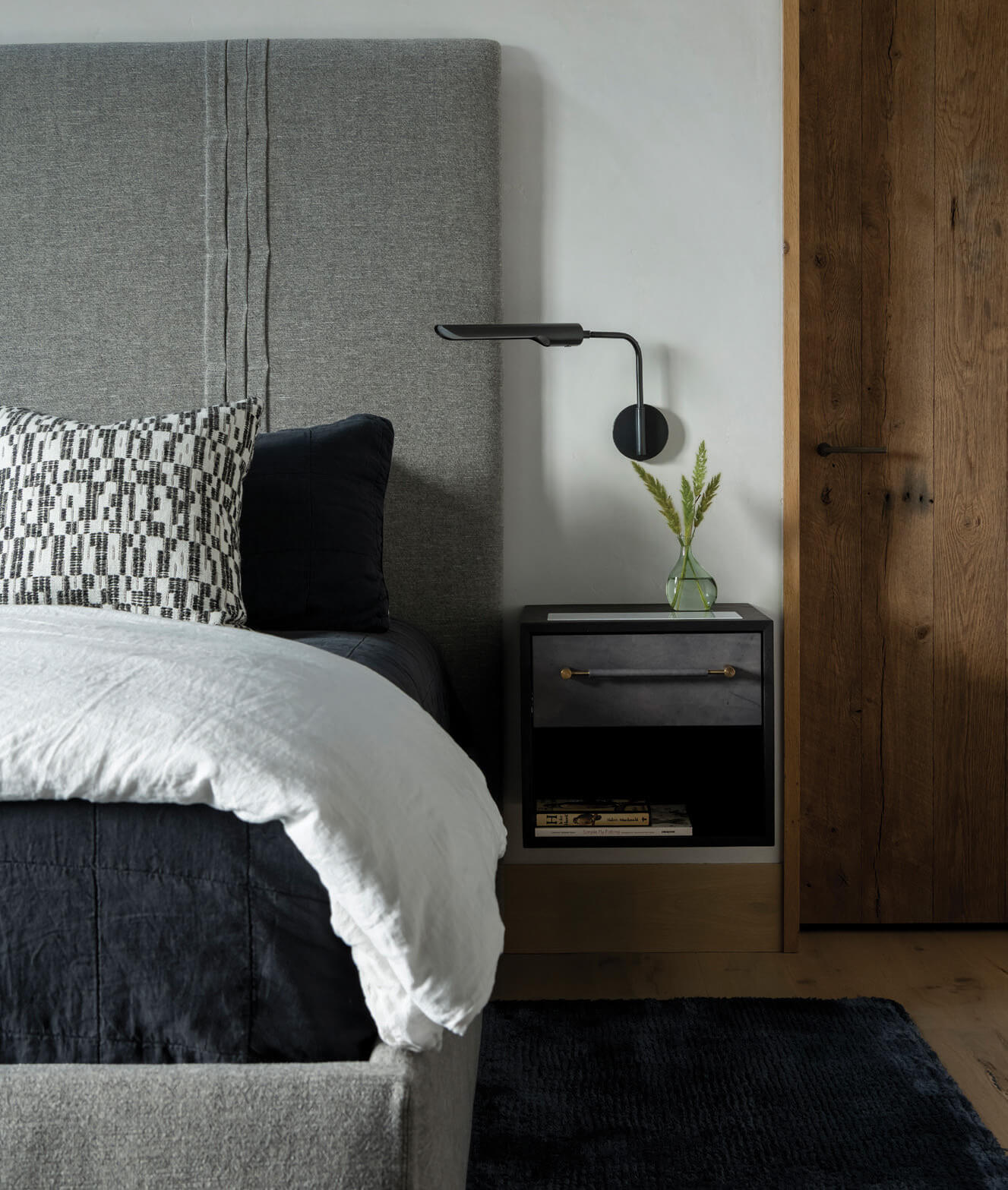
Luxurious finishes executed with subtlety and finesse abound. Here, a black-and-white palette defines a guest room. The bed is covered in gray wool while Wren & Cooper wall-mounted nightstands offer a practical place to stow nighttime essentials.
Given the level of thoughtful design and detail throughout, constructing the home and accessory structures was no easy feat. “The property itself is spectacular, a large ranch that almost feels like a national park given its beauty, vistas, and wildlife habitat,” says Evans. “But it’s very remote — a couple of hours from any major city. This caliber of home is not easy to pull off anywhere, but especially this far from bigger cities.”
As such, getting skilled tradespeople to the site was a challenge. “We try to hire as local as possible, and we found some very talented craftsmen in the small communities nearby, but we did have to bring in labor from across the state, especially for some of the more specialized trades,” Evans adds.
Created by Pearson Design Group’s lead interior designer, Katara Cade, the interiors of the various structures further play off the surroundings, with finishes and furnishings that align with the construction materials and also the tones and textures of the landscape.
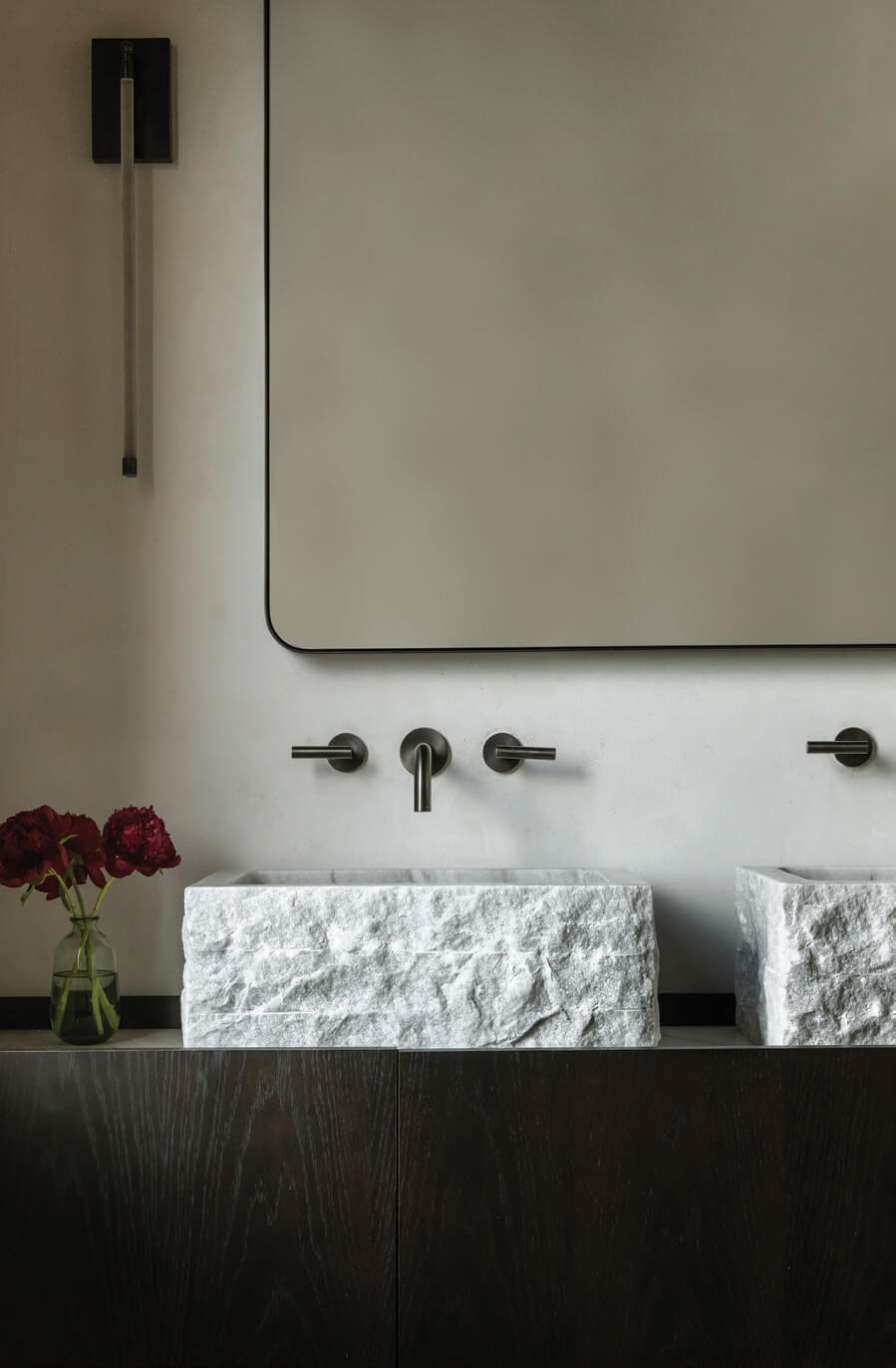
Dual basins, custom cut from white marble, sit atop a dark-stained oak vanity in a guest bath.
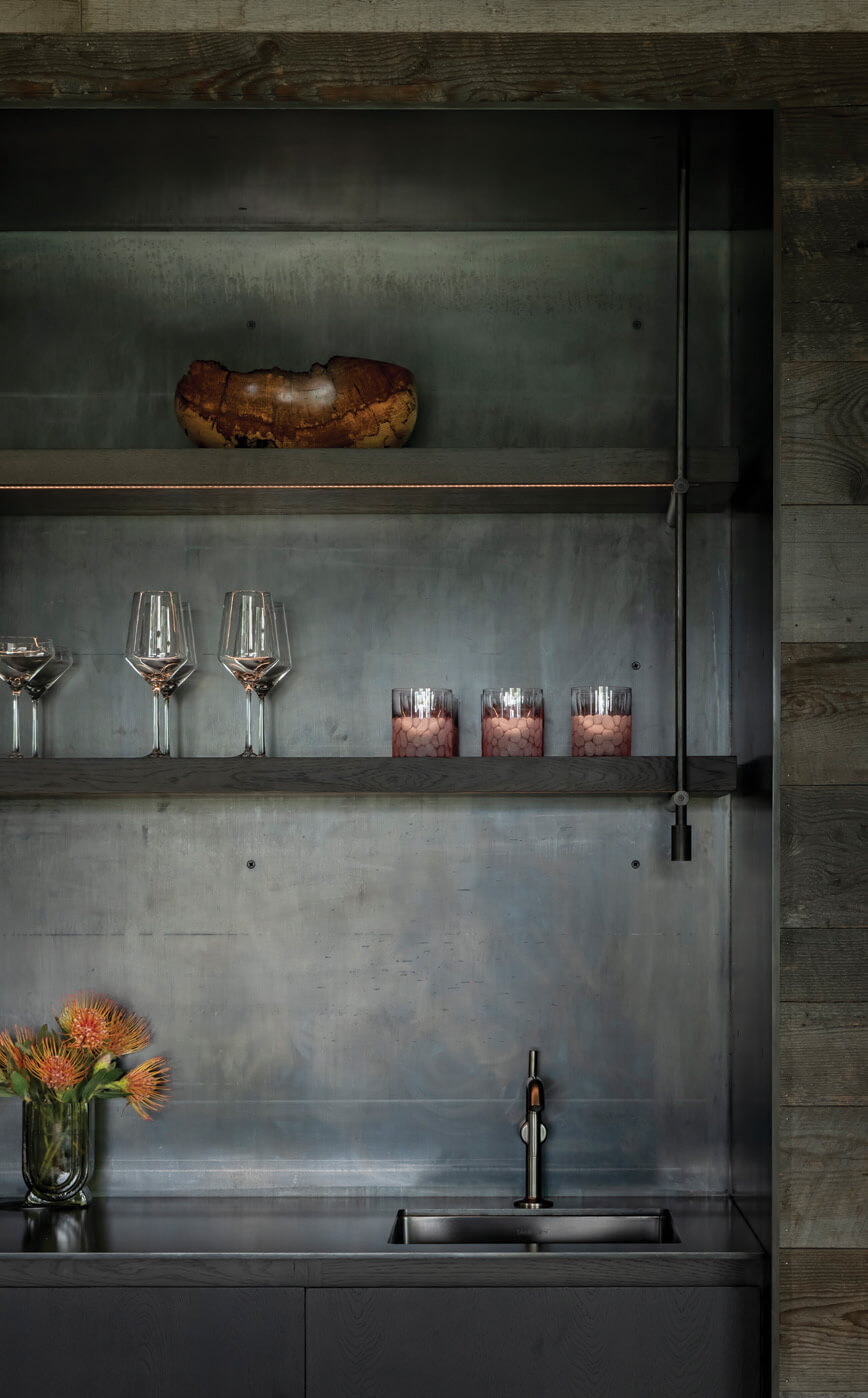
In the lodge’s dining room, a wet bar framed in steel and blackened oak offers a refined take on ranch materials, balancing rugged textures with clean, contemporary lines.
“The goal was to create a sense of quiet luxury while still honoring the landscape and the ranch’s role as a place to gather,” says Cade. Overlooking a mountain peak in the distance, for example, a quartet of hide-upholstered stools and patinated metal shelves in the main lodge’s bar area bring rugged yet refined notes of contrast to the interior’s rusticated surfaces. In the same structure’s dining room, which seats up to 16 people, a tree trunk forms the base of the dining table while a live-edge slab serves as the top. “There’s a specific balance between organic and structured elements — the flowing edge of the dining table draws the eye outward, a sculptural accent chair subtly references antlers, and the console rests on a hollowed tree base,” Cade continues. “Those pieces are grounded by more modern elements like a geometric rug, squared steel dining chairs, and a linear light fixture.” Similarly, the custom table in the dining area of the main house, though more refined, features a petrified wood slab atop a steel base, complementing the linen-textured poured-concrete counters of the adjacent kitchen island and attuning with the environs outdoors.
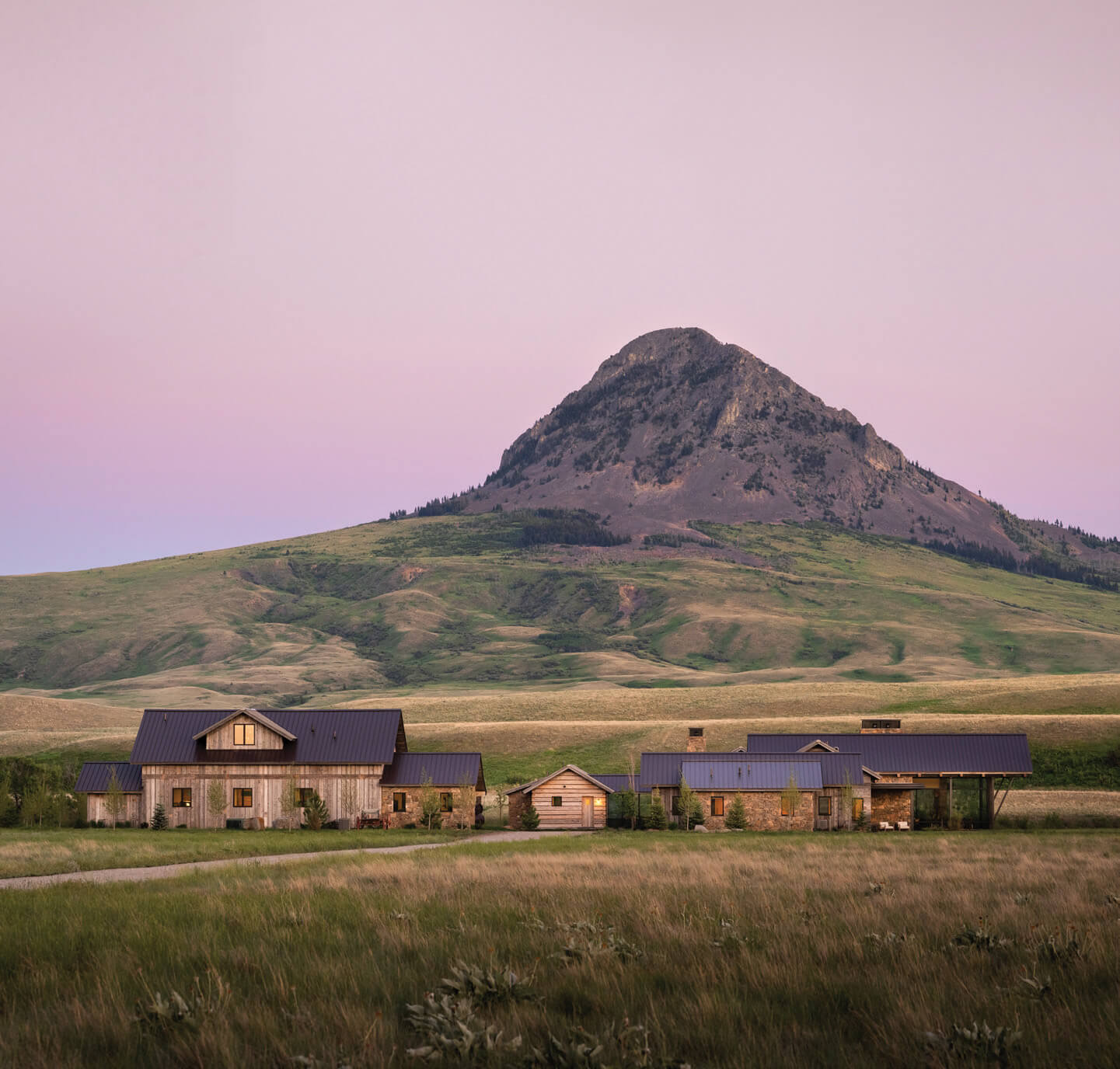
Varying ceiling heights and forms give the compound’s outbuildings the character of structures added over time, while their placement captures views and protects them from strong winds off the Northern Great Plains.
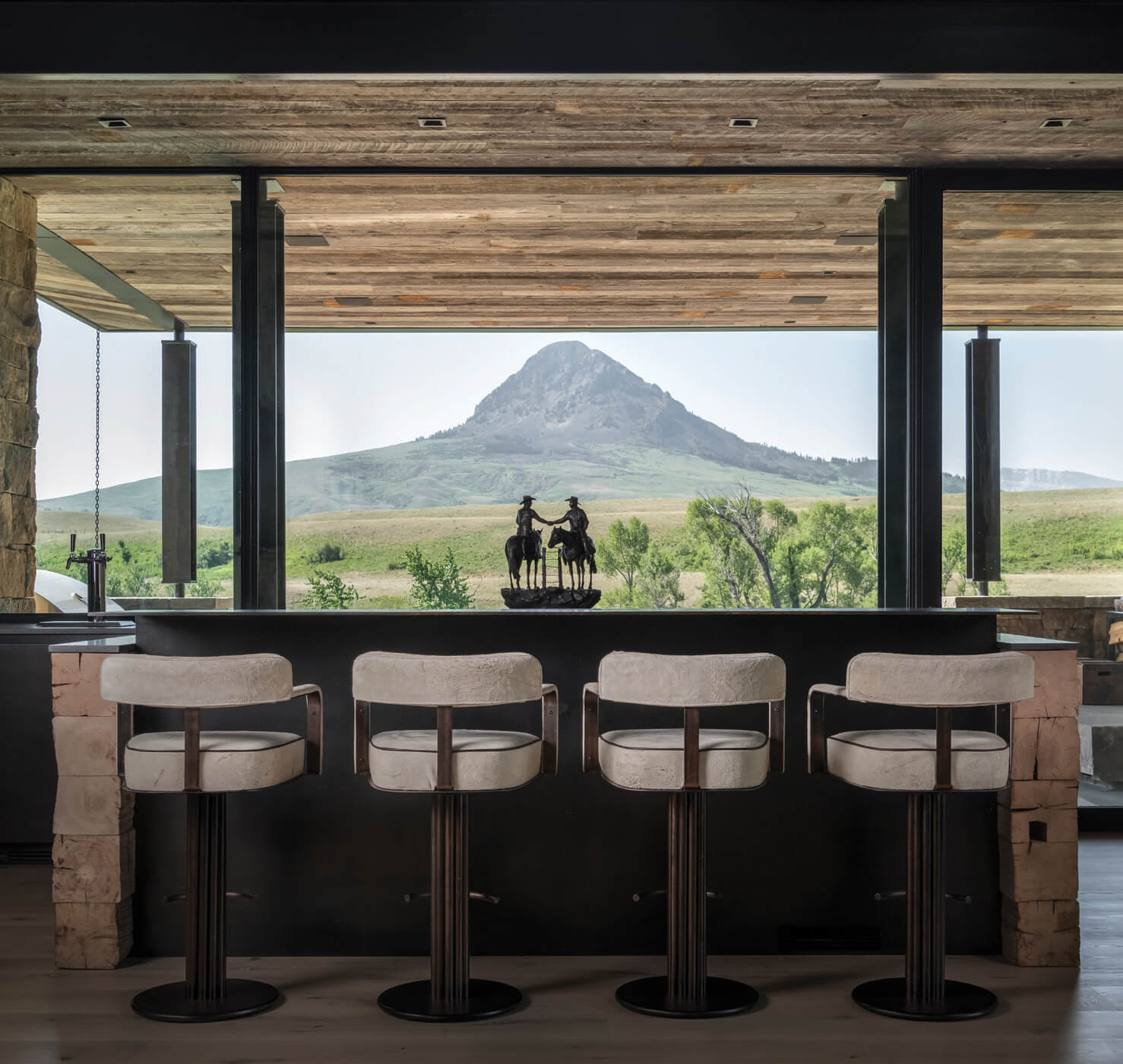
Throughout the main house, lodge, and guest quarters sculptural elements elevate the interior atmosphere while glazing expertly draws the outdoors in. A quartet of hide-upholstered stools in the bar area of the lodge are positioned to take in the spectacular surrounding views.
“From the start, the client was clear that these interiors were meant to be lived in,” Cade says. “Not only did the pieces need to be beautiful, they also had to stand up to the realities of ranch life and constant entertaining.” The lodge’s upholstered sectional from Minotti, covered with a dark-plum fabric for a subtle touch of color, is paired with live-edge nesting tables atop a rug by Integral Thread. “We even custom-colored the great room rug to match the client’s dog so it would better hide the shedding,” Cade adds with a laugh. Bedrooms and baths extend the visual theme with custom beds and furniture layering in touches of luxury, such as the leather-wrapped bedside tables in one bedroom that are inlaid with marble and accented with brass. Dual basins in one bath are carved from blocks of white marble; the tile in another is imported from Belgium. Western art pays tribute to the property’s ranching character and, like sculptural artworks, distinctive light fixtures and historic objects add dimensional touches to every room.
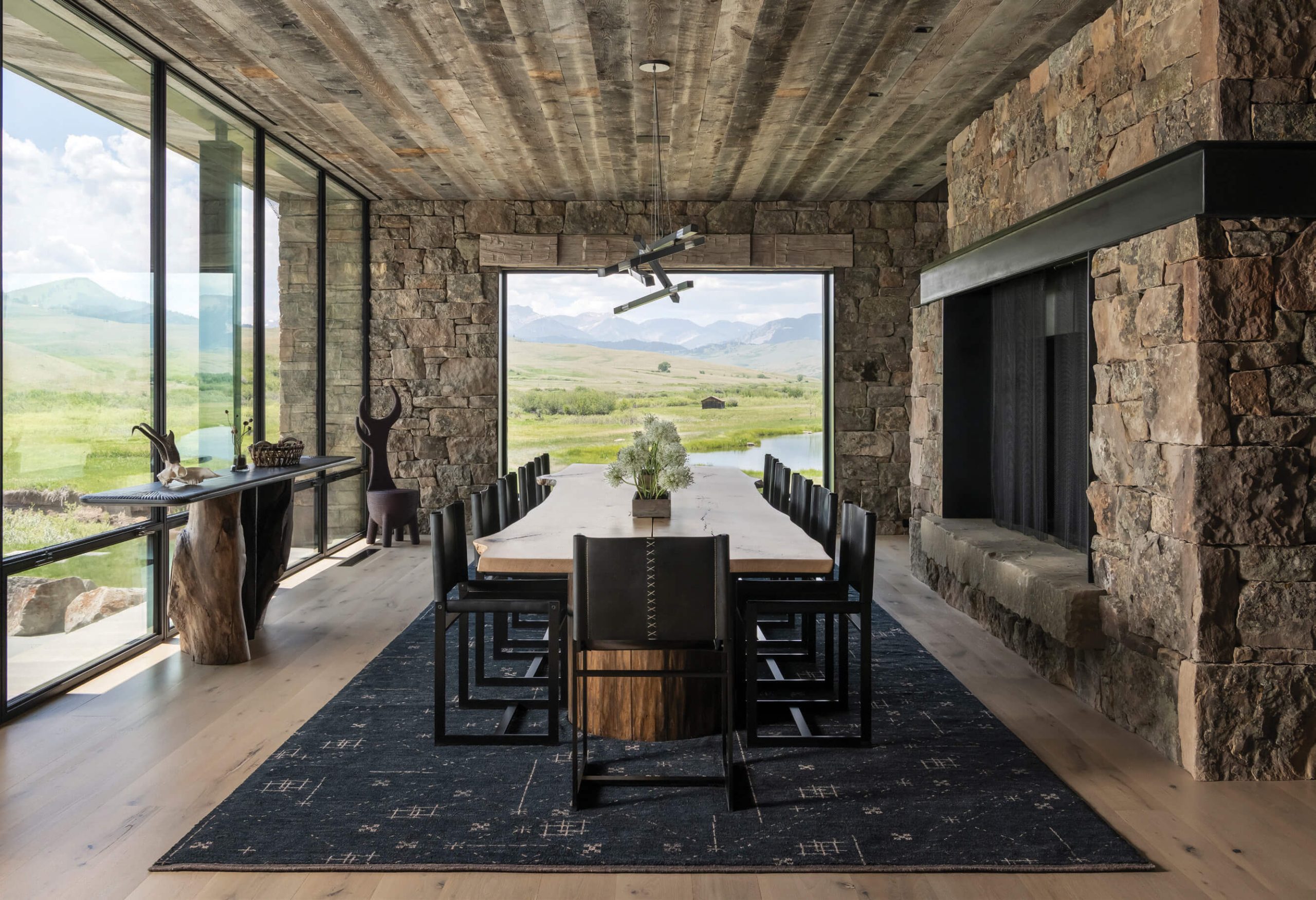
Vistas of the mountains and a serene body of water are framed like a landscape painting through massive custom windows in the lodge’s dining room. The table’s base was cut from a tree trunk and topped with a live-edge wood slab. An offbeat chair from Holly Hunt made of painted rope adds a sculptural note in one corner, as does a compelling yet minimalist pendant fixture over the table.
Certainly the design-build team’s collective efforts speak for themselves. “We never lost sight of the fact that this wasn’t an ordinary piece of property,” Tollefson concludes. “It’s an ecosystem unto itself, adjoining immense public lands, and we were driven to pay homage to the landscape.” Clearly, they accomplished that mission with resourcefulness and great finesse.
A journalist based in Miami Beach and New York, Jean Nayar writes about interior design, art, and people for publications such as Milieu, Cottages & Gardens, and Interior Design. She is also the author of several books, including Living In Style New York and Living In Style Country (teNeues).
Based in Aspen, Brandon Huttenlocher is an architectural and design photographer whose work has appeared in outlets around the country. He loves blending his passion for the outdoors with his architectural photography. When he’s not working, he can be found spending time in the mountains, whether snowboarding and splitboarding or biking and backpacking.
No Comments