


09 Apr Inspired Living
Architecture and Interior Design | MMW Architects
Construction | Jeremy Seifert Construction
For decades, a family with Big Sky roots enjoyed natural beauty and quietude from their secluded parcel occupying a rocky, tree-covered slope on a cove at the southern edge of Flathead Lake. But the accommodations their getaway offered were quite rustic by present-day standards. Two separate, very basic cabins occupied the land. One, older and set higher upslope on the property, offered easy access to the narrow road leading to the area from the nearby town of Polson, but it was barely habitable and not convenient to the lake. The other, built in the 1970s, sat closer to the shoreline and had a small boathouse nearby, but it sorely lacked any modern conveniences, not to mention it was difficult to access down the steep site from the road high above.
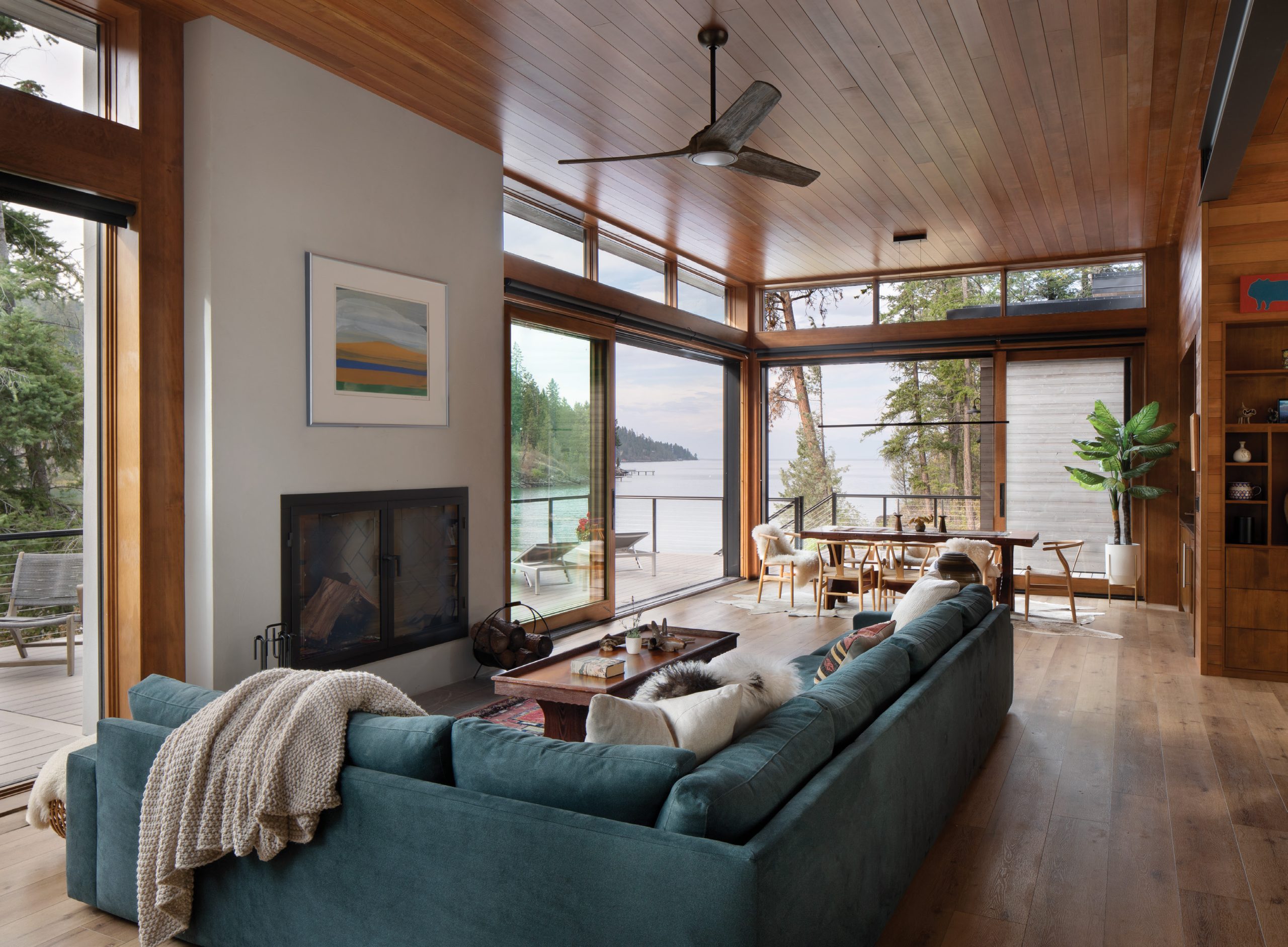
Most of the lake-facing great room is devoted to living and dining areas that glory in watery vistas beyond a spacious outdoor deck reached by floorto-ceiling glass sliders. A Montara sectional sofa from American Leather angles toward both the water and the fireplace. Above the fireplace hangs a silkscreen monoprint created in 1972 by Oregon modernist Hank Kowert [1924–1977].
Finally, with her son and daughter grown and raising children of their own, the owner — herself the second generation to consider the place a second home — and her offspring decided that big changes were necessary to turn the property into a welcoming place where family members and friends alike could gather. To accomplish that feat, she commissioned Angie Lipski, a principal architect with MMW Architects in Missoula, who’s developed particular expertise in “figuring out how to bring different people together on the same aesthetic page.”
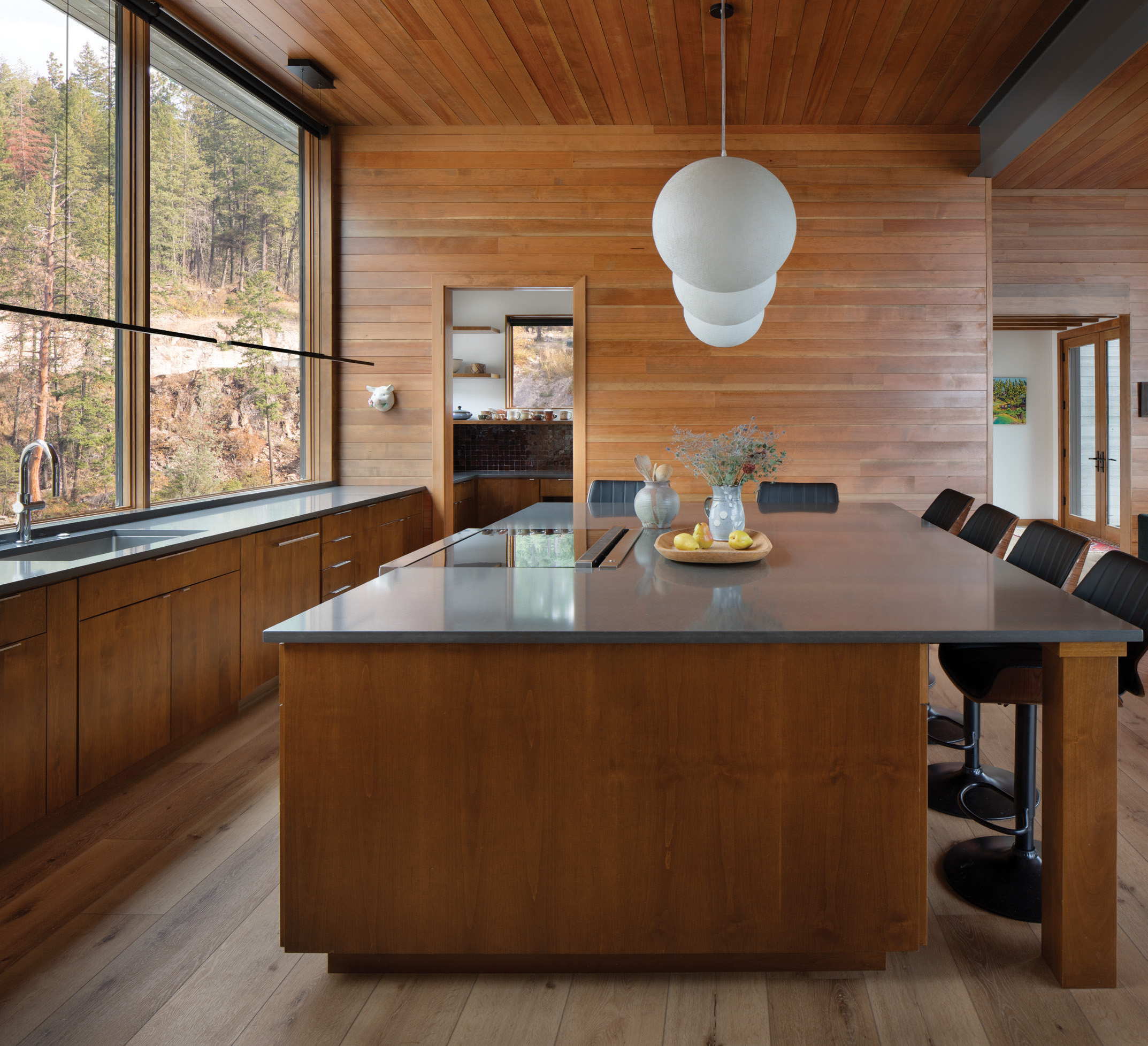
The kitchen features generous workspace for both large-scale meal prep and casual bites.
Lipski sought extensive input from the primary owner, as well as her son and daughter and their respective families. “We wanted them all to feel heard,” she explains of a process that aimed to find “that Goldilocks ‘just right’ within a project.” To reduce the potential for miscommunication, Lipski and her team executed 3D-printed models of three different proposed styles, along with floor plans and elevations, storyboards, photos, and cost estimates for each scenario so the clients “could really see where the house would sit in the topography and what it would look like.”
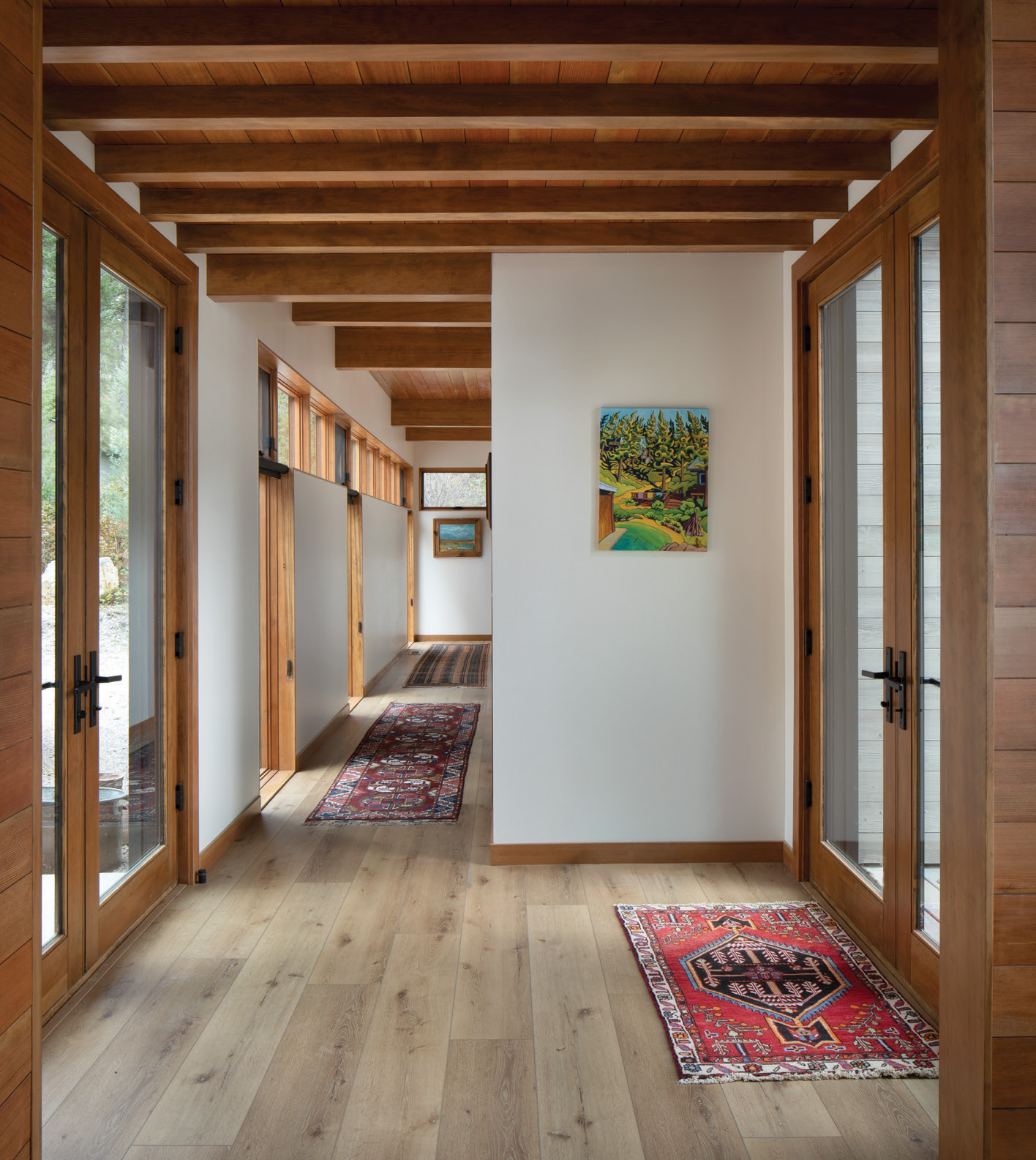
A glassed-in connector between the great room’s living area and the family/guest bedroom hallway opens to both the parking court and, opposite it, the deck and a short stairway down to the shore. Near the lake-facing door, a painting by New Zealand artist Hugh Walcott depicts the site with its two original cabins. At the far end of the hall hangs a landscape by the family’s paternal great-grandmother.
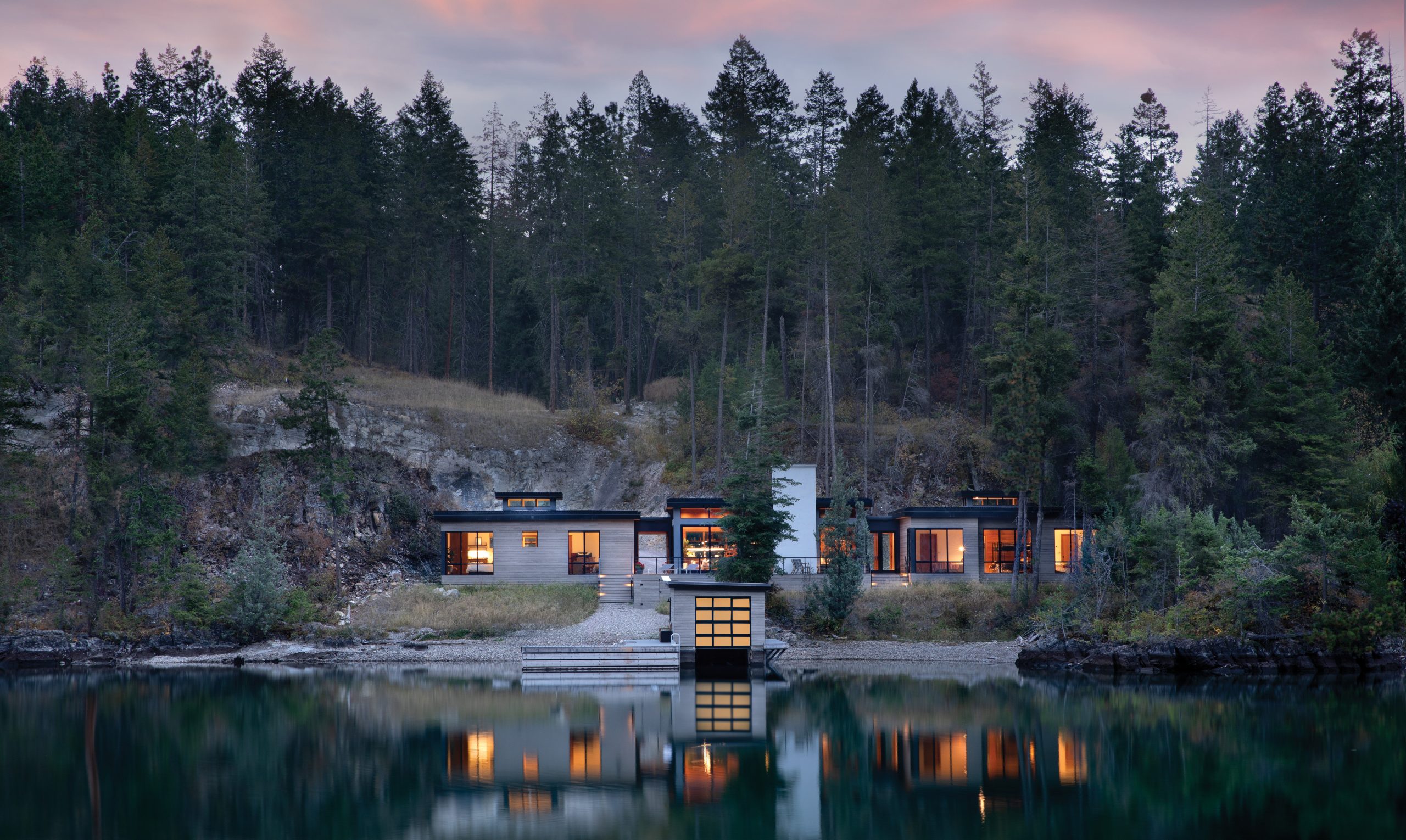
The result of all that advance planning was an agreement to create, on a narrow strip of level land along the lakeshore by the existing boathouse, a streamlined, contemporary, one-story house totaling almost 3,000 square feet. “We could have built it a teeny bit bigger, but then we would have had to take out some huge trees,” notes Lipski.
“I think of myself as a choreographer of space,” she adds. To provide a floor plan that would flexibly serve the needs of multiple generations in various combinations, she carefully planned the structure as three separate but interconnected pieces.
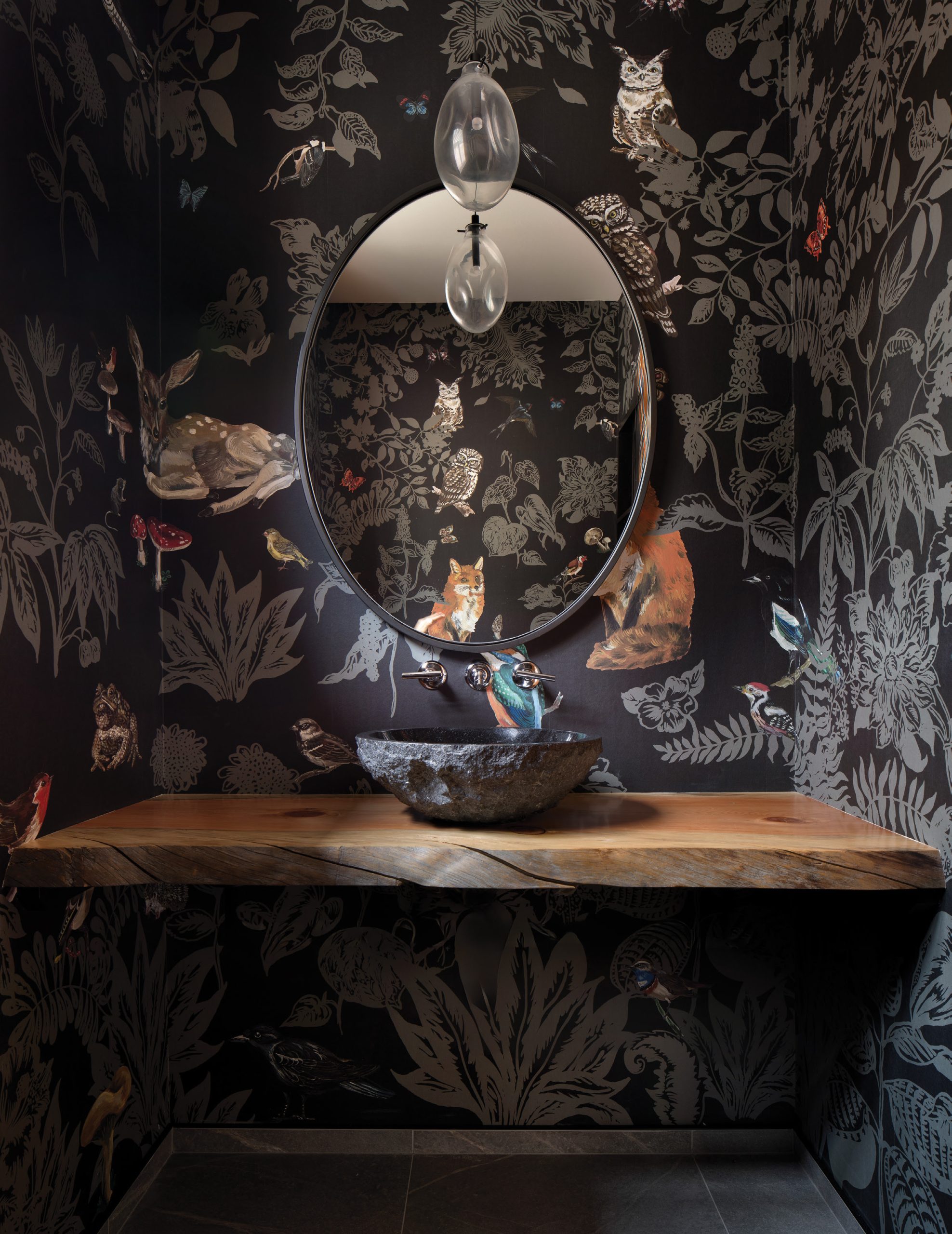
Off the main entrance, a powder room visually immerses visitors in a woodland fantasia with Greener Grass Design’s Forêt Noire scenic wallpaper designed by Nathalie Lété. Atop the live-edge pine counter sits a Grahame Mandy Black vessel sink from Anzzi.
At the center of this architectural dance is a large open-plan communal space for living, cooking, and dining, with cabin-like wood-paneled walls and ceiling that underscore the sense of a rustic retreat despite their clean, contemporary finish. On either end of this great room — linked by glassed-in hallways that Lipski playfully refers to as “gaskets” — are bedrooms, their walls covered with sheetrock to add “a little sense of modernity.” The one at the home’s northern end includes the primary bedroom, which gazes across the water toward Glacier National Park some 70 miles away, along with a guest bedroom and a shared bath. At the southern end is a second wing for family or guests, capable of sleeping up to 12 people, with three bedrooms, one of which features two pairs of queen-sized bunks, and a laundry room. The glass gaskets also provide the home’s primary entrance from a parking court and easy access to the guest bedroom wing, while both also open to an outdoor deck facing the lake.
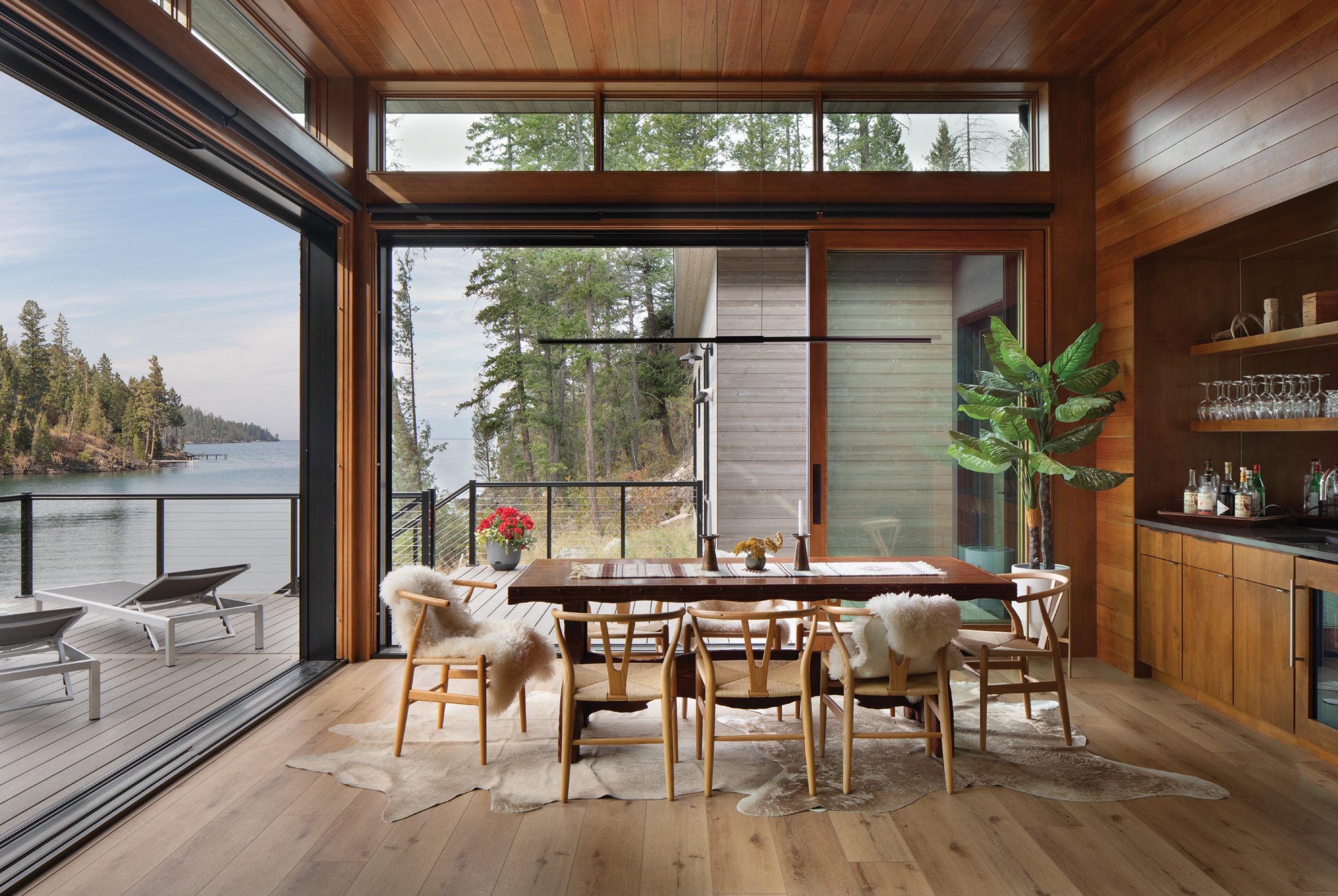
At the great room’s dining end, guests can gather at a family heirloom Bavarian-made dining table (which matches the nearby coffee table) to enjoy meals with the sensation of being in a boat on the water. A built-in cocktail bar and wine refrigerator efficiently complements all entertaining needs. Out on the deck are Crosstown Aluminum chaise lounges from Brayden Studio.
With the layout and style agreed upon and the plans approved, one more key challenge remained: There was no way for the workers, let alone the people who would ultimately be living in the house, to access the shoreline site.
“It’s so super-steep that you couldn’t drive down there, probably not even in a pickup,” says Jeremy Seifert, owner of the eponymous construction firm. Seifert’s start-to-finish work on the project began with creating a new driveway that now winds down the hill from the road above.
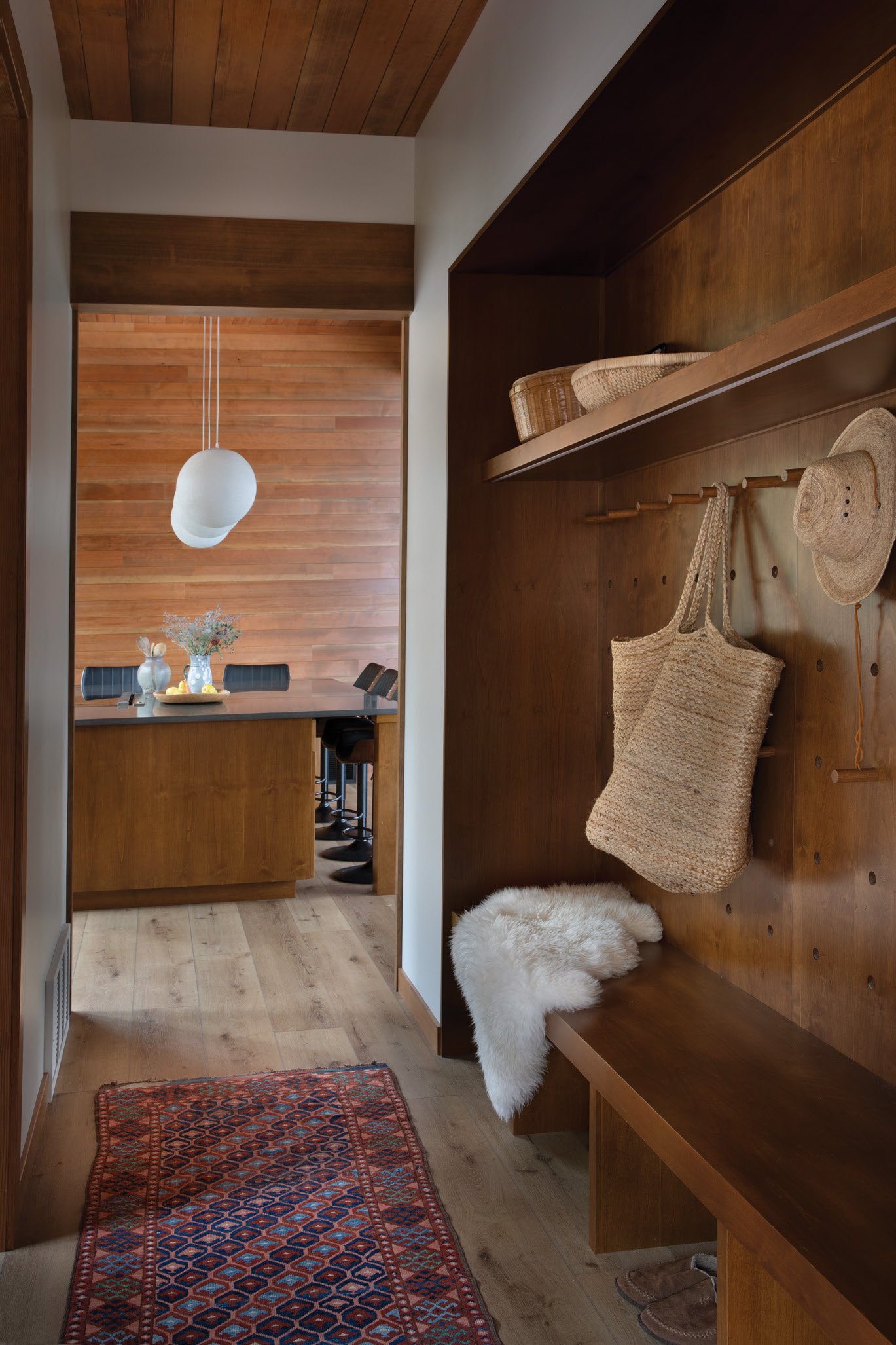
Opposite the powder room, well-crafted storage includes adjustable-height pegs for hats, coats, and totes; a shelf for baskets and parcels; and a bench for slipping off outdoor shoes and stowing them in cubbies beneath.
“The crew spent months with heavy equipment, hammering, picking, and cutting as much as 40 feet deep through the solid rock.” Nor was that the end of the excavation work, he adds. “They were also out there for another month and a half drilling a water well 700 feet deep, as well as blasting septic fields 300 feet uphill from the homesite.”
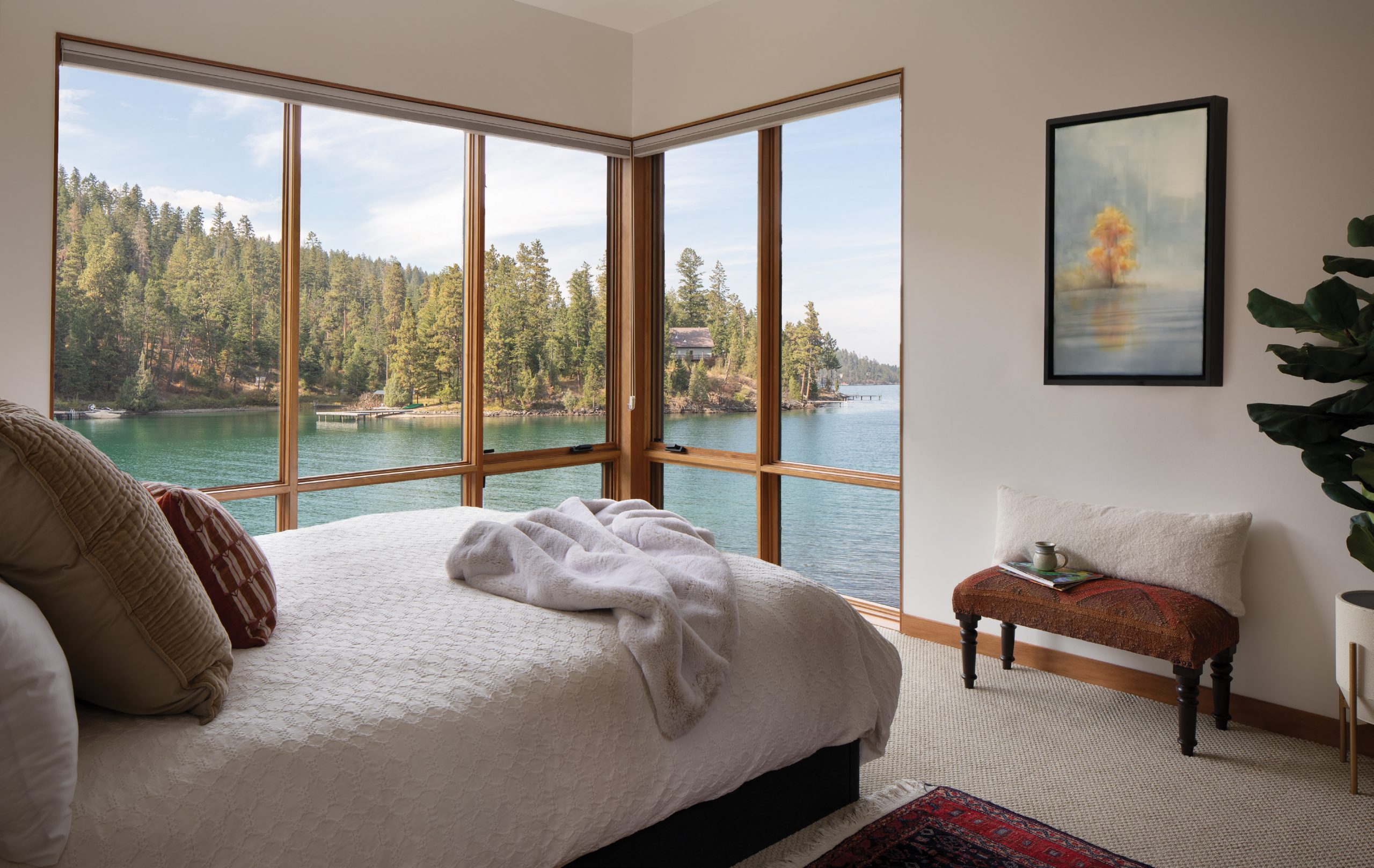
With its corner windows jutting out toward Flathead Lake, the primary bedroom feels like a premium stateroom on a ship. Along with admiring the view, the owner can also gaze at Silver and Gold, a dreamy acrylic landscape by Idaho-based artist Brian Sostrom. Just below it sits a mug for morning coffee, made by Billings-based ceramic artist Danny Bealer.
Finally, a construction crew that eventually totaled about 30 could access the site and — over the course of about a year and a half of construction — bring Lipski and her clients’ shared vision to life. The completed house, which was ready to move into toward the end of 2024, exceeded the clients’ expectations. “They told me, ‘We never thought we could find something that represented all of us. It’s even better than we expected,’” Lipski recalls. “But that’s what I aim to do in my work: to be a curator of their thoughts, needs, goals, and dreams.”
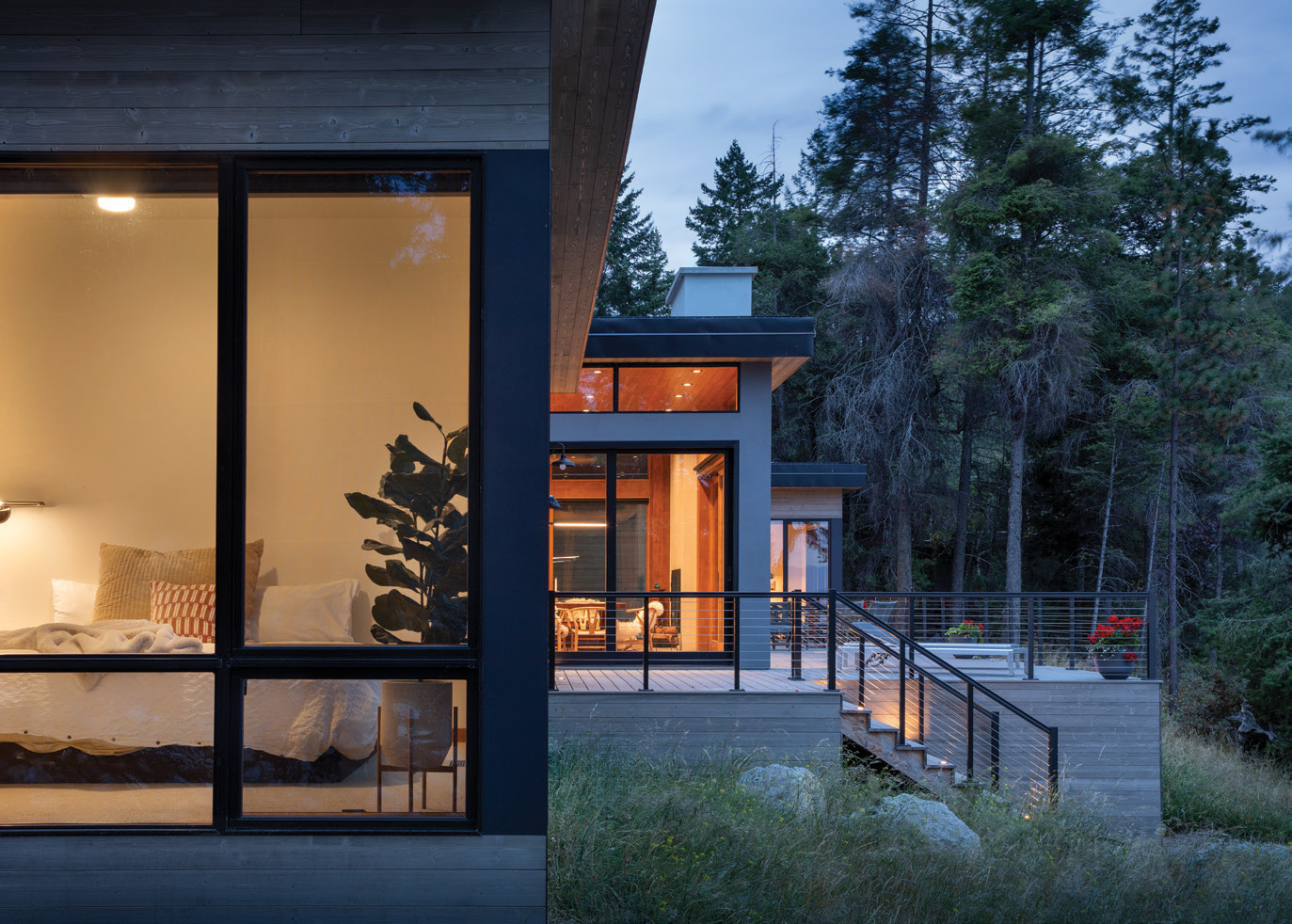
A view from its northeastern corner nearest the primary bedroom dramatizes how efficiently the slightly staggered floor plan provides unimpeded lake views while safeguarding bedroom privacy.
Approached from the new parking court, the house itself appears almost demure with its neutral-toned wood exterior and window arrays that admit dawn’s early light into the interiors and offer tantalizing hints of the great room and lake beyond. One step inside the main entrance, however, provides the owners and guests alike with awe-inspiring views of Flathead Lake through the great room’s floor-to-ceiling windows, so close that it can seem as if the house rests on top of the lake rather than along the shore.
“We began to refer to it as ‘the floating house,’” Lipski says, chuckling. “It can feel as if it’s moored on the water.” Such associations are only underscored by the central great room’s impeccable tongue-and-groove wood paneling and ingeniously efficient built-in cabinetry, all of which perfectly suit the adjective “shipshape.”
Lest such seafaring-worthy precision suggests accommodations that tend toward austerity, the interior design that Lipski and her team at MMW Architects also oversaw conjures an air of warmly welcoming ease — and left the family members themselves plenty of opportunities to furnish and decorate the residence with comfortably casual furnishings and richly evocative possessions. That approach becomes instantly apparent in the great room, where a large sectional sofa welcomes everyone to gather and enjoy daytime lake views and a glowing fireplace at night. Its sleek lines and aqueous-toned upholstery, meanwhile, complement the more rustic, weighty lines of the coffee table and nearby dining table — both of which are Bavarian antique pieces that have been in the family for three generations.
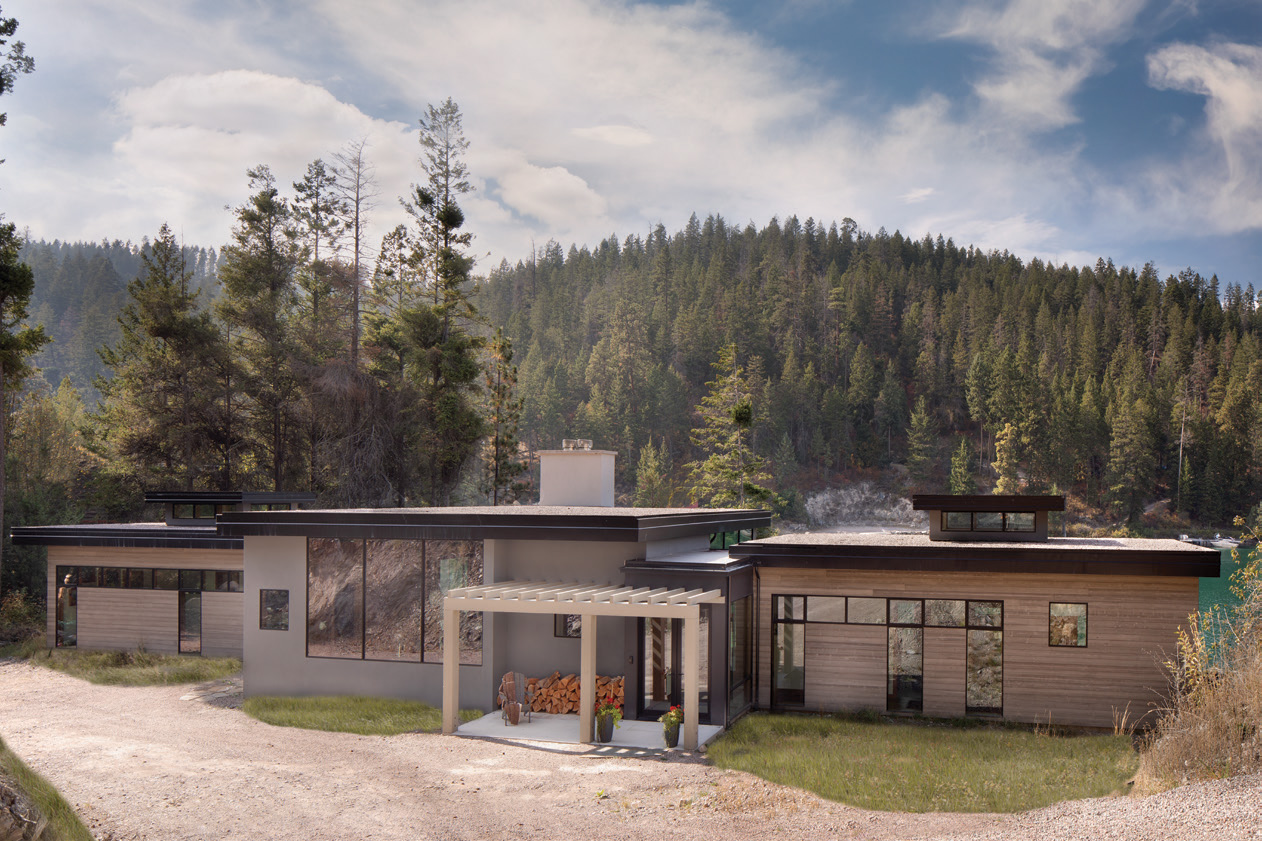
The new driveway that was created to access the homesite from the main road above ends at a gravel court, with additional space for parking just outside a separate entrance to the guest wing.
“They provide a connection back to the great-grandmother, who first stayed at this site,” says Lipski. Still more memories stand on display in two separate built-in units — a wet bar and a hutch — that turn the corner between the dining area and the kitchen, where drawers and shelves house not only practical glassware and dishes, but also meaningful curios and pottery that endow the space with a sense of intergenerational history.
The kitchen itself offers a spacious focal point for both cooking and socializing, with a large island that includes a six-burner induction range with downdraft ventilation and, on the opposite sides, ample space to seat five guests on barstools that face whoever’s cooking and the countertop-to-ceiling window beyond. “As much as the views of the lake, that window allows people to embrace the beautiful, heavily forested, rocky hillside,” says Lipski. “And you fully realize that this house is suspended between cliff and water.”
The home’s two bedroom wings, meanwhile, focus almost exclusively on the water. In the primary chamber, corner lake-facing windows reaching from floor level almost to the ceiling create the sensation of sleeping in a luxury stateroom at the prow of a ship. “In the morning,” says Lipski, regarding the family matriarch, “she can bring the blinds up, sit in bed, and watch the morning sun rise over the lake and the mountains.”
As the day progresses, the home’s occupants will likely be drawn outdoors to the spacious deck. Beyond, just offshore, the old boathouse awaits, its exterior refinished to match the newly built residence. When the day’s activities are done, an outdoor shower adjoining the glass gasket nearest the family or guest wing enables people to enjoy a quick rinse-off before returning inside. Lipski sums up this and other such practical features: “There’s a subtle sensibility and humility to this house that really makes for inspired, multigenerational family living here by the lake.”
From his base in Marin County, California, Norman Kolpas writes about art, architecture, travel, dining, and other lifestyle topics for magazines, including Western Art & Architecture and Southwest Art. He’s a graduate of Yale University and the author of more than 40 books, the latest of which being Foie Gras: A Global History. Kolpas teaches in The Writers’ Program at UCLA Extension, which named him Outstanding Instructor in Creative Writing.
Peter and Kelley Gibeon began their path of collaboration in 2003. Based in the Mountain West, this husband-and-wife duo specializes in luxury architectural and interior design photography. Featured in numerous publications, their passion for their clients and craft shines through in every frame.
No Comments