


09 Apr Between Land and Sky
Architecture | Faure Halvorsen Architects
Construction | Yellowstone Traditions
Interior Design | Laura Fedro Interiors
A passionate fly fisherman, the owner of a new home in Montana had long dreamt of owning a place in the West. As he prepared to sell his business in New England, he imagined buying land where he could cast a line from his own property. After a multi-state search led him to the area around Three Forks — a fabled fishing destination near the confluence of the Jefferson, Madison, and Gallatin rivers — he and his partner found an 1,800-acre property on the Jefferson River, thus fulfilling the dream.
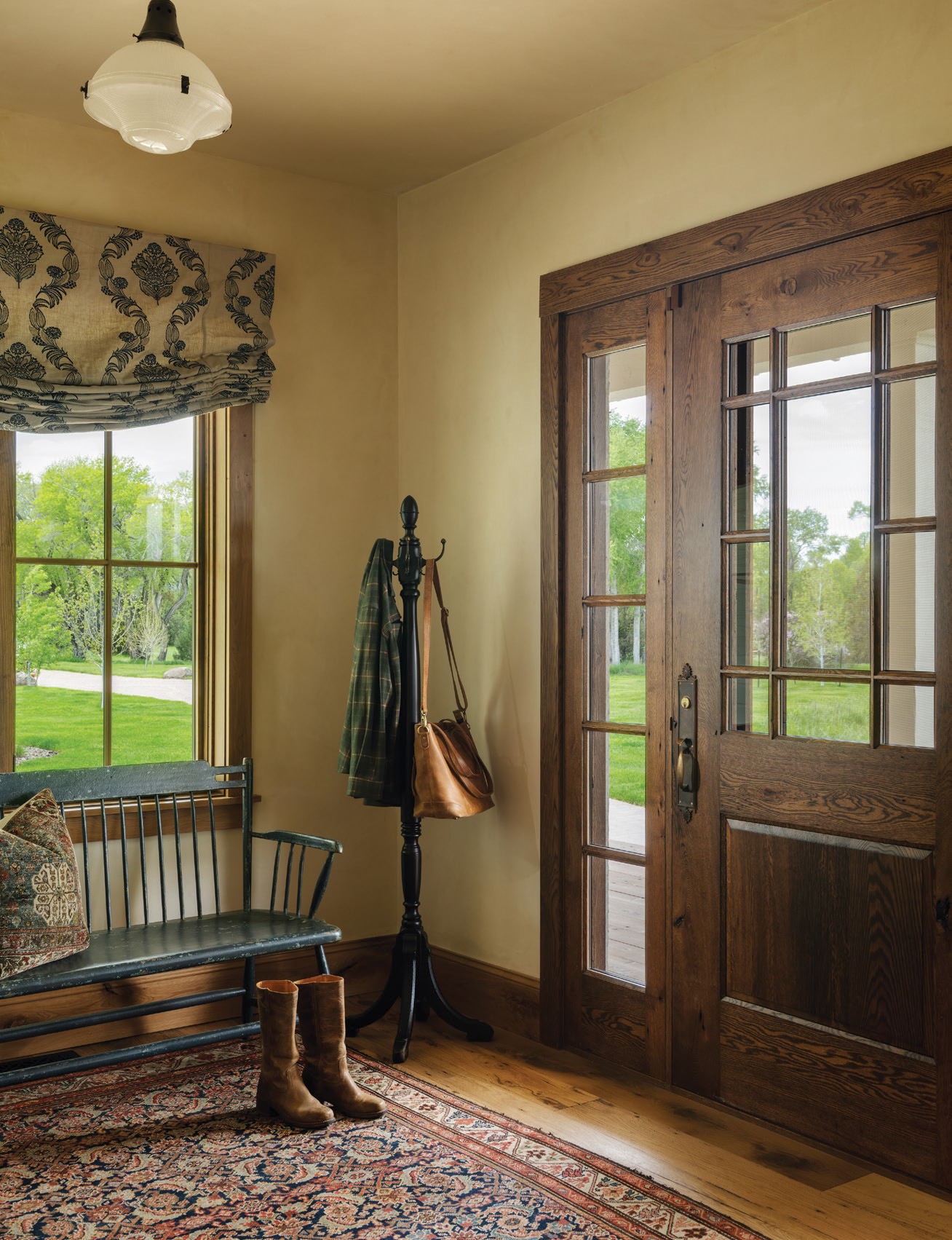
For the central wood-clad volume of the home, the owners and interior designer Laura Fedro agreed that the rooms should have the feel of a true Montana farmhouse, in deference to the agricultural traditions of the community and the property’s own ranching pursuits.
The story comes with a plot twist, though. While establishing their new lives in existing buildings on the property, they’d barely gotten their flies wet when a 12,000-acre ranch across the river came on the market. Within weeks, the couple found they were less anglers than cattle ranchers. They’ve now fulfilled dreams they weren’t aware they had, and, in the process, they have created a home in the West uniquely suited to their new life.
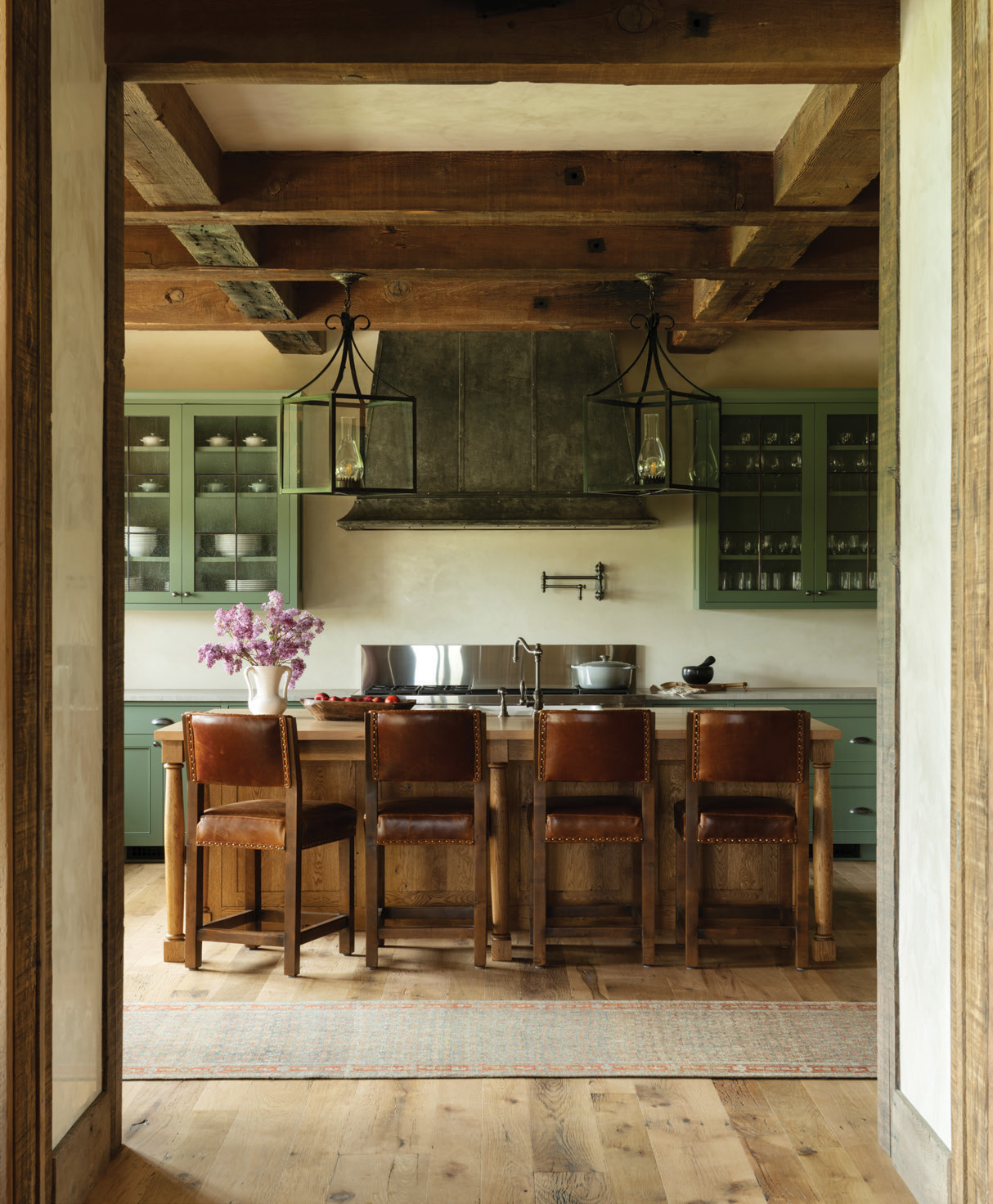
To support the owners’ aim of a home that feels discovered, Fedro kept the interiors simple and clean aesthetically, which allows the textural element of reclaimed materials to shine. The kitchen’s plaster walls and painted cabinets meld seamlessly with the coffered-beam ceiling, patinated range hood, and warm tones of the island and leather bar stools.
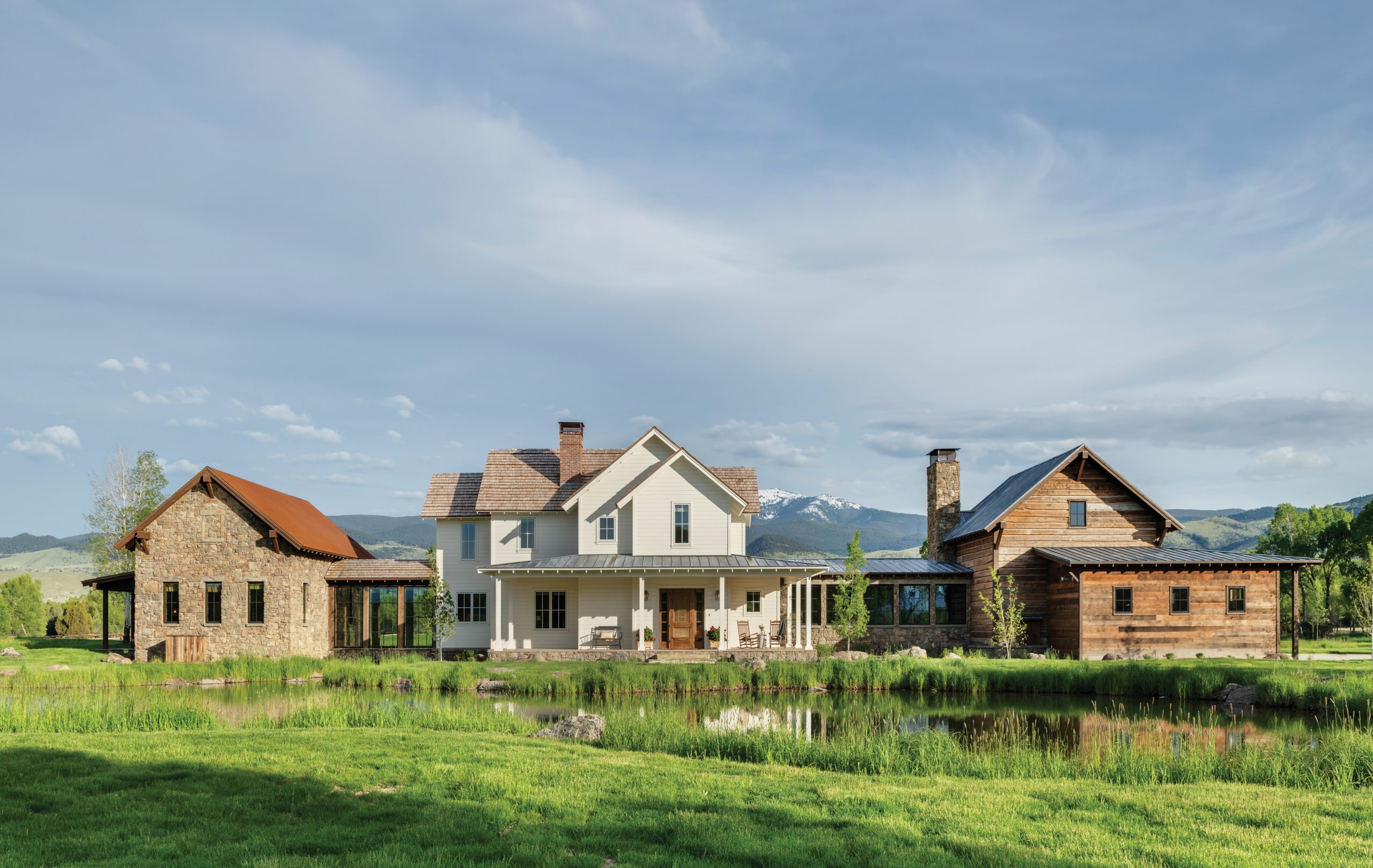
The property was full of potential — located in the heart of a rich riparian ecosystem, with varied habitat for wildlife, an existing classic red barn, a pond, and open areas to take advantage of sublime views of the Tobacco Root Mountains. Rather than constructing a log monolith or a sleek contemporary-rustic structure, the owners and Faure Halvorsen Architects, along with contractor Yellowstone Traditions and interior designer Laura Fedro, envisioned the house as three connected masses — each distinct in form and materiality. These multiple gabled forms, each with similarly steep pitched roofs, give the building the look of a family compound that evolved over time.
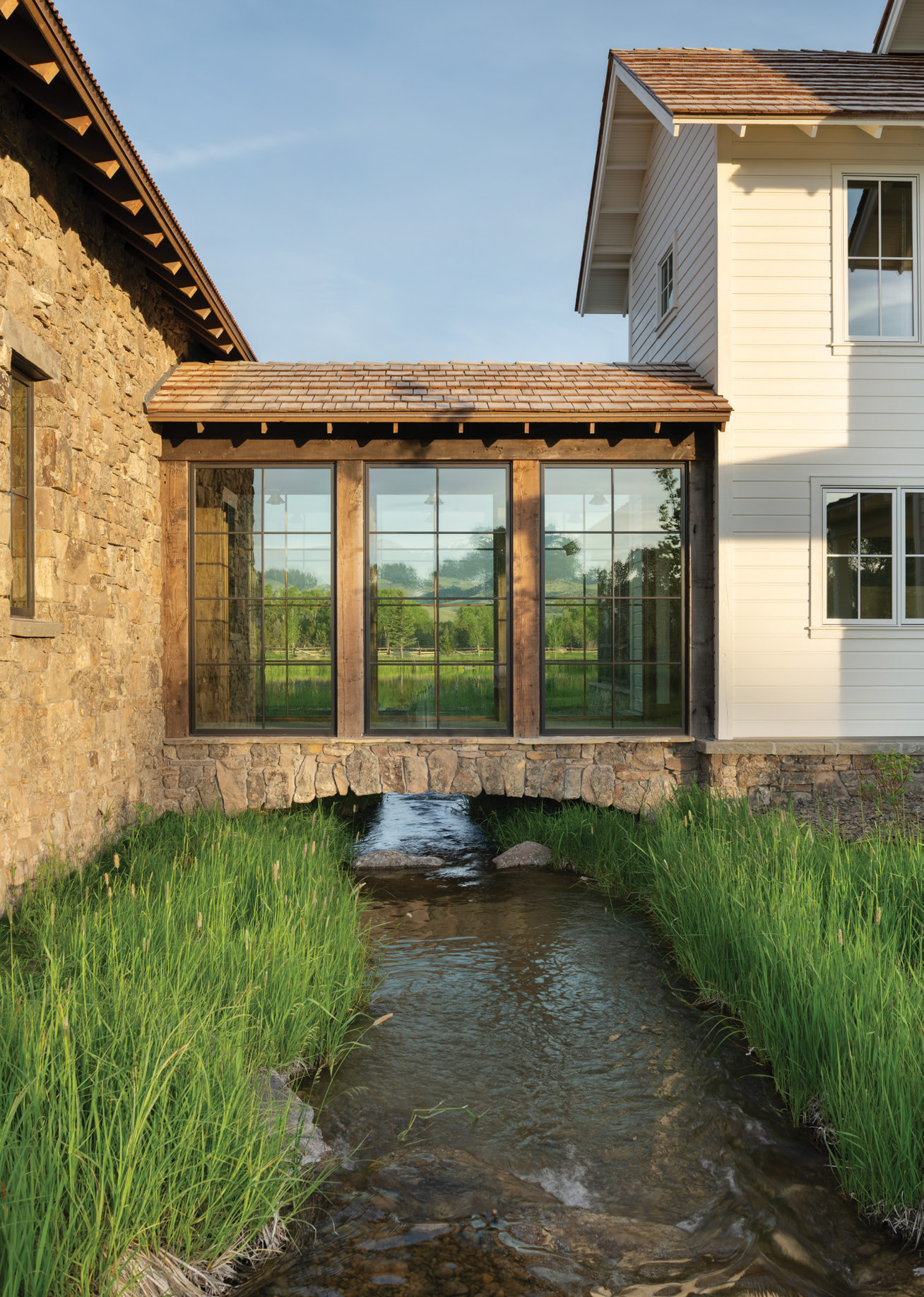
The architecture celebrates live water with a stone-and-glass connective corridor bridging a stream.
At the center lies a white clapboard farmhouse with a cedar shake roof. This is the heart of the home, housing the gathering areas, as well as guest bedrooms on the second floor. Its pillared porch, protected by a shed roof of standing-seam metal, overlooks the main pond. The farmhouse is flanked on the east side by a stone building comprising the primary suite, and on the other by a simple reclaimed wood cabin housing the office, garage, and gym, with an attached shed-like structure that looks as though it was added on later. The ancillary structures are joined to the main home by connective passages, with the glass-walled corridor adjoining the main house to the primary bedroom wing bridging a stream that connects the newly created stocked ponds on the north and south sides of the house.
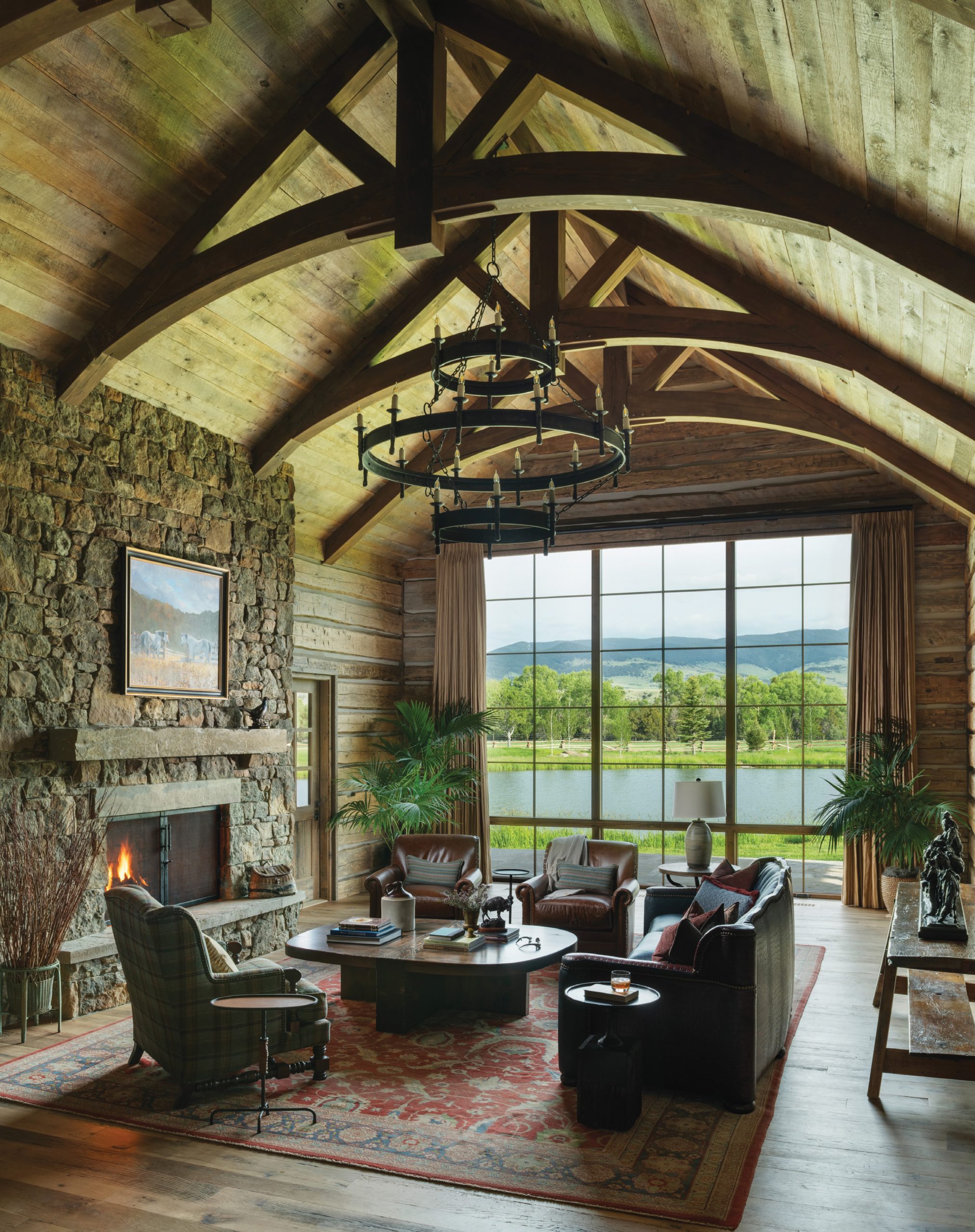
A dramatic but human-scaled timbered great room — with its floor-to-ceiling windows overlooking a pond and taking in mountain views — is the ultimate blend of rustic and contemporary. The iron light fixture was made by Carl Pearson at IronGlass Lighting. All the seating in the great room was custom designed by Laura Fedro Interiors and built by their custom upholstery shop.
“From the beginning, the homeowners were clear that the house should feel discovered rather than imposed, and tucked into the land along the Jefferson River, with the Tobacco Root Mountains framed intentionally,” recalls architect Kipp Halvorsen. “They wanted the scale to feel appropriate to Montana — generous but never grandiose — and broken into volumes that relate more to ranch buildings than a single large residence. The three masses were very much an evolution. The owners were drawn to the honesty of traditional ranch compounds, and together we developed the idea of separate-but-connected forms, each with its own identity, arranged to create shelter, views, and a sense of arrival.”
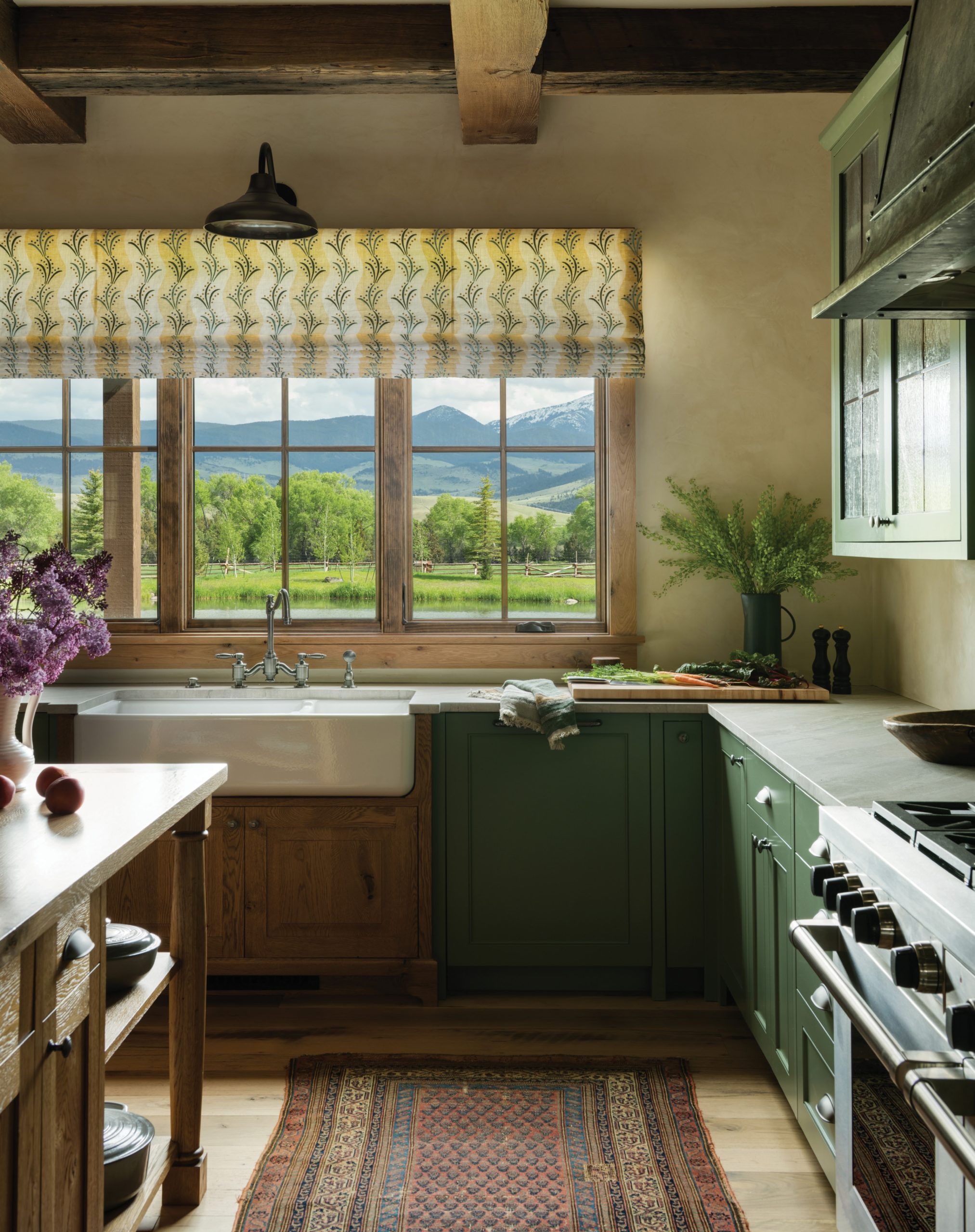
In the light-filled kitchen, painted woodwork, glassfronted cabinets, and a wood island lend a decided country feel. All of the cabinets in the house were custom designed and built by Yellowstone Traditions cabinetmakers.
“We really wanted a home with a farmhouse look because the ranch really is agricultural in nature,” explains the homeowner. “The house that was here was a massive log cabin. We wanted something just big enough to live comfortably in.”
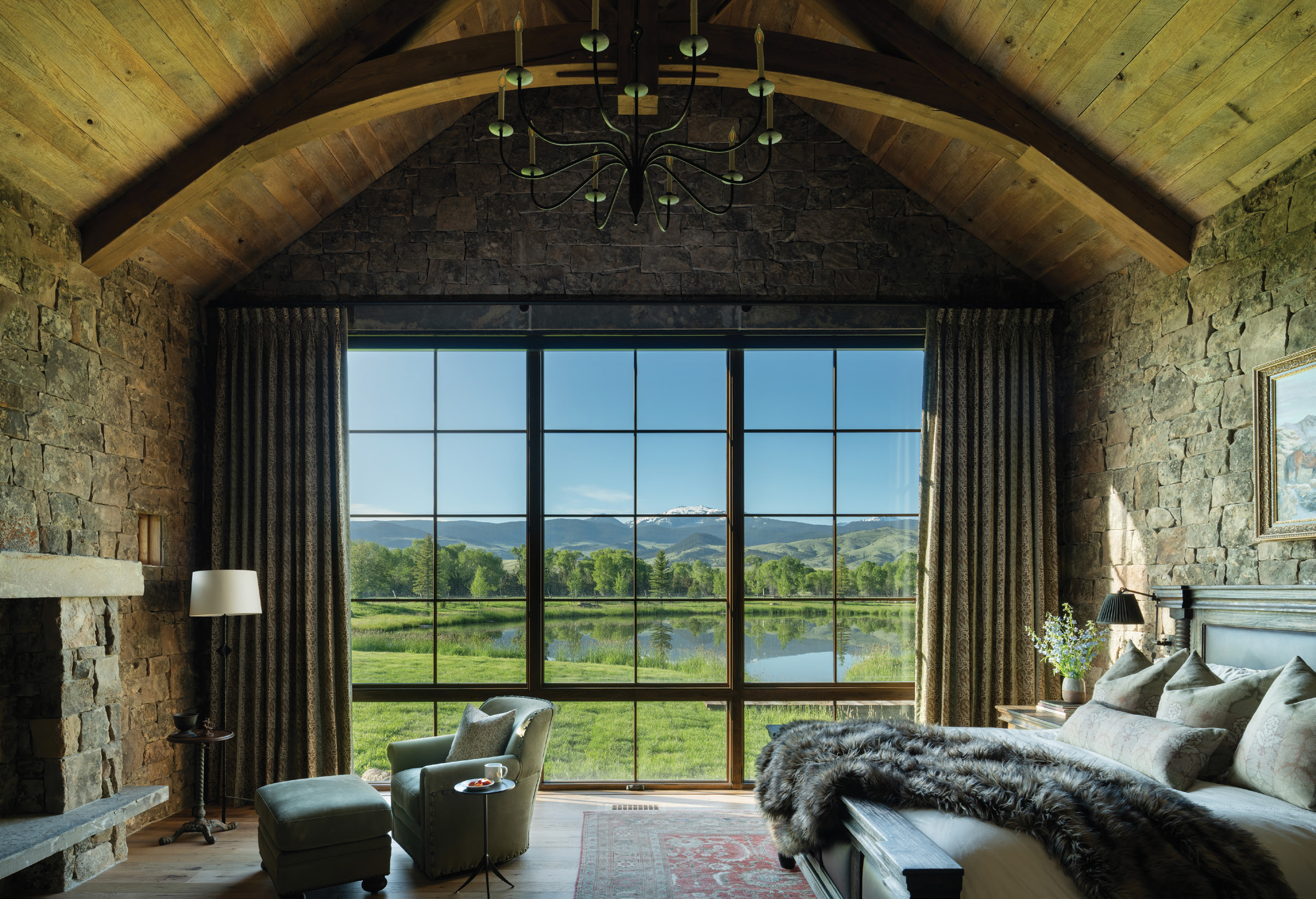
In the primary bedroom, the furniture was custom made, as was the furry coverlet for the dogs. Fedro suggested reorienting the entire room so that the intimacy within is enhanced by firelight, while the views of Brownback Mountain are unrivaled through the paned window wall. Meanwhile, the arched timber frame overhead adds a softness to the stone and steel-framed window wall.
The project was a true collaboration and evolved as time went on, he adds. “Yellowstone Traditions was incredibly good at the creative part of what we did. There was no idea that was off the table. Justin Bowland has a ton of building knowledge, but he also has creativity and could come up with solutions that were both doable and looked very nice. They don’t cut any corners in terms of quality; I expect the house will still be there in 100 years.”
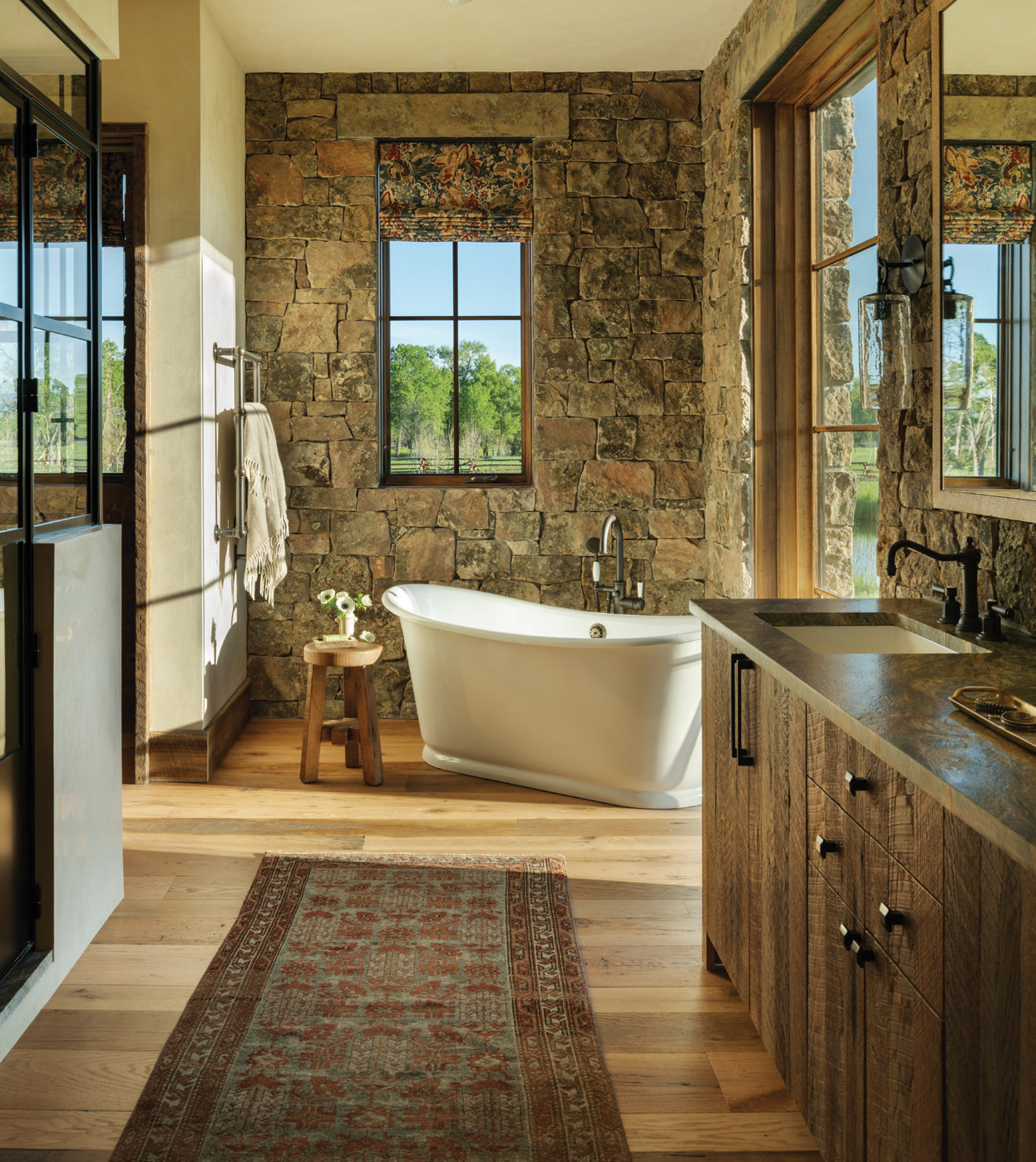
The primary bathroom juxtaposes a white vessel tub against rugged stone.
The structure does inhabit its site in a way that is both unique and appropriate to setting. Every space has a strong relationship to the outdoors. In both the living area and primary bedroom, dramatic curved timbers and floor-to-ceiling windows frame a mountain view, the pond in the foreground reflecting the drama of the sky. The primary bathroom juxtaposes a white vessel tub against a stone wall. An adjacent private terrace leads to a stone bridge spanning a stream to a spa set into a grassy expanse. The chef’s kitchen, with its farmhouse sink, custom-forged hood, and large wood-topped island, opens directly to a dining terrace. A screened porch furnished with rustic seating blurs the line between indoor and out.
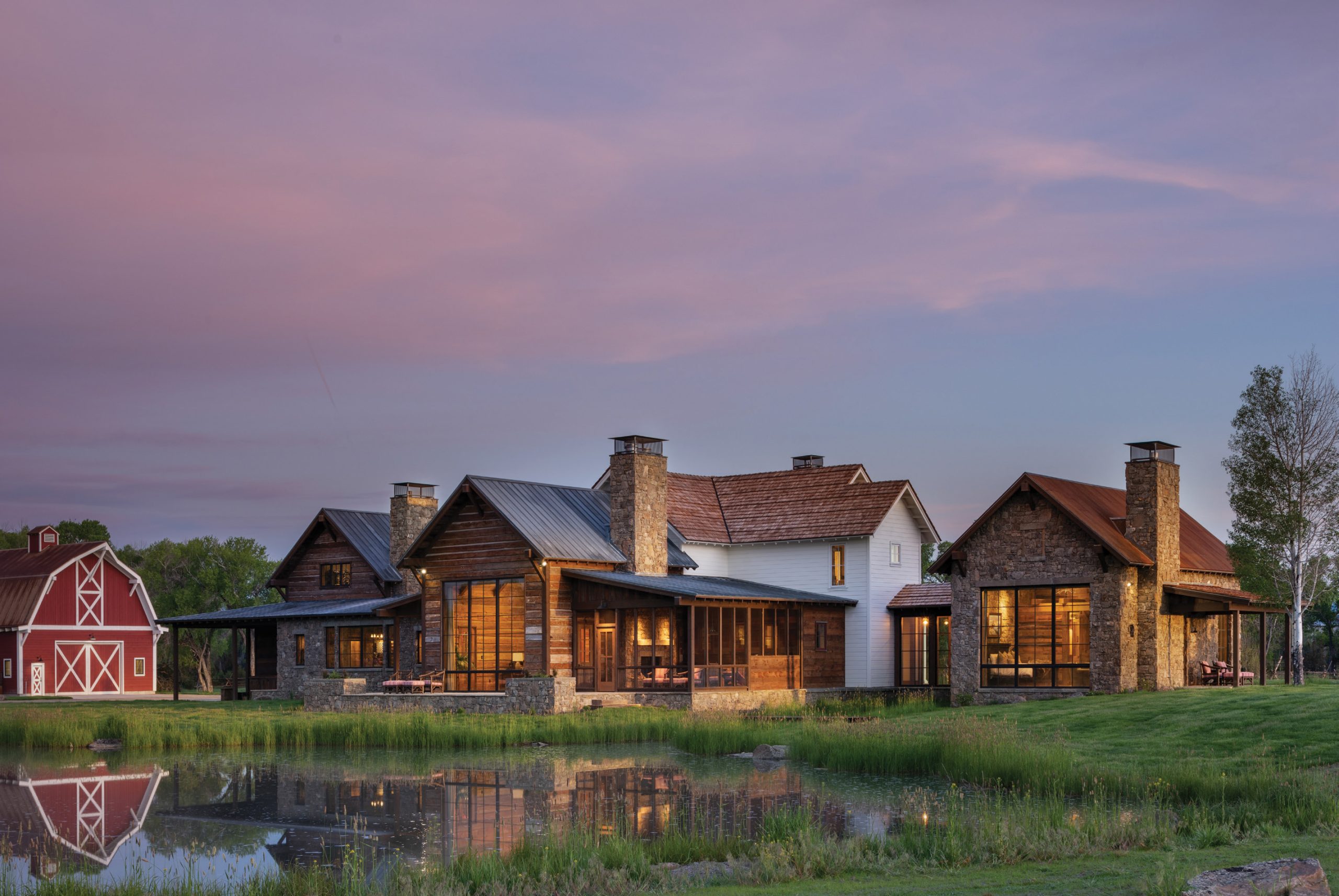
What began as a fishing retreat became a working ranch headquarters. The architecture evolved with that shift, from a seasonal escape to a legacy home rooted in stewardship, resilience, and longterm presence on the land.
Interior designer Laura Fedro and her team were tasked with establishing a tone and palette that would have been appropriate for turn-of-the-century Montana life. “Our design process always starts with both client conversation and presentation imagery,” Fedro says. “This project’s design language sprang from the client admiring a Faure Halvorsen project in the Gallatin Valley, and the myriad talents available within the Yellowstone Traditions team, so those choices made it obvious how to build on what was established within the forms and materiality of the house.”
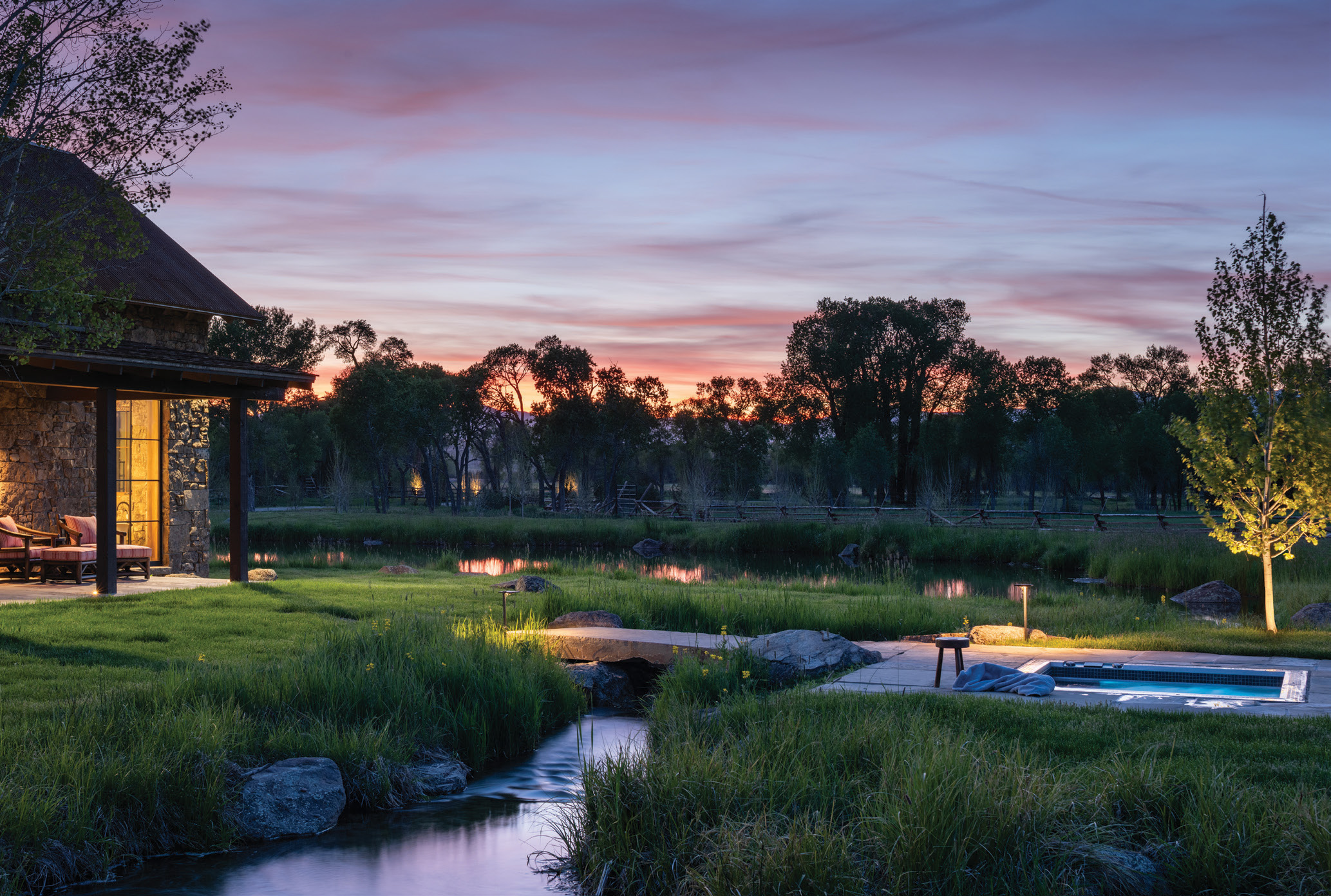
The primary bedroom opens to a private patio and stone bridge to the spa for soaking under a night sky.
The central living space, for instance, replicates a stacked-timber building, with hand-built and tenoned reclaimed trusses overhead. “The spaces came together easily and naturally because of what was already predetermined about the footprint and flow of the house,” she adds.
For the interior furnishings, Fedro says, “We wanted to build on a very simple and clean aesthetic because the house is chock-full of such visually textural, reclaimed materials. We thought the soft, reflective quality of a waxed lime plaster would work so well with all the reclaimed wood. The flagstone floors and stacked stone walls in the entry from the garage, along with the true masonry-built stone fireplaces in the great room, the media room, and the primary suite all lend a gravity and historic quality to the home.”
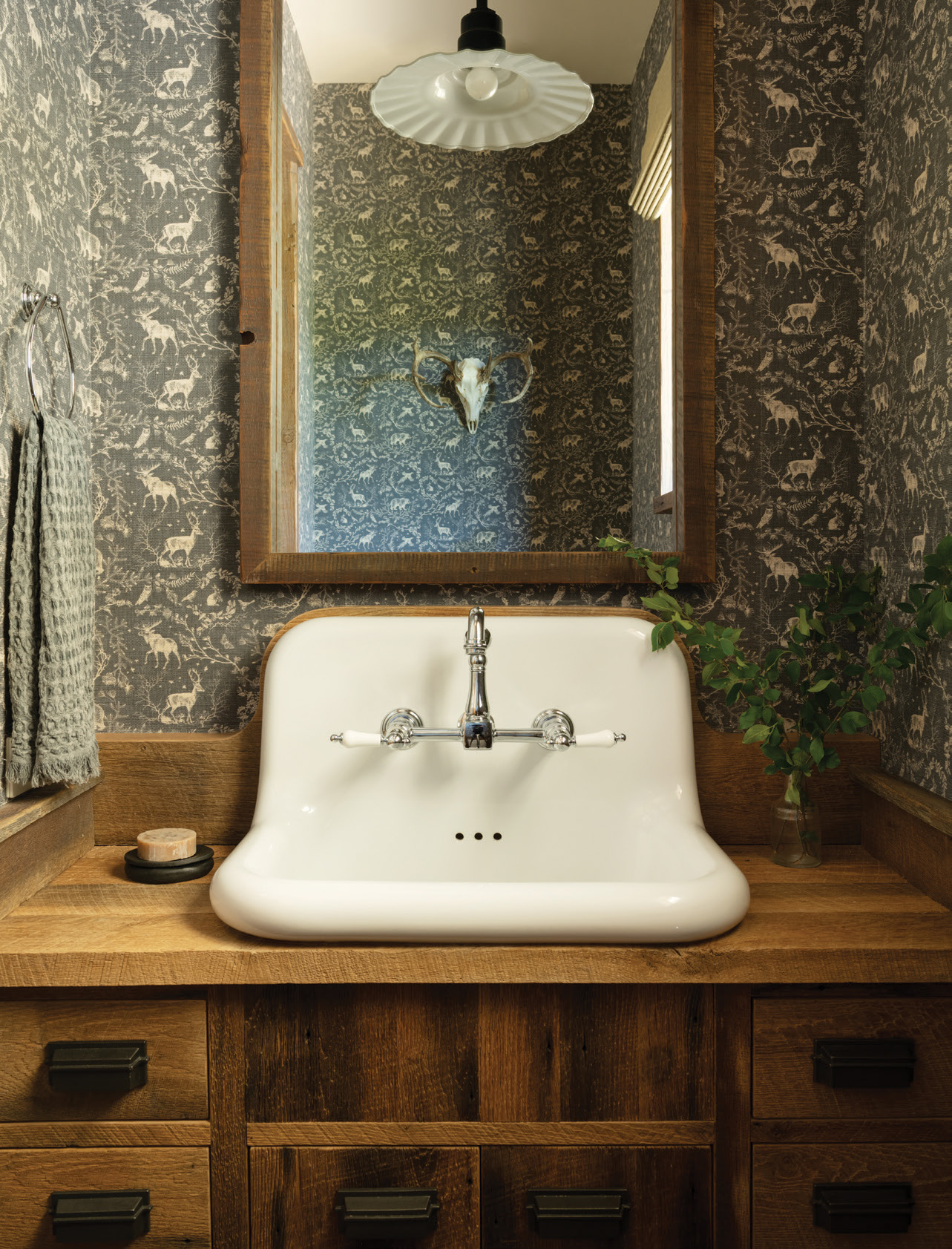
A bathroom channels rustic, country vibes with a vintage-looking sink and wildlife-inspired wallpaper.
The clients live with a pair of dogs, and the dogs rule the roost. “We had to be very aware of dogginess for everything we selected,” Fedro says. “It was fun and very sweet.”
The furnishings are sturdy but have warmth and patina. The farmhouse structure leans toward country antiques, high-quality rugs, and sometimes whimsical wallpapers that speak to the flora and fauna outside the windows. The great room is dominated by reclaimed hewn wood with timber framing, while the adjacent kitchen has plaster walls, a coffered-beam ceiling, and painted cabinets, some with panels of punched tin. The charming guest bathroom has a vintage feel, with beadboard walls and a white porcelain vessel sink atop a custom painted vanity. “The central volume is absolutely turn-of-the-century Montana farmhouse,” Fedro says.
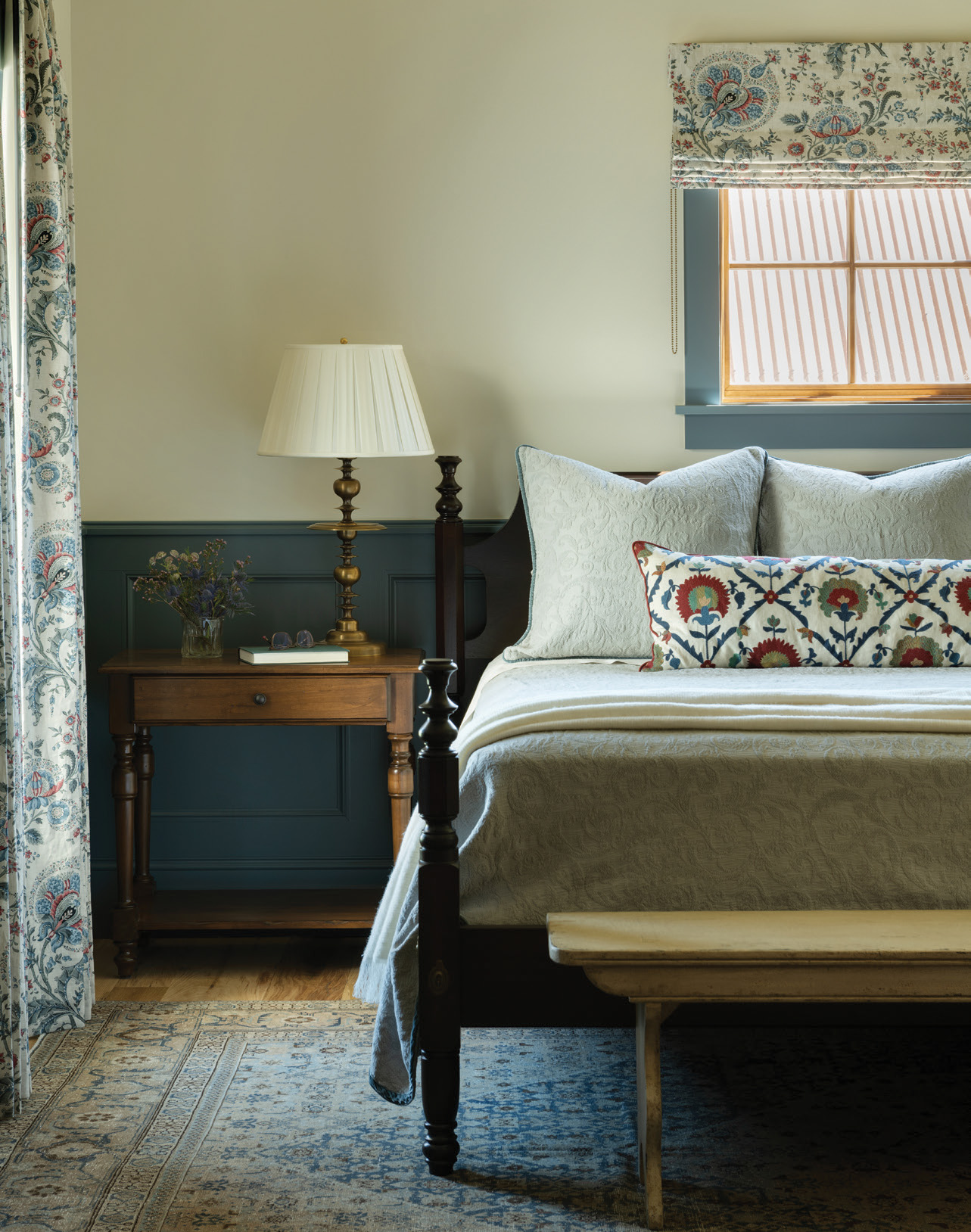
A quiet guest bedroom in the farmhouse invites repose. “When we built the house,” says the owner, “one of my edicts to Laura and the Yellowstone Traditions folks was, whenever possible, to buy things that were made in the U.S.
As one moves away from the main farmhouse structure, the design language changes. On the east end of the home is the primary bedroom and bath — a serene sanctuary with stone walls, a stone fireplace, and a glass wall looking out to the main ranch and mountain views. On the west end of the home, there is an office where the owner manages the working cattle ranch; it has its own entrance for the crew to come and go without having to trail through the house. The office has a rugged, cozy, quiet feel with its stone walls, gas fireplace, and reclaimed hewn timbers and doors. The office interior is dominated by a custom desk and credenza by Yellowstone Traditions’ shop, made from a burled base and a live-edge walnut slab that originated from a tree in Central Park.
The homeowners have found that the house lends itself to both variety and routine as they spend all but the summer months in residence. The owner rouses early to watch the sun rise while drinking coffee in his office. His partner wakes more slowly, with the dogs nearby, watching the world come to life through the big window in their bedroom. The best part might be the sunset, its alpenglow reflected on the Tobacco Root Mountains. And, of course, there’s the wildlife: elk, deer, moose, eagles, antelope, even a mountain lion. “People who come for the first time say it’s like going to a national park,” they say.
To Halvorsen, the scale of the sky was the greatest surprise. “Designing in that vast landscape forces humility,” he says. “We refined rooflines and proportions repeatedly to ensure the architecture felt calm against such an expansive backdrop.” The result, he says, is “a rare architectural dialogue between land and sky.”
Chase Reynolds Ewald has been writing about Western design, food, art, travel, and rustic style for more than 25 years. A consultant, editor, and freelancer, her books include American Rustic; Cabin Style; At Home in the Wine Country; and, with photographer Audrey Hall, the multi-award-winning Bison: Portrait of an Icon. Her latest book, Modern West, was released in 2025; chasereynoldsewald.com.
Whitney Kamman is an architectural photographer based out of Bozeman. Her love for architecture came naturally growing up with an architect father and interior designer mother. Kamman’s work has appeared in The Wall Street Journal, Architectural Digest, Robb Report, and Mountain Living, among others.
No Comments